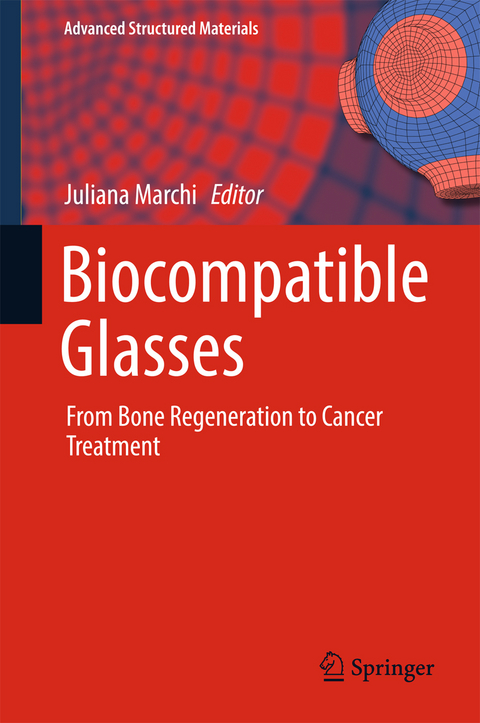
Biocompatible Glasses (eBook)
XIV, 336 Seiten
Springer International Publishing (Verlag)
978-3-319-44249-5 (ISBN)
This book focuses on the applications of bioglasses in the biomedical field. It starts with the history and evolution of bioglasses before moving on to the structure and percolation theory, and lastly investigating their current and potential future applications in various fields including dentistry, tissue engineering, bone regeneration, ophthalmology, and drug delivery. The chapters were written by a team of international experts in the field and will be of great interest not only to material scientists, but also to medical doctors and other health sector professionals.
Foreword 7
Acknowledgments 8
Contents 9
Editor’s Notes 11
1 Bioactive Materials: Definitions and Application in Tissue Engineering and Regeneration Therapy 13
Abstract 13
1 Biomaterials History 13
2 Bioactivity Concept and Bioactive Materials 16
3 Introduction to Stem Cells for Regeneration Therapy 19
4 Bioactive Ceramics and Stem Cells: A Synergistic Approach for Regeneration Therapy 20
4.1 Hydroxyapatite 21
4.2 TCP and Biphasic Calcium Phosphates 22
4.3 Silicate Nanoclay 22
4.4 Bioactive Glass 23
4.5 Polymers and Biomaterials 25
4.6 Emerging Carbon Based Nanomaterials 25
Acknowledgments 26
References 26
2 An Introduction and History of the Bioactive Glasses 30
Abstract 30
1 Bioactive Glasses as Biomaterials 30
2 Implantation and Transplantation 34
3 Elements Required by Human Body 35
4 Design Criteria for Biomaterials/Bioactive Glasses 39
5 Different Types of Bioactive Glasses 40
5.1 Silicate Glasses 41
5.2 Borate/Borosilicate Glasses 41
5.3 Phosphate Glasses 41
5.4 Doped Glasses 42
5.5 Metallic Glasses 42
5.6 Mesoporous Glasses 43
6 History and State of Art of Bioglasses 43
7 Techniques for Bioactive Glass Fabrication 47
8 Conclusions 52
References 52
3 Structure and Percolation of Bioglasses 59
Abstract 59
1 Introduction About Bioglass 59
2 Soda-Lime Silicate and Bioactive Soda-Lime Phosphosilicate Glasses Structure 64
3 Interaction Mechanisms Between Living Tissue and Glasses Soda-Lime Phosphosilicate 77
3.1 Cations and Anions Diffusion Through the Glass Matrix 78
3.2 Glass Network Hydrolysis 85
3.3 Silica Enriched Layer Formation on the Glass Surface 87
3.4 Glass Network Attack by OH-Ions 88
3.5 Ca2+ and PO43? rich film formation in material surface 89
3.6 HA Precipitation on the Material Surface 89
References 91
4 The Evolution, Control, and Effects of the Compositions of Bioactive Glasses on Their Properties and Applications 95
Abstract 95
1 Introduction 95
1.1 Glass Structure 97
1.2 Therapeutic Ion Release 101
2 Composition Effects on Properties and Applications of Bioactive Glasses 102
2.1 Effect of Sodium 104
2.2 Effect of Calcium 105
2.3 Effect of Fluorine 106
2.4 Effects of Strontium 107
2.5 Effect of Zinc 108
2.6 Effect of Magnesium 109
2.7 Effects of Manganese 110
2.8 Effect of Cobalt 111
2.9 Effects of Copper 113
2.10 Effect of Silver 113
2.11 Effects of Gallium 115
2.12 Effect of Cerium 115
3 Summary and Outlook 117
Acknowledgments 117
References 118
5 What Can We Learn from Atomistic Simulations of Bioactive Glasses? 128
Abstract 128
1 Introduction 128
2 How to Obtain the Glass Structure Models: A Brief Overview of Classical and Ab Initio Molecular Dynamics 129
2.1 Classical Molecular Dynamics 129
2.2 Ab Initio Molecular Dynamics 130
2.3 Mixed Classical-AI MD Procedure 131
3 Structural Descriptors for Bioactivity Prediction 131
3.1 The Network Connectivity 131
3.1.1 Strength of the Glass Network 133
3.1.2 Strength of Modifier-Mediated Cross-Link Interactions 133
3.2 Clustering of Network and Modifying Cations 133
4 SiO2-Based Bioactive Glass Systems 134
4.1 Structure of Bioglass 45S5 134
4.2 The Structure–Property Relationships of Substituted Bioactive Glasses 136
4.2.1 Magnesium-Bioactive Glasses 136
4.2.2 Strontium-Bioative Glasses 137
4.2.3 Zinc-Bioactive Glasses 138
Alkali-Free Zinc Bioactive Glasses 139
4.2.4 Fluoride-Bioactive Glasses 140
4.2.5 Gallium/Alluminum Co-Doped Bioactive Glasses 142
4.2.6 Cerium-Bioactive Glasses 143
5 Bioglass Nanoparticles and Surface Reactivity 143
5.1 Glass Surface 143
5.2 Bioglass Nanparticles 144
6 P2O2-Based Bioglass Systems 144
6.1 Fluoride-Bioactive Glasses 145
6.2 Silver-Bioactive Glasses 147
7 Final Remarks 148
References 149
6 Bioactive Glasses: Advancing from Micro to Nano and Its Potential Application 155
Abstract 155
1 Introduction 156
1.1 Origin of Conventional Bioactive Glasses (BG) 156
1.2 Development of Mesoporous Bioactive Glasses (MBG) 157
2 Preparation and Properties of Different Forms of Bioactive Glasses 158
2.1 Synthesis of Bioglasses: From Melt Quenching to Sol–Gel Methods 158
2.2 Fabrication of Bioglasses: From Micro to Nano 159
2.2.1 Bioglasses Particulates for Clinical Use 159
2.2.2 Bioglasses Scaffolds for Bone Regeneration 160
2.2.3 Bioglasses Coatings 163
2.2.4 Bioglasses Fibers 165
2.2.5 Bioglasses Nanoparticles 166
2.3 Ion Substitution of Bioglasses 167
2.4 Bioglasses Composites 170
3 Application Potential of Bioglasses in Tissue Engineering 176
3.1 Drug/Growth Factor Delivery by Bioglasses 176
3.2 Application in Bone/Teeth Regeneration 177
3.3 Application in Soft Tissue Engineering 180
4 Conclusion and Perspective 182
References 183
7 45S5 Bioglass Based Scaffolds for Skeletal Repair 190
Abstract 190
1 Bone Tissue and Skeletal Repair 190
2 Bioceramic Materials for Skeletal Repair 192
3 Therapeutic Potential of Bioactive Glasses 193
3.1 Ionic Dissolution from Vitreous Materials 194
4 Ideal Scaffold for Skeletal Restoration 196
5 Scaffold Synthesis and Processing 197
6 45S5 Bioglass® Based Bone Tissue Scaffolds 199
6.1 Bioglass® Scaffolds Influence on Angiogenesis 205
7 Chapter Summary 206
References 206
8 Vitreous Materials for Dental Restoration and Reconstruction 209
Abstract 209
1 Dental Anatomy and Tooth Restoration 209
2 Skeletal Repair to Support Dental Surgery 211
3 Aqueous Evaluation of Glasses for Dental Restoration 212
4 Bioglass® Based Dental Restorative Materials 214
4.1 Endosseous Ridge Maintenance Implant (ERMI®)—Monolithic Materials 214
4.2 texmath_BoldPerioglas®: 90–710 ?m Glass Particles 215
4.3 texmath_BoldNovamin®: 18 ?m Glass Particles 218
5 Glass Based Adhesive Materials for Dental Restoration 222
5.1 Glass Polyalkenoate Cements (GPCs) 222
5.1.1 Dental Suitability and Applicability 223
5.1.2 The Glass Component of GPCs 223
5.1.3 Bonding of GPC to Mineralized Tissues 226
5.1.4 Resin Modification of GPCs 227
5.2 Non-vitreous Based Cements for Dental Restoration 228
6 Chapter Summary 229
References 229
9 Special Applications of Bioactive Glasses in Otology and Ophthalmology 232
Abstract 232
1 Introduction 233
2 Bonding Mechanism of Bioactive Glasses to Hard and Soft Tissues 234
3 Applications in Otology 237
3.1 Reconstruction of Middle Ear Small Bones 237
3.2 Cochlear Implants 240
3.3 Mastoid Cavity Obliteration 240
4 Applications in Ophthalmology 241
4.1 Orbital Implants 241
4.2 Orbital Floor Repair 244
4.3 Artificial Cornea 246
5 Summary and Outlook 249
References 249
10 Biocompatible Glasses for Cancer Treatment 254
Abstract 254
1 Therapies for Cancer Treatment 254
2 Magnetic Biocompatible Glasses for Hyperthermia Treatment 259
3 Bioacompatible Glasses as Radioisotope Vectors 263
4 Challenges and Perspectives 267
References 268
11 Glasses for Treatment of Liver Cancer by Radioembolization 271
Abstract 271
1 Introduction 271
2 Required Properties of Glass Particles 275
3 Commercial Glass Particles 278
3.1 Glass Synthesis and Properties 278
3.2 TheraSphere® Treatment 280
3.3 TheraSphere® Clinical Benefits 280
3.4 TheraSphere® Clinical Risks 282
3.5 TheraSphere® Side Effects and Limitations 282
4 Non-commercial Glass Particles 282
4.1 Glass Particles Containing 32P 282
4.2 Borate Glass Particles Containing Rhenium 284
5 Summary 286
References 286
12 Biocompatible Glasses for Controlled Release Technology 288
Abstract 288
1 Drugs and Controlled Release: Basic Concepts 288
2 Biocompatible Glasses for Controlled Release Technology 293
2.1 Release of Ions 293
2.2 Release of Bioactive Molecules 298
2.2.1 BM–BG Bond 298
2.2.2 Chemical Composition and Morphology 299
2.2.3 Concentration of BG Within Polymer Matrixes 301
2.3 Glass Morphology in Controlled Release Technology 303
2.4 Particulate Bioactive Glass Used as Composite Materials 303
2.5 Mesoporous and Nanofibers Bioactive Glass 307
3 Examples of Bioactive Glasses Applications in Controlled Release Technology 310
3.1 Bone Regeneration and Osteoporosis 310
3.2 Cancer Treatment 311
3.3 Bactericidal Properties and Osteomyelitis 312
4 Concluding Remarks 313
References 314
13 Future Applications of Bioglass 319
1 Introduction 319
2 Bone Tissue Engineering and Regenerative Medicine 320
2.1 Prospective Improvisations 321
2.2 Mechanical Strength 322
2.3 Vascularity 322
2.4 Function 322
2.5 Ion Release 323
2.6 Sterilization 323
3 Angiogenesis 324
4 Stimulation and Interaction with Human Mesenchymal Stem Cells 325
5 Cytotoxicity of Silica, for Prospective Use in Cancer 325
6 Dental Applications 327
6.1 Graft Material [12, 13] 328
6.2 Endosseous Implants 328
6.3 Demineralizing Agent 329
6.4 Antibacterial Activity 329
6.5 Periodontal Tissue Engineering 329
6.6 Bioglass in Glass Ionomer Cement 330
7 Gene Therapy Applications 331
8 Drug Delivery, Ionic Release via Phosphate Glass Vehicles 332
8.1 Drug Delivery 332
9 Neurite Regeneration by Phosphate Glass Fibres 333
10 Toxicity 333
11 Conclusion 334
References 335
| Erscheint lt. Verlag | 30.11.2016 |
|---|---|
| Reihe/Serie | Advanced Structured Materials | Advanced Structured Materials |
| Zusatzinfo | XIV, 336 p. 126 illus., 87 illus. in color. |
| Verlagsort | Cham |
| Sprache | englisch |
| Themenwelt | Technik ► Maschinenbau |
| Schlagworte | Bioglass 45s5 • Bioglass 8625 • Bone Growth • Bone healing • bone regeneration • Drug Delivery • glass-ceramics • Tissue engineering |
| ISBN-10 | 3-319-44249-X / 331944249X |
| ISBN-13 | 978-3-319-44249-5 / 9783319442495 |
| Informationen gemäß Produktsicherheitsverordnung (GPSR) | |
| Haben Sie eine Frage zum Produkt? |
 PDF (Wasserzeichen)
DRM: Digitales Wasserzeichen
Dieses eBook enthält ein digitales Wasserzeichen und ist damit für Sie personalisiert. Bei einer missbräuchlichen Weitergabe des eBooks an Dritte ist eine Rückverfolgung an die Quelle möglich.
Dateiformat: PDF (Portable Document Format)
Mit einem festen Seitenlayout eignet sich die PDF besonders für Fachbücher mit Spalten, Tabellen und Abbildungen. Eine PDF kann auf fast allen Geräten angezeigt werden, ist aber für kleine Displays (Smartphone, eReader) nur eingeschränkt geeignet.
Systemvoraussetzungen:
PC/Mac: Mit einem PC oder Mac können Sie dieses eBook lesen. Sie benötigen dafür einen PDF-Viewer - z.B. den Adobe Reader oder Adobe Digital Editions.
eReader: Dieses eBook kann mit (fast) allen eBook-Readern gelesen werden. Mit dem amazon-Kindle ist es aber nicht kompatibel.
Smartphone/Tablet: Egal ob Apple oder Android, dieses eBook können Sie lesen. Sie benötigen dafür einen PDF-Viewer - z.B. die kostenlose Adobe Digital Editions-App.
Buying eBooks from abroad
For tax law reasons we can sell eBooks just within Germany and Switzerland. Regrettably we cannot fulfill eBook-orders from other countries.
aus dem Bereich