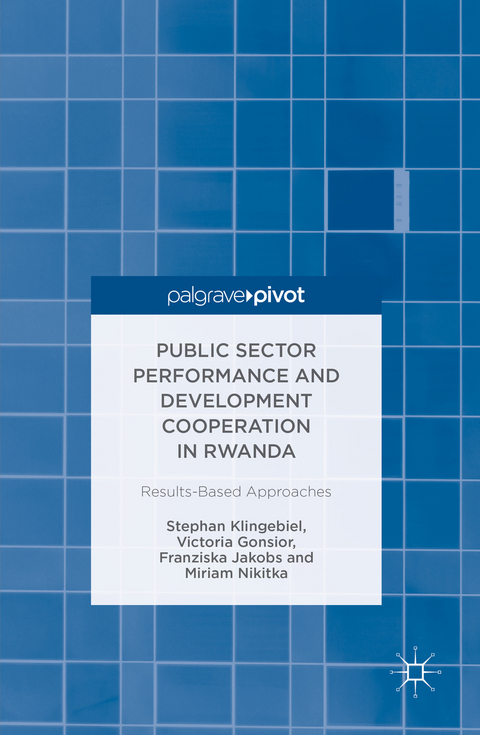
Public Sector Performance and Development Cooperation in Rwanda (eBook)
XII, 96 Seiten
Springer International Publishing (Verlag)
978-3-319-42144-5 (ISBN)
This study provides a conceptual framework for analysing Results-Based Approaches to improving public sector effectiveness and efficiency according to their actor constellation and shared characteristics. Though the importance of functioning public sector agencies and organizations for sustainable development is accepted, public sector reform efforts have achieved only modest success. Results-Based Approaches aim at improving public sector performance through the establishment of reward modalities on the domestic and international levels, and the authors evaluate the potential of these approaches to provide an entry point for development cooperation. Applying their framework to empirical data obtained from fieldwork in Rwanda, they analyse the main domestic performance approach - Imhigo - and suggest how this might be strengthened.
Stephan Klingebiel is Department Head (Bilateral and Multilateral Development Policy) at the German Development Institute / Deutsches Institut für Entwicklungspolitik (DIE). His research focuses on political economy of aid, aid and development effectiveness, political economy and governance issues in sub-Saharan Africa, and crisis prevention and conflict management.
Victoria Gonsior is a consultant for Public Finance Management at GFA Consulting Group. She participated in the Postgraduate Training Programme and worked as a researcher at the German Development Institute. Her research concentrates on development economics with a focus on public finance.
Franziska Jakobs is a consultant for Governance at GFA Consulting Group, Germany. She completed the Postgraduate Training Programme and worked as a researcher at the German Development Institute. Her research mainly focuses on good governance issues, in particular decentralization, public service delivery and local governance.
Miriam Nikitka is a consultant in the Monitoring & Evaluation Unit at GFA Consulting Group. She participated in the Postgraduate Training Programme at the German Development Institute. Her research concentrates on results-based approaches, results-oriented monitoring and complex strategic evaluations.
Stephan Klingebiel is Department Head (Bilateral and Multilateral Development Policy) at the German Development Institute / Deutsches Institut für Entwicklungspolitik (DIE). His research focuses on political economy of aid, aid and development effectiveness, political economy and governance issues in sub-Saharan Africa, and crisis prevention and conflict management.Victoria Gonsior is a consultant for Public Finance Management at GFA Consulting Group. She participated in the Postgraduate Training Programme and worked as a researcher at the German Development Institute. Her research concentrates on development economics with a focus on public finance.Franziska Jakobs is a consultant for Governance at GFA Consulting Group, Germany. She completed the Postgraduate Training Programme and worked as a researcher at the German Development Institute. Her research mainly focuses on good governance issues, in particular decentralization, public service delivery and local governance.Miriam Nikitka is a consultant in the Monitoring & Evaluation Unit at GFA Consulting Group. She participated in the Postgraduate Training Programme at the German Development Institute. Her research concentrates on results-based approaches, results-oriented monitoring and complex strategic evaluations.
Abbreviations............................................................................................................................. IVContents..................................................................................................................................... VIBoxes, Figures and Tables........................................................................................................ VIIAbstract....................................................................................................................................... 11. Introduction......................................................................................................................... 21.1. Conceptual Background and Purpose of the Study....................................................... 21.2. Case Selection: Rwanda´s DPA - Imihigo...................................................................... 31.3. Research Design and Used Methods............................................................................ 41.4. Outline of the Report.................................................................................................... 82. Theoretical Framework: RBApps......................................................................................... 82.1. Conceptual Debates...................................................................................................... 82.1.1. Performance as in Public Sector Reform/New Public Management.................... 92.1.2. Results as in Development Cooperation and Aid Effectiveness.......................... 102.2. The Concept RBApp.................................................................................................... 122.2.1. Actor Constellations............................................................................................. 122.2.2. Characteristics..................................................................................................... 142.3. RBApps and the Usage of Country Systems................................................................ 172.4. Critique, Challenges and Limitations of RBApps........................................................ 182.4.1. RBApps and development cooperation................................................................ 182.4.2. Performance indicators....................................................................................... 192.4.3. Incentive schemes................................................................................................ 202.5. Concluding Remarks................................................................................................... 213. Case Study: Imihigo – a Traditional Rwandan Concept as a RBApp................................. 223.1. Country Context.......................................................................................................... 233.2. Actor Constellation..................................................................................................... 263.2.1. Responsibilities at the Central and the District Level.......................................... 273.2.2. Discussions........................................................................................................... 323.3. Characteristics............................................................................................................ 333.3.1. Target Setting....................................................................................................... 333.3.2. Monitoring, Evaluation and Verification............................................................. 363.3.3. Reward Mechanism............................................................................................. 393.4. Concluding Remarks................................................................................................... 414. Imihigo and Development Cooperation: What kind of relationship?............................... 434.1. The Rwandan Aid Policy.............................................................................................. 434.2. Imihigo: a Country System for Development Cooperation?....................................... 445. Final Conclusion................................................................................................................. 49References................................................................................................................................... I
| Erscheint lt. Verlag | 30.11.2016 |
|---|---|
| Zusatzinfo | XII, 96 p. 5 illus. in color. |
| Verlagsort | Cham |
| Sprache | englisch |
| Themenwelt | Sozialwissenschaften ► Politik / Verwaltung |
| Sozialwissenschaften ► Soziologie | |
| Technik | |
| Schlagworte | Actor Constellations • aid effectiveness • decentralisation • Development cooperation • Development Policy • Imhigo • Incentive schemes • Monitoring • New Public Management • performance indicators • Political Science and International Relations • Public sector effectiveness • Public sector reform • R-BApps • Reward modalities • Rwanda • sustainable development • target setting |
| ISBN-10 | 3-319-42144-1 / 3319421441 |
| ISBN-13 | 978-3-319-42144-5 / 9783319421445 |
| Informationen gemäß Produktsicherheitsverordnung (GPSR) | |
| Haben Sie eine Frage zum Produkt? |
 PDF (Wasserzeichen)
DRM: Digitales Wasserzeichen
Dieses eBook enthält ein digitales Wasserzeichen und ist damit für Sie personalisiert. Bei einer missbräuchlichen Weitergabe des eBooks an Dritte ist eine Rückverfolgung an die Quelle möglich.
Dateiformat: PDF (Portable Document Format)
Mit einem festen Seitenlayout eignet sich die PDF besonders für Fachbücher mit Spalten, Tabellen und Abbildungen. Eine PDF kann auf fast allen Geräten angezeigt werden, ist aber für kleine Displays (Smartphone, eReader) nur eingeschränkt geeignet.
Systemvoraussetzungen:
PC/Mac: Mit einem PC oder Mac können Sie dieses eBook lesen. Sie benötigen dafür einen PDF-Viewer - z.B. den Adobe Reader oder Adobe Digital Editions.
eReader: Dieses eBook kann mit (fast) allen eBook-Readern gelesen werden. Mit dem amazon-Kindle ist es aber nicht kompatibel.
Smartphone/Tablet: Egal ob Apple oder Android, dieses eBook können Sie lesen. Sie benötigen dafür einen PDF-Viewer - z.B. die kostenlose Adobe Digital Editions-App.
Buying eBooks from abroad
For tax law reasons we can sell eBooks just within Germany and Switzerland. Regrettably we cannot fulfill eBook-orders from other countries.
aus dem Bereich