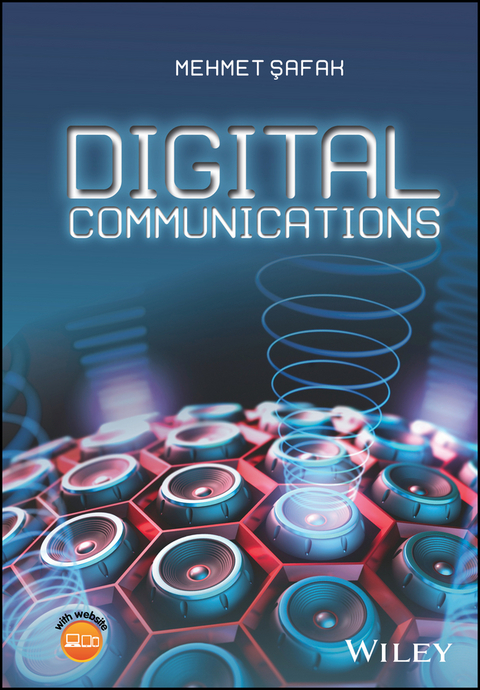
Digital Communications (eBook)
John Wiley & Sons (Verlag)
978-1-119-09127-1 (ISBN)
This is a modern textbook on digital communications and is designed for senior undergraduate and graduate students, whilst also providing a valuable reference for those working in the telecommunications industry. It provides a simple and thorough access to a wide range of topics through use of figures, tables, examples and problem sets. The author provides an integrated approach between RF engineering and statistical theory of communications. Intuitive explanations of the theoretical and practical aspects of telecommunications help the reader to acquire a deeper understanding of the topics. The book covers the fundamentals of antennas, channel modelling, receiver system noise, A/D conversion of signals, PCM, baseband transmission, optimum receiver, modulation techniques, error control coding, OFDM, fading channels, diversity and combining techniques, MIMO systems and cooperative communications. It will be an essential reference for all students and practitioners in the electrical engineering field.
Professor Mehmet Safak, Hacettepe University, Ankara, Turkey. Professor Safak achieved his PhD on the topic of Antennas, and he taught electromagnetic theory and antennas before joining NATO in the Hague, Netherlands, where he worked on military satellite communications. Following this wide and multi-disciplined exposure, Safak returned to academia and taught courses in digital communications. He is currently a member of the CONASENSE Foundation which studies visionary projects in Communications, Navigation, Sensors and Services. Teaching and supervising remain his priority, however, and this book is the result of many years' lecture work, plus the most recent research outcomes.
Preface
1. Signal Analysis
2. Antennas
3. Channel Modeling
4. Receiver System Noise
5. Pulse Modulation
6. Baseband Transmission
7. Optimum Receiver in AWGN Channel
8. Passband Modulation Techniques
9. Error Control Coding
10. Broadband Transmission Techniques
11. Fading Channels
12. Diversity and Combining Techniques
13. MIMO Systems
14. Cooperative Communications
15. Appendix A Vector Calculus in Spherical Coordinates
Appendix B Gaussian Q Function
Appendix C Fourier Transforms
Appendix D Mathematical Tools
Appendix E The Wishart Distribution
Appendix F Probability and Random Variables
Preface
Telecommunications is a rapidly evolving area of electrical engineering, encompassing diverse areas of applications, including RF communications, radar systems, ad‐hoc networks, sensor networks, optical communications, radioastronomy, and so on. Therefore, a solid background is needed on numerous topics of electrical engineering, including calculus, antennas, wave propagation, signals and systems, random variables and stochastic processes and digital signal processing. In view of the above, the success in the telecommunications education depends on the background of the student in these topics and how these topics are covered in the curriculum. For example, the Fourier transform may not usually be taught in relation with time‐ and frequency‐response of the systems. Similarly, concepts of probabiliy may not be related to random signals. On the other hand, students studying telecommunications may not be expected to know the details of the Maxwell’s equations and wave propagation. However, in view of the fact that wireless communication systems comprise transmit/receive antennas and a propagation medium, it is necessary to have a clear understanding of the radiation by the transmit antenna, propagation of electromagnetic waves in the considered channel and the reception of electromagnetic waves by the receive antenna. Otherwise, the students may face difficulties in understanding the telecommunications process in the physical layer.
The engineering education requires a careful tradeoff between the rigour provided by the theory and the simple exposure of the corresponding physical phenomena and their applications in our daily life. Therefore, the book aims to help the students to understand the basic principles and to apply them. Basic principles and analytical tools are provided for the design of communication systems, illustrated with examples, and supported by graphical illustrations.
The book is designed to meet the needs of electrical engineering students at undergraduate and graduate levels, and those of researchers and practicing engineers. Though the book is on digital communications, many concepts and approaches presented in the book are also applicable for analog communication systems. The students are assumed to have basic knowledge of Maxwell’s equations, calculus, matrix theory, probability and stochastic processes, signals and systems and digital signal processing. Mathematical tools required for understanding some topics are incorporated in the relevant chapters or are presented in the appendices. Each chapter contains graphical illustrations, figures, examples, references, and problems for better understanding the exposed concepts.
Chapter 1 Signal Analysis summarizes the time‐frequency relationship and basic concepts of Fourier transform for deterministic and random signals used in the linear systems. The aim was to provide a handy reference and to avoid repeating the same basic concepts in the subsequent chapters. Chapter 2 Antennas presents the fundamentals of the antenna theory with emphasis on the telecommunication aspects rather than on the Maxwell’s equations. Chapter 3 Channel Modeling presents the propagation processes following the conversion of the electrical signals in the transmitter into electromagnetic waves by the transmit antenna until they are reconverted into electrical signals by the receive antenna. Chapter 4 System Noise is mainly based on the standards for determining the receiver noise of internal and external origin and provides tools for calculating SNR at the receiver output; the SNR is known to be the figure‐of‐merit of communication systems since it determines the system performance. Chapters 2, 3 and 4 thus relate the wireless interaction between transmitter and receiver in the physical layer. It may be worth mentioning that, unlike many books on wireless communications, covering only VHF and UHF bands, Chapters 2, 3 and 4 extend the coverage of antennas, receiver noise and channel modeling to SHF and EHF bands. A thorough understanding of the materials provided in these chapters is believed to be critical for deeper understanding of the rest of the book. These three chapters are believed to close the gap between the approaches usually followed by books on antennas and RF propagation, based on the Maxwell’s equations, and the books on digital communications, based on statistical theory of communications. One of the aims of the book is to help the students to fuse these two complementary approaches.
The following chapters are dedicated to statistical theory of digital communications. Chapter 4 Pulse Modulation treats the conversion of analog signals into digital for digital communication systems. Sampling, quantization and encoding tradeoffs are presented, line codes used for pulse transmission are related to the transmission bandwidth. Time division multiplexing (TDM) allows multiple digital signals to be transmitted as a single signal. At the receiver they are reconverted into analog for the end user. PCM and other pulse modulations as well as audio and video coding techniques are also presented. Chapter 5 Baseband Modulation focuses on the optimal reception of pulse modulated signals and intersymbol interference (ISI) between pulses, due to filtering so as to limit the transmission bandwidth or to minimize the received noise power. In an AWGN channel, the optimum receiver maximizes the output SNR by matching the receive filter characteristics to those of the transmitter. The optimal choice of pulse shape, for example, Nyquist, raised‐cosine, or correlative‐level coding (partial‐response signaling) is also presented in order to mitigate the ISI. Chapter 7 Optimum Receiver in AWGN Channels is focused on the geometric representation of the signals so as to be able to identify the two functionalities (demodulation and detection) of an optimum receiver. Based on this approach, derivation of the bit error probability (BEP) is presented and upper bounds are provided when the BEP can not be obtained exactly. Chapter 8 Passband Modulation Techniques starts with the definition of bandwidth and the bandwidth efficiency, followed by the synchronization (in frequency, phase and symbol timing) between transmitted and received symbols. The PSD, bandwidth and power efficiencies and bit/symbol error probabilities are derived for M‐ary coherent, differentially coherent and noncoherent modulations, for example, M‐ary PSK, M‐ary ASK, M‐ary FSK, M‐ary QAM and M‐ary DPSK. This chapter also provides a comparasion of spectrum and power efficiencies of the above‐cited passband modulation techniques. Chapter 9 Error Control Coding presents the principles of channel coding in order to control (detect and/or correct) Gaussian (random) and burst errors occuring in the channel due to noise, fading, shadowing and other potential sources of interference. Source coding is not addressed in the book. Channel coding usually comes at the expense of increased transmission rate, hence wider transmission bandwidth, due to the inclusion of additional (parity check) bits among the data bits. Use of parity check bits reduces energy per channel bits and hence leads to higher channel BEP. However, a good code is expected to correct more errors than it creates and the overall coded BEP decreases at the expense of increased transmission bandwidth. This tradeoff between the BEP and the transmission bandwidth is well‐known in the coding theory. As shown by the Shannon capacity theorem, one can achieve error‐free communications as the transmission bandwidth goes to infinity, that is, by using infinitely many parity check bits, as long as the ratio of the energy per bit to noise PSD (Eb/N0) is higher than −1.6 dB. This chapter addresses block and convolutional codes which are capable of correcting random and burst‐errors. Automatic‐repeat request (ARQ) techniques based on error‐detection codes and hybrid ARQ (HARQ) techniques exploiting codes which can both detect and correct channel bit errors are also presented. Chapter 10 Broadband Transmission Techniques is composed of mainly two sections, namely spread‐spectrum (SS) and the orthogonal frequency division multiplexing (OFDM). SS and OFDM provide alternative approaches for transmission of multi‐user signals over wide transmission bandwidths. In SS, spread multi‐user signals are distinguished from each other by orthogonal codes, while, in OFDM, narrowband multi‐user signals are transmitted with different orthogonal subcarriers. The chapter is focused on two versions of SS, namely the direct sequence (DS) SS and frequency‐hopping (FH) SS. Intercarrier‐ and intersymbol‐interference, channel estimation and synchronization, adaptive modulation and coding, peak‐to‐average power ratio, and multiple access in up‐ and down‐links of OFDM systems are also presented. Chapter 11 Fading Channels accounts for the effects of multipath propagation and shadowing. Fading channels are usually characterized by delay and Doppler spread of the received signals. The fading may be slow or fast, frequency‐flat or frequency‐selective. If the receiver can not collect coherently all the incoming signal components spread in time and frequency, then the received signal power level will be decreased drastically, hence leading to sigificant performance losses. This...
| Erscheint lt. Verlag | 17.1.2017 |
|---|---|
| Sprache | englisch |
| Themenwelt | Technik ► Elektrotechnik / Energietechnik |
| Technik ► Nachrichtentechnik | |
| Schlagworte | Antennas & Propagation • Communication technology • Digital Communications<br />RF Engineering<br />Antennas • Drahtlose Kommunikation • Electrical & Electronics Engineering • Elektrotechnik u. Elektronik • Kommunikationstechnik • Mobile & Wireless Communications • Sende- u. Empfangseinrichtungen |
| ISBN-10 | 1-119-09127-6 / 1119091276 |
| ISBN-13 | 978-1-119-09127-1 / 9781119091271 |
| Informationen gemäß Produktsicherheitsverordnung (GPSR) | |
| Haben Sie eine Frage zum Produkt? |
 EPUB (Adobe DRM)
Kopierschutz: Adobe-DRM
Adobe-DRM ist ein Kopierschutz, der das eBook vor Mißbrauch schützen soll. Dabei wird das eBook bereits beim Download auf Ihre persönliche Adobe-ID autorisiert. Lesen können Sie das eBook dann nur auf den Geräten, welche ebenfalls auf Ihre Adobe-ID registriert sind.
Details zum Adobe-DRM
Dateiformat: EPUB (Electronic Publication)
EPUB ist ein offener Standard für eBooks und eignet sich besonders zur Darstellung von Belletristik und Sachbüchern. Der Fließtext wird dynamisch an die Display- und Schriftgröße angepasst. Auch für mobile Lesegeräte ist EPUB daher gut geeignet.
Systemvoraussetzungen:
PC/Mac: Mit einem PC oder Mac können Sie dieses eBook lesen. Sie benötigen eine
eReader: Dieses eBook kann mit (fast) allen eBook-Readern gelesen werden. Mit dem amazon-Kindle ist es aber nicht kompatibel.
Smartphone/Tablet: Egal ob Apple oder Android, dieses eBook können Sie lesen. Sie benötigen eine
Geräteliste und zusätzliche Hinweise
Buying eBooks from abroad
For tax law reasons we can sell eBooks just within Germany and Switzerland. Regrettably we cannot fulfill eBook-orders from other countries.
aus dem Bereich