


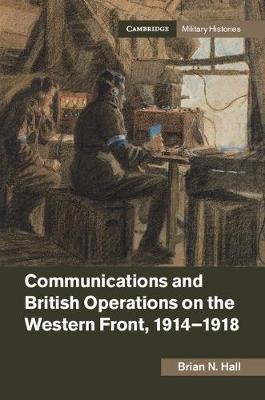
Communications and British Operations on the Western Front, 1914–1918
Seiten
2017
Cambridge University Press (Verlag)
978-1-107-17055-1 (ISBN)
Cambridge University Press (Verlag)
978-1-107-17055-1 (ISBN)
This is a major new study of the role of communications in shaping the outcome of British military operations on the Western Front during World War 1. It argues that communications were not only a leading cause of the trench stalemate of 1915–17, but were also crucial in helping break the deadlock in 1918.
This is an important new study examining the military operations of the British Expeditionary Force in 1914–18 through the lens of its communications system. Brian Hall charts how new communications technology such as wireless, telephone and telegraph were used alongside visual signalling, carrier pigeons and runners as the British army struggled to develop a communication system adequate enough to wage modern warfare. He reveals how tenuous communications added to the difficulties of command and control during the war's early years, and examines their role during the major battles of the Somme, Arras, Ypres and Cambrai. It was only in 1918 that the British army would finally develop a flexible and sophisticated communications system capable of effectively coordinating infantry, artillery, tanks and aeroplanes. This is a major contribution to our understanding of British military operations during the First World War, the learning processes of armies and the revolution in military affairs.
This is an important new study examining the military operations of the British Expeditionary Force in 1914–18 through the lens of its communications system. Brian Hall charts how new communications technology such as wireless, telephone and telegraph were used alongside visual signalling, carrier pigeons and runners as the British army struggled to develop a communication system adequate enough to wage modern warfare. He reveals how tenuous communications added to the difficulties of command and control during the war's early years, and examines their role during the major battles of the Somme, Arras, Ypres and Cambrai. It was only in 1918 that the British army would finally develop a flexible and sophisticated communications system capable of effectively coordinating infantry, artillery, tanks and aeroplanes. This is a major contribution to our understanding of British military operations during the First World War, the learning processes of armies and the revolution in military affairs.
Brian N. Hall is a Lecturer in Contemporary Military History at the University of Salford.
1. Organisation; 2. Personnel, recruitment and training; 3. Means of communication; 4. 1914–15; 5. 1916; 6. 1917; 7. 1918; Conclusion.
| Erscheinungsdatum | 23.06.2017 |
|---|---|
| Reihe/Serie | Cambridge Military Histories |
| Zusatzinfo | Worked examples or Exercises; 5 Tables, black and white; 1 Maps; 15 Halftones, black and white; 18 Line drawings, black and white |
| Verlagsort | Cambridge |
| Sprache | englisch |
| Maße | 160 x 235 mm |
| Gewicht | 710 g |
| Themenwelt | Geschichte ► Allgemeine Geschichte ► Neuzeit (bis 1918) |
| Geschichte ► Allgemeine Geschichte ► 1918 bis 1945 | |
| Geschichte ► Teilgebiete der Geschichte ► Militärgeschichte | |
| Technik | |
| ISBN-10 | 1-107-17055-9 / 1107170559 |
| ISBN-13 | 978-1-107-17055-1 / 9781107170551 |
| Zustand | Neuware |
| Informationen gemäß Produktsicherheitsverordnung (GPSR) | |
| Haben Sie eine Frage zum Produkt? |
Mehr entdecken
aus dem Bereich


aus dem Bereich
Geschichte einer wilden Handlung
Buch | Hardcover (2024)
C.H.Beck (Verlag)
CHF 47,60


