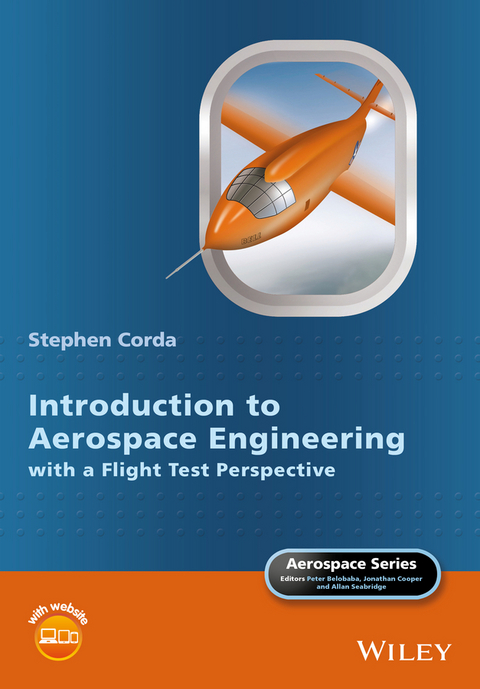
Introduction to Aerospace Engineering with a Flight Test Perspective (eBook)
John Wiley & Sons (Verlag)
978-1-118-95337-2 (ISBN)
Comprehensive textbook which introduces the fundamentals of aerospace engineering with a flight test perspective
Introduction to Aerospace Engineering with a Flight Test Perspective is an introductory level text in aerospace engineering with a unique flight test perspective. Flight test, where dreams of aircraft and space vehicles actually take to the sky, is the bottom line in the application of aerospace engineering theories and principles. Designing and flying the real machines are often the reasons that these theories and principles were developed. This book provides a solid foundation in many of the fundamentals of aerospace engineering, while illuminating many aspects of real-world flight. Fundamental aerospace engineering subjects that are covered include aerodynamics, propulsion, performance, and stability and control.
Key features:
- Covers aerodynamics, propulsion, performance, and stability and control.
- Includes self-contained sections on ground and flight test techniques.
- Includes worked example problems and homework problems.
- Suitable for introductory courses on Aerospace Engineering.
- Excellent resource for courses on flight testing.
Introduction to Aerospace Engineering with a Flight Test Perspective is essential reading for undergraduate and graduate students in aerospace engineering, as well as practitioners in industry. It is an exciting and illuminating read for the aviation enthusiast seeking deeper understanding of flying machines and flight test.
Stephen Corda has BS, MS, and PhD degrees in Aerospace Engineering from the University of Maryland and an Aeronautics Diploma from the Von Karman Institute for Fluid Dynamics in Belgium. The material for this textbook is derived from the author's 30 years of experience as an aerospace engineer, flight test engineer, flight research pilot, and educator at the NASA Armstrong Flight Research Center, The Johns Hopkins University Applied Physics Laboratory, the U.S. Air Force Test Pilot School, the U.S. Naval Academy, the University of Tennessee Space Institute, and Virgin Galactic-The Spaceship Company. He is currently an aerospace engineering consultant, living in California.
Stephen Corda has BS, MS, and PhD degrees in Aerospace Engineering from the University of Maryland and an Aeronautics Diploma from the Von Karman Institute for Fluid Dynamics in Belgium. The material for this textbook is derived from the author's 30 years of experience as an aerospace engineer, flight test engineer, flight research pilot, and educator at the NASA Armstrong Flight Research Center, The Johns Hopkins University Applied Physics Laboratory, the U.S. Air Force Test Pilot School, the U.S. Naval Academy, the University of Tennessee Space Institute, and Virgin Galactic-The Spaceship Company. He is currently an aerospace engineering consultant, living in California.
Chapter 1
First Flights
The first controlled flight of a heavier-than-air airplane, 17 December 1903.
(Source: W. Wright, O. Wright, and J. Daniels, 1903, US Library of Congress.)
“Wilbur, having used his turn in the unsuccessful attempt on the 14th, the right to the first trial now belonged to me. After running the motor a few minutes to heat it up, I released the wire that held the machine to the track, and the machine started forward in the wind. Wilbur ran at the side of the machine, holding the wing to balance it on the track. Unlike the start on the 14th, made in a calm, the machine, facing a 27-mile wind, started very slowly. Wilbur was able to stay with it till it lifted from the track after a forty-foot run. One of the Life Saving men snapped the camera for us, taking a picture just as the machine had reached the end of the track and had risen to a height of about two feet.1 The slow forward speed of the machine over the ground is clearly shown in the picture by Wilbur's attitude. He stayed along beside the machine without any effort.
The course of the flight up and down was exceedingly erratic, partly due to the irregularity of the air, and partly to lack of experience in handling this machine. The control of the front rudder was difficult on account of its being balanced too near the center. This gave it a tendency to turn itself when started; so that it turned too far on one side and then too far on the other. As a result the machine would rise suddenly to about ten feet, and then as suddenly dart for the ground. A sudden dart when a little over a hundred feet from the end of the track, or a little over 120 ft from the point at which it rose into the air, ended the flight. As the velocity of the wind was over 35 ft per second and the speed of the machine over the ground against this wind ten feet per second, the speed of the machine relative to the air was over 45 ft per second, and the length of the flight was equivalent to a flight of 540 feet made in calm air. This flight lasted only 12 seconds, but it was nevertheless the first in the history of the world in which a machine carrying a man had raised itself by its own power into the air in full flight, had sailed forward without reduction of speed and had finally landed at a point as high as that from which it started.”
Orville Wright writing about the first successful flight of a heavier-than-air flying machine from Kill Devil Hills, North Carolina, on 17 December, 19032
1.1 Introduction
The history of aerospace engineering is full of firsts, such as the first balloon flight, the first airplane flight, the first helicopter flight, the2 first artificial satellite flight, the first manned spacecraft flight, and many others. In this first chapter, these many firsts are discussed in the context of the aerospace engineering involved in making these historic events happen. The first flight of a new vehicle design is a significant achievement and milestone. It is usually the culmination of years of hard work by many people, including engineers, technicians, managers, pilots, and other support personnel. First flights often represent firsts in the application of new aerospace engineering concepts or theories that are being validated by the actual flight.
As an aerospace engineer, you have the opportunity to contribute to the first flight of a new aircraft, a new spacecraft, or a new technology. Aerospace engineers are involved in all facets of the design, analysis, research, development, and testing of aerospace vehicles. This encompasses many different aerospace engineering discipline specialties, including aerodynamics, propulsion, performance, stability, control, structures, systems, and others. Several of these fundamental disciplines of aerospace engineering are introduced in this text. The aerospace engineer tests the vehicle, on the ground and in flight, to verify that it can perform as predicted and to improve its operating characteristics. Flight testing is usually the final test to be performed on the complete vehicle or system.
In many areas of engineering and technology, there is sometimes a perception that there is “nothing left to be done”, or that “there is nothing left to be invented”. The impressive successes of our aerospace past may appear, to some, to dim the prospects for future innovations. Aerospace engineers have indeed designed, built, and flown some of the most innovative, complex, and amazing machines known to humanity. However, there is still ample room for creativity and innovation in the design of aerospace vehicles, and opportunities for technological breakthroughs to make the skies and stars far more accessible. By the end of this textbook, you will have greatly increased your knowledge of aerospace engineering, but you will also be humbled by how much more there is to be discovered.
1.1.1 Organization of the Book
Aerospace engineering encompasses the fields of aeronautical and astronautical engineering. As a broad generalization, the aeronautical field tends to deal with vehicles that fly through the sensible atmosphere, that is, aircraft. Astronautics deals with vehicles that operate in the airless space environment, that is, spacecraft. Aerospace engineering is, in many ways, a merging of these two fields, and includes aircraft, spacecraft, and other vehicles that operate in both the air and space environments. In the coming sections, we get more precise with the definitions of the various types of aerospace vehicles, such as aircraft and spacecraft.
The material in the text is organized in an academic building-block fashion as shown in Figure 1.1. In Chapter 1, we start by defining and discussing some of the many different types of aircraft and spacecraft. Many first flights of these different types of aerospace vehicles are described, providing insights and perspectives into the development and evolution of aerospace engineering. The terms aircraft and spacecraft are clearly defined, along with definitions of the various parts, components, and assemblies that make up various examples of these types of vehicles. The reader also makes a literary “first flight” in a modern, supersonic jet airplane, which introduces many of the areas to be discussed in the coming chapters.
Figure 1.1 Academic building blocks followed in the text.
In Chapter 2, several introductory concepts in aerospace engineering and flight test are discussed. This chapter gives the reader some of the basic concepts and terminology, in aerospace engineering and flight test, from which to learn the material in the subsequent chapters. Some basic mathematical ideas, definitions, and concepts are reviewed, which starts to fill our engineering toolbox with the basic tools required to analyze and design aerospace vehicles. Basic aerospace engineering concepts, relating to the flight of aerospace vehicles, are introduced, including aircraft axis systems, free-body diagrams, the regimes of flight, and the flight envelope. Basic flight test concepts are introduced, including the different types of flight test, the flight test process, the players involved, and the use of flight test techniques.
The fundamental disciplines of aerodynamics and propulsion are discussed in Chapters 3 and 4, respectively. The study of aerodynamics, in Chapter 3, provides the theories and tools required to analyze the flow of air over aerospace vehicles, the flow that produces aerodynamic forces such as lift and drag. We discover how and why these aerodynamic forces are created, and how this affects the design of aerodynamic surfaces such as airfoils and wings. In studying propulsion in Chapter 4, we learn about the devices that generate the thrust force to propel aerospace vehicles both in the atmosphere and in space. We develop a deeper understanding of how thrust is produced, regardless of the type of machinery that is used.
The study of performance, in Chapter 5, builds upon an understanding of aerodynamics and propulsion, as shown graphically in Figure 1.1. Performance deals with the linear motion of the vehicle caused by the aerodynamic forces (lift and drag) and propulsive force (thrust) acting upon it. Performance seeks to determine how fast, how high, how far, and how long a vehicle can fly.
In Chapter 6, the study of stability and control also builds upon the fundamental disciplines of aerodynamics and propulsion. Stability and control deals with the angular motion of the vehicle caused by the aerodynamic and propulsive moments acting on it. We investigate the vehicle's stability when disturbed from its equilibrium condition and seek to understand the impacts of various vehicle configurations and geometries. We also look at the means by which the vehicle can be controlled throughout its flight regime.
Many examples of ground and flight testing are integrated throughout the text, in sections entitled Ground Test Techniques and Flight Test Techniques. The flight test techniques are described in a unique manner, by placing the reader “in the cockpit” of different aircraft as the test pilot or flight test engineer. The reader obtains an intimate knowledge of the engineering concepts, test techniques, and in-flight data collection by “flying” the flight test techniques. A collateral benefit of this approach is that the reader is familiarized with several different types of real aircraft.
1.1.2 FTT: Your Familiarization Flight
This is the...
| Erscheint lt. Verlag | 3.1.2017 |
|---|---|
| Reihe/Serie | Aerospace Series |
| Aerospace Series (PEP) | Aerospace Series (PEP) |
| Mitarbeit |
Herausgeber (Serie): Peter Belobaba, Jonathan Cooper, Allan Seabridge |
| Sprache | englisch |
| Themenwelt | Technik ► Fahrzeugbau / Schiffbau |
| Technik ► Luft- / Raumfahrttechnik | |
| Technik ► Maschinenbau | |
| Schlagworte | aerodynamics • Aeronautic & Aerospace Engineering • Aerospace Engineering • Aircraft performance • Aircraft Propulsion • aircraft stability and control • Control Systems Technology • Electrical & Electronics Engineering • Elektrotechnik u. Elektronik • Flight • flight testing • Hypersonics • Luft- u. Raumfahrttechnik • Maschinenbau • mechanical engineering • Physics • Physik • Regelungstechnik • theoretical physics • Theoretische Physik |
| ISBN-10 | 1-118-95337-1 / 1118953371 |
| ISBN-13 | 978-1-118-95337-2 / 9781118953372 |
| Informationen gemäß Produktsicherheitsverordnung (GPSR) | |
| Haben Sie eine Frage zum Produkt? |
 EPUB (Adobe DRM)
Kopierschutz: Adobe-DRM
Adobe-DRM ist ein Kopierschutz, der das eBook vor Mißbrauch schützen soll. Dabei wird das eBook bereits beim Download auf Ihre persönliche Adobe-ID autorisiert. Lesen können Sie das eBook dann nur auf den Geräten, welche ebenfalls auf Ihre Adobe-ID registriert sind.
Details zum Adobe-DRM
Dateiformat: EPUB (Electronic Publication)
EPUB ist ein offener Standard für eBooks und eignet sich besonders zur Darstellung von Belletristik und Sachbüchern. Der Fließtext wird dynamisch an die Display- und Schriftgröße angepasst. Auch für mobile Lesegeräte ist EPUB daher gut geeignet.
Systemvoraussetzungen:
PC/Mac: Mit einem PC oder Mac können Sie dieses eBook lesen. Sie benötigen eine
eReader: Dieses eBook kann mit (fast) allen eBook-Readern gelesen werden. Mit dem amazon-Kindle ist es aber nicht kompatibel.
Smartphone/Tablet: Egal ob Apple oder Android, dieses eBook können Sie lesen. Sie benötigen eine
Geräteliste und zusätzliche Hinweise
Buying eBooks from abroad
For tax law reasons we can sell eBooks just within Germany and Switzerland. Regrettably we cannot fulfill eBook-orders from other countries.
aus dem Bereich