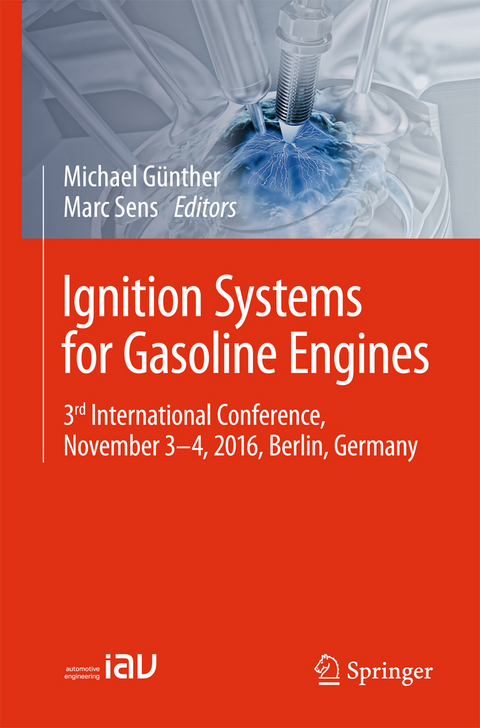
Ignition Systems for Gasoline Engines (eBook)
VII, 331 Seiten
Springer International Publishing (Verlag)
978-3-319-45504-4 (ISBN)
Experts from industry and universities discuss in their papers the challenges to ignition systems in providing reliable, precise ignition in the light of a wide spread in
mixture quality, high exhaust gas recirculation rates and high cylinder pressures. Classic spark plug ignition as well as alternative ignition systems are assessed, the
ignition system being one of the key technologies to further optimizing the gasoline engine.
Contents 5
Requirements for Ignition Systems 8
Challenges to the Ignition System of Future Gasoline Engines – An Application Oriented Systems Comparison 9
Abstract 9
1 Introduction 9
2 Challenges to Ignitions Systems Within the Engine Map 10
3 Test Setup and Procedure 13
3.1 Engines for Thermodynamic Testing 13
3.2 Ignition Systems 13
4 Results 15
4.1 Potentials in Part Load 15
4.2 Potentials in Upper Part Load 21
4.3 Potentials at High Load 22
4.4 Transient Behavior 26
4.5 Functional Integration Aspects 28
5 Conclusion 30
Acknowledgements 31
References 31
Extension of Operating Window for Modern Combustion Systems by High Performance Ignition 32
Abstract 32
1 Introduction 32
2 Requirements on Ignition System for Modern Combustion Concepts 35
2.1 Requirements for Efficient Combustion 35
2.2 Derived Component Requirements 39
2.3 Requirements Development vs. Ignition Solutions 41
3 CEI Working Principle and Sample Status 42
3.1 CEI Working Principle 42
3.2 CEI Sample Status and Performance Measurement Results 45
4 Engine Results 47
4.1 Potential Study for EGR Combustion Concepts 48
4.2 Potential Study for Lean Combustion Concepts 53
5 Summary 55
References 56
Demonstration of Improved Dilution Tolerance Using a Production-Intent Compact Nanosecond Pulse Ignition System 58
Abstract 58
1 Introduction 59
1.1 Technical Approach 59
2 Ignition System 63
2.1 Ignition Module 64
2.2 Measurement 64
3 Experimental Setup 64
4 Results 65
5 Discussion 68
6 Conclusion 69
Acknowledgements 70
References 70
Operating Conditions/Flammability 72
Study of Ignitability in Strong Flow Field 73
Abstract 73
1 Introduction 73
2 Direction of the Study 75
3 Analysis of Discharge Channel Behavior and Initial Flame Propagation in Strong Flow Fields 75
3.1 Effect of Strong Flow Fields on Ignitability 75
3.2 Analysis of Misfire Mechanism 77
4 Effect of Discharge Specifications on Discharge Channel Behavior and Initial Flame Propagation 81
4.1 Effect of Discharge Current and Duration 81
4.2 Optimizing Discharge Specifications 85
5 Conclusion 86
Acknowledgment 87
References 87
Simulation of Ignition 89
Simulating Extreme Lean Gasoline Combustion – Flow Effects on Ignition 90
Abstract 90
1 Introduction 90
2 Challenges of Lean Burn Combustion 91
3 Experimental Study on Lean Burn Combustion 93
3.1 Test Bench Setup and Instrumentation 93
3.2 Thermodynamic Engine Testing 95
4 Lean Mixtures Ignition and Combustion Model 96
5 Extreme Lean Concept Study 100
5.1 Charge Motion Design 100
5.2 Predictive 1D-Model 102
5.3 Extreme Lean Concept Study 103
6 Conclusion and Outlook 106
References 107
New Ignition Systems 1 109
High Energy Multipole Distribution Spark Ignition System 110
Abstract 110
1 Introduction 110
2 Experimental Setups 113
2.1 Three-pole Spark Plug and Ignition System Configurations 113
2.2 Constant Volume Combustion Vessels 115
2.3 Single-Cylinder Engine Dynamometer Test 117
3 Results and Discussions 118
3.1 Evaluation on the Constant Volume Combustion Vessels 118
3.2 Evaluation on the Single Cylinder Engine 123
4 Future Works 129
5 Conclusions 129
Acknowledgements 130
References 130
Development of Homogeneous Charged Multi-point Ignition Engine 132
Abstract 132
1 Introduction 132
2 System Configuration of Multi-point Ignition 133
3 Realization of Fast Combustion by Multi-point Ignition 134
4 Performance Evaluation of a Multi-point Ignition Engine 135
4.1 Retardation of Ignition Timing 135
4.2 Realization of Lean Combustion 136
4.3 Realization of High Compression Ratio by a Multi-point Ignition 137
5 Consideration of the Effect of Thermal Efficiency Improvement by Multi-point Ignition 137
6 Conclusion 140
7 Closing Remark 140
Reference 140
Development of an Ignition Coil Integrated System to Monitor the Spark Plugs Wear 141
Abstract 141
1 Introduction 141
2 Ignition Process 143
3 Breakdown Voltage Determinant Factors 144
3.1 Paschen Law 145
4 Microcontroller-Based Ignition Control 146
4.1 Indirect Measurement of Breakdown Voltage 147
5 Conclusions 151
References 151
Components 153
Fatigue Life Simulation and Analysis of an Ignition Coil 154
Abstract 154
1 Introduction 154
2 Ignition Coil 155
3 Thermal Fatigue and Durability of Primary Wire 156
4 Assembly Loads and In-Service Thermal Operating Conditions 156
5 Computer Simulation Modelling and Analysis for Predicting Thermal Fatigue Durability 158
5.1 Simulating Primary Wire Assembly 158
5.2 Simulating in-Service Thermal Cycling of Coil Assembly 159
5.3 Thermal Fatigue Life Evaluation of the Primary Wire 161
6 Lab Test Results and Comparison with Simulation Results 162
7 Conclusions 163
Acknowledgments 164
References 164
Visualization of Ignition Processes 165
Calorimetry and Atomic Oxygen Laser-Induced Fluorescence of Pulsed Nanosecond Discharges at Above-Atmospheric Pressures 166
Abstract 166
1 Introduction 166
2 Experiment Description 169
2.1 Pressure-Rise Calorimetry 169
2.2 O-Atom Two-Photon Laser Induced Fluorescence 171
3 Results and Discussion 172
3.1 Pressure-Rise Calorimetry 172
3.2 LTP Two-Photon Laser Induced Fluorescence 178
3.3 Discussion 180
4 Conclusions 182
Acknowledgements 183
References 184
Comparing Visualization of Inflammation at Transient Load Steps Comparing Ignition Systems 187
Abstract 187
1 Introduction 187
2 Experimental Setup 188
2.1 Requirements for Engine Testing in Transient Operation 188
2.2 Engine in the Loop as Test Bed with Synchronized Measurements 188
3 Investigated Transient Processes 190
4 Camera Measurements of Chemiluminescence as Tool for Flame Kernel Investigation 191
5 Measurement Results 195
5.1 Comparison OH*Chemiluminescence and Visual Light 195
5.2 CH* and C2* Results 196
5.3 Results for Early Engine Cycles in Transient Load Step 197
6 Summary and Discussion 199
Acknowledgements 200
References 200
Spark Control for Ion Current Sensing 201
Abstract 201
1 Ion Current Sensing for Combustion Analyses 201
2 Ion Current Sensing Using Inductive Ignition Systems 205
3 Spark Control 208
4 Summary 210
References 210
Combustion Processes 211
Ignition System Development for High Speed High Load Lean Boosted Engines 212
Abstract 212
1 Background 212
2 Lean Boosting 214
3 2013 4-Cylinder Concept 215
3.1 Functionality Issues 215
3.2 Ignitability Tradeoffs with Breakdown Voltage 217
4 Initial 2014 Concept Testing 220
4.1 Impact of Regulation Change on Ignition System 220
4.2 Ignition Coil Emulator Testing: Round 1 220
4.3 Ignition Coil Emulator Testing: Round 2 223
4.4 Further Plug Geometry Testing 227
4.5 Effect of Spark Plug Penetration 229
5 Endoscopic Flame Kernel Measurements 230
6 Multispark Testing 232
7 Importance of Early Burn Duration 234
8 Conclusions 236
References 237
New Ignition Systems 2 238
Effects of Microwave-Enhanced Plasma on Laser Ignition 239
Abstract 239
1 Introduction 239
2 Experimental Setup and Method 240
3 Results and Discussion 242
3.1 Effect of Microwave-Enhancement on the Laser Ignition 242
3.2 Effect of the Total Duration Time of Microwave Enhancement and the Effect of Duty Ratio on the Microwave-Enhanced Laser Ignition 244
3.3 Effect of the Frequency of Pulsed Microwave on the Minimum Pulse Energy Required for Ignition 244
4 Conclusion 246
References 246
Pulse Train Ignition with Passively Q-Switched Laser Spark Plugs Under Engine-like Conditions 248
Abstract 248
1 Introduction 248
2 Influence of Laser Pulse Profile on Flame Kernel Formation 249
3 Influence of Pulse Trains on Flame Kernel Formation 250
4 Ignition and Combustion Process After Pulse Train Ignition 251
5 Conclusion 252
References 252
Advanced Plasma Ignition (API): A Simple Corona and Spark Ignition System 254
1 Introduction 254
2 General Description 255
2.1 Compatibility 255
2.2 Safety 256
3 Technical Description 256
3.1 Plasma Plug 256
3.2 Oscillator 257
3.3 Current Supply 257
3.4 High-Voltage Transformer 258
4 Conclusion 258
References 258
Alternative Ignition Systems 259
Analytical and Experimental Optimization of the Advanced Corona Ignition System 260
Abstract 260
1 Introduction 260
2 Energy Audit 262
2.1 Effect of Operating Frequency 262
2.2 Analysis of Power Distribution 265
2.3 Conclusions 269
3 Igniter Optimization 269
3.1 Electrical Design 270
3.2 Thermal Design 276
3.3 Conclusions 278
4 Combustion Chamber Optimization 279
4.1 Simplified Treatment in FEA 279
4.2 Conclusions 283
5 Summary 284
References 285
Comparative Optical and Thermodynamic Investigations of High Frequency Corona- and Spark-Ignition on a CV Natural Gas Research Engine Operated with Charge Dilution by Exhaust Gas Recirculation 286
Abstract 286
1 Introduction and Motivation 286
2 Basics 287
2.1 Ignition Systems 287
2.2 Initial Phase of Combustion 288
2.3 Exhaust-Gas Recirculation 289
3 Experimental Set-up 290
3.1 Research Engine 290
3.2 Measurement Instrumentation 291
3.3 Specifications of the Ignition Systems 291
4 Test Procedure 292
4.1 Operating Points 292
4.2 Single Cylinder Optical Engine Operating Mode 293
4.3 Data Analysis 294
5 Experimental Results 295
5.1 Phenomenology of Ignition and Flame Propagation 295
5.2 Charge Dilution with EGR 297
5.3 Ignition Energy Variation 302
6 Summary 304
Acknowledgement 306
References 306
Potential of Advanced Corona Ignition System (ACIS) for Future Engine Applications 308
Abstract 308
1 Introduction 308
2 Optical Engine Specifications 309
3 Operating Conditions and Diagnostics 311
4 Optical Engine Results and Discussion 311
4.1 Stoichiometric Mixture, a/F = 15.0, Same Spark Advance 311
4.2 Stoichiometric Mixture, Matched CA50 313
4.3 Stoichiometric Mixture, 20 % N2 Dilution 313
4.4 Lean Limit, a/F = 25.8 315
4.5 Lean Limit, a/F = 25.2, Similar COVIMEP 317
4.6 Rich Condition, a/F = 13.1 318
5 Multi-cylinder Engine Specifications 319
6 Test Conditions 319
7 Multi-cylinder Engine Results 320
7.1 Part Load Combustion Performance 320
7.2 Light Load Combustion Performance 322
8 Summary 323
Acknowledgements 324
References 324
| Erscheint lt. Verlag | 18.11.2016 |
|---|---|
| Zusatzinfo | VII, 331 p. 254 illus. |
| Verlagsort | Cham |
| Sprache | englisch |
| Themenwelt | Technik ► Maschinenbau |
| Schlagworte | combustion engines • conference proceedings • Emission • Gasoline Engines • Ignition systems |
| ISBN-10 | 3-319-45504-4 / 3319455044 |
| ISBN-13 | 978-3-319-45504-4 / 9783319455044 |
| Informationen gemäß Produktsicherheitsverordnung (GPSR) | |
| Haben Sie eine Frage zum Produkt? |
 PDF (Wasserzeichen)
DRM: Digitales Wasserzeichen
Dieses eBook enthält ein digitales Wasserzeichen und ist damit für Sie personalisiert. Bei einer missbräuchlichen Weitergabe des eBooks an Dritte ist eine Rückverfolgung an die Quelle möglich.
Dateiformat: PDF (Portable Document Format)
Mit einem festen Seitenlayout eignet sich die PDF besonders für Fachbücher mit Spalten, Tabellen und Abbildungen. Eine PDF kann auf fast allen Geräten angezeigt werden, ist aber für kleine Displays (Smartphone, eReader) nur eingeschränkt geeignet.
Systemvoraussetzungen:
PC/Mac: Mit einem PC oder Mac können Sie dieses eBook lesen. Sie benötigen dafür einen PDF-Viewer - z.B. den Adobe Reader oder Adobe Digital Editions.
eReader: Dieses eBook kann mit (fast) allen eBook-Readern gelesen werden. Mit dem amazon-Kindle ist es aber nicht kompatibel.
Smartphone/Tablet: Egal ob Apple oder Android, dieses eBook können Sie lesen. Sie benötigen dafür einen PDF-Viewer - z.B. die kostenlose Adobe Digital Editions-App.
Buying eBooks from abroad
For tax law reasons we can sell eBooks just within Germany and Switzerland. Regrettably we cannot fulfill eBook-orders from other countries.
aus dem Bereich