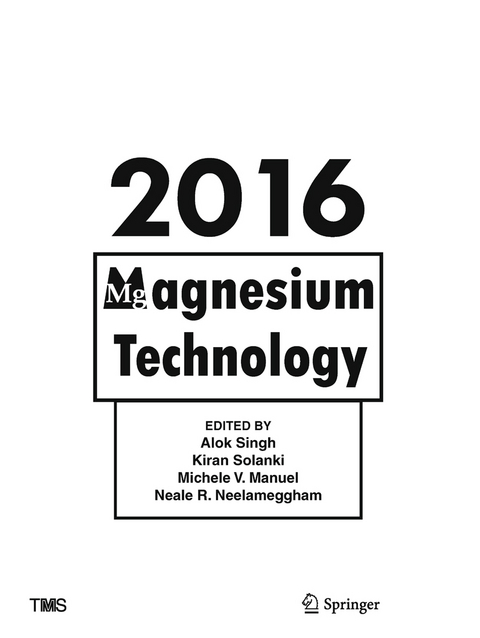
Magnesium Technology 2016 (eBook)
XXVI, 402 Seiten
Springer International Publishing (Verlag)
978-3-319-48114-2 (ISBN)

The Minerals, Metals & Materials Society (TMS) is a member-driven international professional society dedicated to fostering the exchange of learning and ideas across the entire range of materials science and engineering, from minerals processing and primary metals production, to basic research and the advanced applications of materials. Included among its nearly 13,000 professional and student members are metallurgical and materials engineers, scientists, researchers, educators, and administrators from more than 70 countries on six continents. For more information on TMS, visit www.tms.org.
The Minerals, Metals & Materials Society (TMS) is a member-driven international professional society dedicated to fostering the exchange of learning and ideas across the entire range of materials science and engineering, from minerals processing and primary metals production, to basic research and the advanced applications of materials. Included among its nearly 13,000 professional and student members are metallurgical and materials engineers, scientists, researchers, educators, and administrators from more than 70 countries on six continents. For more information on TMS, visit www.tms.org.
Cover 1
Half Title 2
Title Page 4
Copyright Page 5
Table of Contents 6
Preface 12
About the Editors 14
Session Chairs 23
Reviewer Pool 24
Magnesium Technology 2016 26
Keynote Session 27
Challenges for Implementation of Magnesium into More Applications 28
Development of Magnesium Alloys for High Speed Trains in China 30
Korea’s R& D Activities towards the Application of Wrought Mg Alloys
Fascinating LPSO-Structured Mg Alloys 34
Developments in High Magnesium-Content Bulk Metallic Glasses and Future Possibilities 36
Solidification and Casting 38
In Situ Synchrotron Radiation Diffraction of the Solidification of Mg-Dy(-Zr) Alloys 39
As Solidified Microstructure Investigation of Mg15Y and MgxYyGd (x+y=15 wt.%) Ternary Alloys 44
Development of the New High Shear Technology for Continuous Processing of Mg-Alloys for Ingot Casting 49
Dendrite Morphology and Growth Orientation of Magnesium Alloys: Simulation by Phase-Field and 3-D Characterization by Synchrotron X-Ray Tomography 54
Influence of Hot Isostatic Processing on the Microstructure and Tensile Behavior of HPDC AM50 59
Microsegregation in High Pressure Die Cast AM70 65
Predicting Solidification Properties of Magnesium by Molecular Dynamics Simulations 70
Keynote Session Part II and Primary Production and Recycling 74
A Perspective: Potential Growth in the Global Magnesium Industry – Where Is Our Research Leading Us? 75
Study on Mechanism of Magnesia Production by Reversion Reaction Process in Vacuum 77
Thermodynamic Description of Reactions between Mg and CaO 83
Atomic-Level Mechanisms of Magnesium Oxidation 89
Alloy Development, Diffusion and Joining 93
Development of Mg-Al-Sn-Si Alloys Using a CALPHAD Approach 94
Lattice Ordering and Microstructure of Ultra-High Strength Mg-Ca-Zn Alloys 98
Pre-Straining Effect on Precipitation Behaviour of AZ31B 104
The Effect of Ageing on the Compressive Deformation of Mg-Sn-Zn-Na Alloy 108
First-Principles Study of Diffusion Coefficients of Alloy Elements in Dilute Mg Alloys 112
Study of ZE10 Magnesium Alloy Welded Joints Produced with Disk Laser 117
Similar and Dissimilar Ultrasonic Spot Welding of a Rare-Earth Containing ZEK100 Magnesium Alloy 122
Effect of Filler Wires on Cracking along Edges of Magnesium Welds 127
Magnesium-Rare Earth Alloys 132
Hot Tearing in Magnesium-Rare Earth Alloys 133
Hot Tearing Susceptibility of Mg-5Nd-xZn Alloys 139
Solid Solution Strengthening in Mg–Gd Alloys 145
Effects of Homogenization on Microstructure and Mechanical Properties of a ZE20 Mg Alloy Processed by Indirect Extrusion 150
Age-Hardening of Dual Phase Mg-Sc Alloy at 573 K 156
The Structure of ?” and ?’ in an Aged Mg-Nd Alloy 159
LPSO Alloys and Composites 163
Solid Solution Hardening in Mg-Gd-TM (TM=Ag, Zn and Zr) Alloys: An Integrated Density Functional Theory and Electron Work Function Study 164
Microstructure and Mechanical Properties New Magnesium-Zinc-Gadolinium Alloys 165
Effects of Alloying Elements on Microstructures and Mechanical Properties of Mg-Gd-Zn-Ca Alloys 170
Creep of a Mg-Zn-Y Alloy at Elevated Temperatures 174
An Insight into Use of Hollow Fly Ash Particles on the Properties of Magnesium 180
Role of SiC in Grain Refinement of Aluminum-Free Mg-Zn Alloys 182
Hot Deformation and Processing Map in an Mg-Zn-Mn-Y Alloy 187
Twinning and Plasticity 191
What is in a Strain Hardening “Plateau”? 192
Asymmetric Growth of Tensile Twins in Magnesium 198
Non-Dislocation Based Room Temperature Plastic Deformation Mechanism in Magnesium 202
Investigation of the Plastic Flow Field in Magnesium Alloy AZ31B in Three Orientations for Empirical Penetration Models 205
Deformation Behavior of Mg Single Crystals Compressed along c-Axis 211
The Use of Acoustic Emission and Neutron Diffraction to Reveal the Active Deformation Mechanisms in Polycrystalline Magnesium and Comparison to Theoretical Modeling 214
Strain Rate Dependent Deformation and Failure Process of Magnesium Foams 218
Exploration of Thin-Walled Magnesium Alloy Tube Extrusion for Improved Crash Performance 224
High Temperature Tensile Behaviors and Deformation Mechanisms of Mg-x%Al Alloys 230
Texture and Formability 236
In-Situ EBSD Observations of Recrystallization and Texture Evolution in Rolled Mg-2Zn-xCe (wt.%) 237
Non-Basal Texture Evolution during Annealing of Cold-Deformed Magnesium Alloy 238
On Modeling the Mechanical Behavior and Texture Evolution of Rolled AZ31 Mg for Complex Loadings Involving Strain Path Changes 243
Formability of Extruded Magnesium Alloy Sheets with Different Textures 249
Prediction of Magnesium Alloy Formability: The Role of Texture 255
Texture Evolution and Mechanical Properties of Mg-Li Alloy during Thermo-Mechanical Process 261
Effect of Dynamic Recrystallization on Microstructure Evolution and Texture Weakening during Annealing of High Speed Rolled AZ31 Magnesium Alloy Sheets 265
Corrosion 270
Numerical Investigation of the AE44-Mild Steel Galvanic Structural Joint 271
Fabrication of a Superhydrophobic Film with Self-Cleaning Property on Magnesium Alloy and Its Corrosion Resistance Properties 275
The Surface Films and Their Possible Roles in Mg Corrosion 280
Micro-Arc Oxide Film of Aluminum Coating Pre-Sprayed on AZ31 Magnesium Alloy 286
Poster Session 291
Study on Fatigue Mechanism of Mg-0.6at%Y Alloy by Cyclic Tensile Test 292
Mechanical Response of a Gravity Cast Mg-9Al-1Zn-0.2Sc Alloy at Strain Rates from 10-4 to 103/s 297
Magnesium-based Biodegradable Implants 302
Materials and Processing / Surface Modification and Corrosion 303
Fabrication, Testing and Performance of Rare Earth-Containing Magnesium Biodegradable Metals 304
Manufacturing of Osteosynthesis Systems Made of Magnesium Alloy AZ91 306
Absorbable Filament Technologies: Wire-Drawing to Enable Next-Generation Medical Devices 312
Plasma Surface Modification of Magnesium-Based and Related Materials 317
Degradation of MgF2-Coated and Uncoated MgNd2 Specimens in Contact with Nasal Mucosa 319
Flow Induced Biodegradation Behavior of Magnesium Metal: From Bioreactors to In Vivo Models 324
Corrosion / Market and Clinic 327
Understanding Corrosion-Assisted Cracking of Magnesium Alloys for Bioimplant Applications 328
In Vitro Corrosion and Cytocompatibility Properties of Mg-2Gd-X(Ag, Ca) Alloys 332
Appropriate Corrosion-Fatigue Testing of Magnesium Alloys for Temporary Bioimplant Applications 337
Standardized Guidance for the Preclinical Evaluation of Absorbable Metal Implants 341
The Industrial Challenges of Manufacturing Bioabsorbable Magnesium 344
Strip Casting of Light Metals 348
Strip Casting Process 349
Microstructure Investigations of Inverse Segregations in Twin-Roll Cast AZ31 Strips 350
Strip Casting: Properties 356
Substitution of Rare Earth Elements in Magnesium Alloys for the Sheet Production via Twin Roll Casting 357
Microstructure and Mechanical Properties of Ca Containing AZX310 Alloy Sheets Produced via Twin Roll Casting Technology 363
Poster Session 368
Microstructure and Properties of SiCp/Al Matrix Composite Strip Fabricating by Twin-Roll Casting Process 369
Author Index 375
Subject Index 378
| Erscheint lt. Verlag | 12.12.2016 |
|---|---|
| Reihe/Serie | The Minerals, Metals & Materials Series | The Minerals, Metals & Materials Series |
| Zusatzinfo | XXVI, 402 p. |
| Verlagsort | Cham |
| Sprache | englisch |
| Themenwelt | Technik ► Maschinenbau |
| Schlagworte | cast products and processing • corrosion and surface finishing • Magnesium technology • Materials science and application • material technology and application |
| ISBN-10 | 3-319-48114-2 / 3319481142 |
| ISBN-13 | 978-3-319-48114-2 / 9783319481142 |
| Informationen gemäß Produktsicherheitsverordnung (GPSR) | |
| Haben Sie eine Frage zum Produkt? |
 PDF (Wasserzeichen)
DRM: Digitales Wasserzeichen
Dieses eBook enthält ein digitales Wasserzeichen und ist damit für Sie personalisiert. Bei einer missbräuchlichen Weitergabe des eBooks an Dritte ist eine Rückverfolgung an die Quelle möglich.
Dateiformat: PDF (Portable Document Format)
Mit einem festen Seitenlayout eignet sich die PDF besonders für Fachbücher mit Spalten, Tabellen und Abbildungen. Eine PDF kann auf fast allen Geräten angezeigt werden, ist aber für kleine Displays (Smartphone, eReader) nur eingeschränkt geeignet.
Systemvoraussetzungen:
PC/Mac: Mit einem PC oder Mac können Sie dieses eBook lesen. Sie benötigen dafür einen PDF-Viewer - z.B. den Adobe Reader oder Adobe Digital Editions.
eReader: Dieses eBook kann mit (fast) allen eBook-Readern gelesen werden. Mit dem amazon-Kindle ist es aber nicht kompatibel.
Smartphone/Tablet: Egal ob Apple oder Android, dieses eBook können Sie lesen. Sie benötigen dafür einen PDF-Viewer - z.B. die kostenlose Adobe Digital Editions-App.
Buying eBooks from abroad
For tax law reasons we can sell eBooks just within Germany and Switzerland. Regrettably we cannot fulfill eBook-orders from other countries.
aus dem Bereich