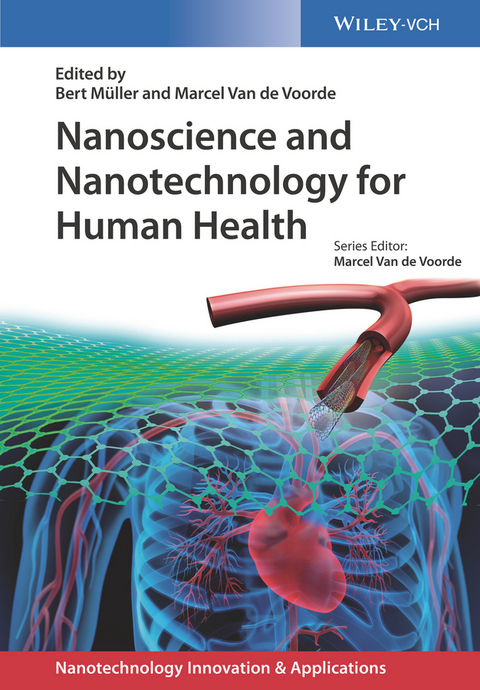
Nanoscience and Nanotechnology for Human Health (eBook)
Wiley-VCH Verlag GmbH & Co. KGaA
978-3-527-69206-4 (ISBN)
To this end, the book cover the materials aspects of nanomedicine, such as the hierarchical structure of biological materials, the imaging of hard and soft tissues and, in particular, concrete examples of nanotechnology-based approaches in modern medical treatments. The whole is rounded off by a discussion of the opportunities and risks of using nanotechnology and nanomaterials in medicine, backed by case studies taken from real life.
Bert Müller is Professor for Materials Science in Medicine at the University of Basel and teaches physics at ETH Zurich. He received a diploma in mechanical engineering, followed by M.Sc. degrees in Physics and English from the Dresden University of Technology, and obtained a PhD in experimental physics from the University of Hannover, Germany. For his achievements he was granted with the Morton M. Traum Award of the American Vacuum Society. Afterwards, he worked as researcher at the Paderborn University, Germany, as Feodor Lynen Fellow and research associate at the EPF Lausanne and as team leader at ETH Zurich. He has become a faculty member of the Physics Department at ETH Zurich. Ten years ago he has founded the Biomaterials Science Center. Currently, this center has more than twenty researchers dealing with nanotechnology-based artificial muscles for incontinence treatment, smart nano-containers to treat cardiovascular diseases, high-resolution X-ray imaging to visualize the human body down to the molecular level, computational sciences of tissues in health and disease and other applications of physics and nanosciences in medicine and dentistry. He is Fellow of SPIE and an active member of the European Academy of Sciences and Arts. Marcel Van de Voorde has 40 years` experience in European Research Organisations including CERN-Geneva, European Commission, with 10 years at the Max Planck Institute in Stuttgart, Germany. For many years, he was involved in research and research strategies, policy and management, especially in European research institutions. He holds a Professorship at the University of Technology in Delft, the Netherlands, as well as multiple visiting professorships in Europe and worldwide. He holds a doctor honoris causa and various honorary Professorships. He is senator of the European Academy for Sciences and Arts, in Salzburg and Fellow of the World Academy for Sciences. He is a Fellow of various scientific societies and has been decorated by the Belgian King. He has authored of multiple scientific and technical publications and co-edited multiple books in the field of nanoscience and nanotechnology.
Foreword
PART I. Introduction to Nanoscience in Medicine of the 21st Century
Challenges and Opportunities of Nanotechnology for Human Health
Nanoscience and Nanotechnology, the Armory for the Twenty-First Century Health Care
Nanomedicine Activities in the United States and Worldwide
PART II. Leading Cause of Death: Cardiovascular Diseases
Challenges in Cardiovascular Treatments Using Nanotechnology-Based Approaches
Smart Container for Targeted Drug Delivery
Human Nano-Vesicles in Physiology and Pathology
Challenges and Risks of Nanotechnology in Medicine: An Immunologist's Point of View
PART III. Second Most Common Cause of Death: Cancer
Challenges of Applying Targeted Nanostructures with Multifunctional Properties in Cancer Treatments
Highly Conformal Radiotherapy Using Protons
Self-Organization on a Chip: From Nanoscale Actin Assemblies to Tumor Spheroids
Nanomechanical Signature of Tissues in Health and Disease
PART IV. Most Common Diseases: Caries, Musculoskeletal Diseases, Incontinence, Allergies
Revealing the Nano-Architecture of Human Hard and Soft Tissues by Spatially Resolved Hard X-Ray Scattering
Regenerative Dentistry Using Stem Cells and Nanotechnology
Nanostructured Polymers for Medical Applications
Nanotechnology in the Treatment of Incontinence
Nanomedicine in Dermatology: Nanotechnology in Prevention, Diagnosis, and Therapy
PART V. Benefitting Patients
Therapeutic Development and the Evolultion of Precision Medicine
Benefits from Nanoscience and Nanotechnology: Benefitting Patients
Nanomedicine: Present Accomplishments and Far-Reaching Promises
PART I. INTRODUCTION TO NANOSCIENCE IN MEDICINE OF THE TWENTY-FIRST CENTURY
Challenges and Opportunities of Nanotechnology for Human Health
Nanoscience and Nanotechnology and the Armory for the Twenty-First Century Health Care
Nanomedicine Activities in the United States and Worldwide
PART II. LEADING CAUSE OF DEATH: CARDIOVASCULAR DISEASES
Challenges in Cardiovascular Treatments Using Nanotechnology-Based Approaches
Smart Container for Targeted Drug Delivery
Human Nano-Vesicles in Physiology and Pathology
Challenges and Risks of Nanotechnology in Medicine: An Immunologist's Point of View
PART III. SECOND MOST COMMON CAUSE OF DEATH: CANCER
Challenges of Applying Targeted Nanostructures with Multifunctional Properties in Cancer Treatments
Highly Conformal Radiotherapy Using Protons
Self-Organization on a Chip: From Nanoscale Actin Assemblies to Tumor Spheroids
The Nanomechanical Signature of Tissues in Health and Disease
PART IV. MOST COMMON DISEASES: CARIES, MUSCUSKELETAL DISEASES, INCONTINENCE, ALLERGIES
Revealing the Nano-Architecture of Human Hard and Soft Tissues by Spatially Resolved Hard X-Ray Scattering
Regenerative Dentistry Using Stem Cells and Nanotechnology
Nanostructured Polymers for Medical Applications
Nanotechnology in the Treatment of Incontinence
Nanomedicine in Dermatology: Nanotechnology in Prevention, Diagnosis, and Therapy
PART V. BENEFITTING PATIENTS
Therapeutic Development and the Evolultion of Precision Medicine
Benefits from Nanoscience and Nanotechnology: Benefitting Patients
Index
| Erscheint lt. Verlag | 28.11.2016 |
|---|---|
| Reihe/Serie | Applications of Nanotechnology |
| Nanotechnology Innovation & Applications | Nanotechnology Innovation & Applications |
| Sprache | englisch |
| Themenwelt | Medizin / Pharmazie |
| Technik ► Maschinenbau | |
| Schlagworte | Basic Medical Sciences • Chemie • Chemistry • medical applcations, nanomedicine, nanotechnology-based treatments, biological materials • Medical Science • Medizin • Medizinische Grundlagenfächer • Medizinische Grundlagenfächer • nanomedicine • Nanomedizin • Nanotechnologie • nanotechnology • Pharmaceutical & Medicinal Chemistry • Pharmazeutische u. Medizinische Chemie |
| ISBN-10 | 3-527-69206-1 / 3527692061 |
| ISBN-13 | 978-3-527-69206-4 / 9783527692064 |
| Informationen gemäß Produktsicherheitsverordnung (GPSR) | |
| Haben Sie eine Frage zum Produkt? |
 EPUB (Adobe DRM)
Kopierschutz: Adobe-DRM
Adobe-DRM ist ein Kopierschutz, der das eBook vor Mißbrauch schützen soll. Dabei wird das eBook bereits beim Download auf Ihre persönliche Adobe-ID autorisiert. Lesen können Sie das eBook dann nur auf den Geräten, welche ebenfalls auf Ihre Adobe-ID registriert sind.
Details zum Adobe-DRM
Dateiformat: EPUB (Electronic Publication)
EPUB ist ein offener Standard für eBooks und eignet sich besonders zur Darstellung von Belletristik und Sachbüchern. Der Fließtext wird dynamisch an die Display- und Schriftgröße angepasst. Auch für mobile Lesegeräte ist EPUB daher gut geeignet.
Systemvoraussetzungen:
PC/Mac: Mit einem PC oder Mac können Sie dieses eBook lesen. Sie benötigen eine
eReader: Dieses eBook kann mit (fast) allen eBook-Readern gelesen werden. Mit dem amazon-Kindle ist es aber nicht kompatibel.
Smartphone/Tablet: Egal ob Apple oder Android, dieses eBook können Sie lesen. Sie benötigen eine
Geräteliste und zusätzliche Hinweise
Buying eBooks from abroad
For tax law reasons we can sell eBooks just within Germany and Switzerland. Regrettably we cannot fulfill eBook-orders from other countries.
aus dem Bereich