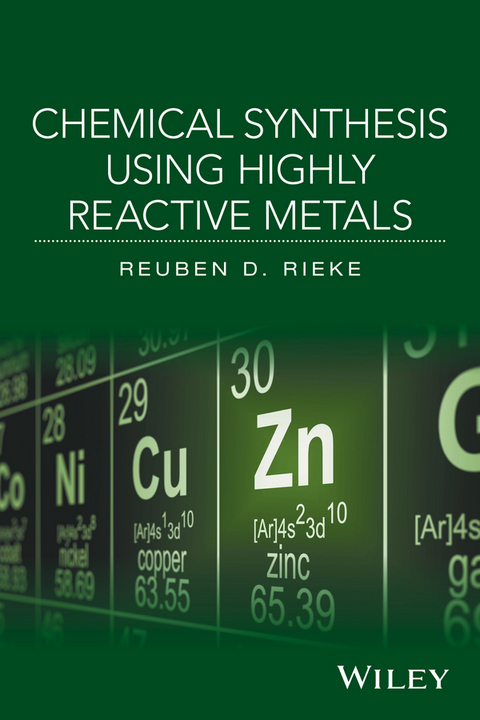
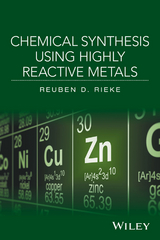
Chemical Synthesis Using Highly Reactive Metals (eBook)
480 Seiten
Wiley (Verlag)
978-1-118-92914-8 (ISBN)
• Addresses a new generation of chemistry that goes beyond the standard use of metals and activation
• Provides step-by-step guidelines, chemical equations, and experimental descriptions for handling metals including zinc, magnesium, copper, indium, nickel, manganese, calcium, barium, iron, palladium, platinum, uranium, thorium, aluminum, cobalt, and chromium
• Uses a unique approach to highlight methods and techniques that make chemical synthesis and activation of Rieke metals more safe and efficient
• Discusses novel applications and special topics, such as highly reactive metals for novel organometallic reagents, semiconducting polymers, plastics electronics, photovoltaics, and the Reformatsky reagent
Reuben D. Rieke, PhD, is internationally recognized for his pioneering work in the development of highly reactive metals, the synthesis of highly regioregular 3-alkylpolythiophenes, and novel organometallic reagents. In 1991, Dr. Rieke founded Rieke Metals, Inc. He has 38 years of academic experience teaching organic chemistry and has published over 225 papers and been awarded over 25 patents.
Reuben D. Rieke, PhD, is internationally recognized for his pioneering work in the development of highly reactive metals, the synthesis of highly regioregular 3-alkylpolythiophenes, and novel organometallic reagents. In 1991, Dr. Rieke founded Rieke Metals, Inc. He has 38 years of academic experience teaching organic chemistry and has published over 225 papers and been awarded over 25 patents.
Title Page 5
Copyright Page 6
Contents 7
Preface 19
Chapter 1 Genesis of Highly Reactive Metals 21
Chapter 2 General Methods of Preparation and Properties 25
2.1 General Methods for Preparation of Highly Reactive Metals 25
2.2 Physical Characteristics of Highly Reactive Metal Powders 28
2.3 Origin of the Metals’ High Reactivity 29
References 30
Chapter 3 Zinc 33
3.1 General Methods for Preparation of Rieke Zinc 33
3.2 Direct Oxidative Addition of Reactive Zinc to Functionalized Alkyl, Aryl, and Vinyl Halides 36
Typical Preparation of 3-Fluorobenzylzinc Bromide 39
Typical Preparation of 4-Cyanobutylzinc Bromide 40
Typical Preparation of 4-Bromophenylzinc Iodide 40
Typical Preparation of 3-Methyl-2-Pyridlyzinc Bromide 40
3.3 Reactions of Organozinc Reagents with Acid Chlorides 40
Typical Generation of Organozinc Halides from Organic Halides and Active Zinc and Their Copper-Mediated Coupling with Acid Chlorides 41
Synthesis of 4-Methoxy-2?-Thiomethylbenzophenone Using Tetrakis(triphenylphosphine)palladium(0) as Catalyst 46
Synthesis of Ethyl 7-(3,4-Difluorophenyl)-7-Oxoheptanoate Using Copper Iodide as Catalyst 46
Cyanide-Based Rieke Zinc 47
3.4 Reactions of Organozinc Reagents with ?,??Unsaturated Ketones 47
Typical Copper-Mediated Conjugate Addition Reaction of Organozinc Halides to ?,?-Unsaturated Ketones 50
3.5 Reactions of Organozinc Reagents with Allylic and Alkynyl Halides 50
Typical Reaction of Organozinc Halides with Allylic Halides 51
Preparation of 2,3-Di(p-Cyanobenzyl)-1,3-Butadiene Reaction 54
3.6 Negishi Cross-Coupling of Vinyl and Aryl Organozinc Halides 54
Typical Procedure for the Reaction of RZnX with Aryl and Vinyl Halides 56
Preparation of Aryl Ketones via Ni-Catalyzed Negishi Coupling Reactions 56
Typical Reaction Procedure 62
3.7 Intramolecular Cyclizations and Conjugate Additions Mediated by Rieke Zinc 62
3.8 The Formation and Chemistry of Secondary and Tertiary Alkylzinc Halides 64
3.9 Electrophilic Amination of Organozinc Halides 70
3.10 Reformatsky and Reformatsky-Like Reagents and Their Chemistry 72
Synthesis of Reformatsky Reagent in THF 73
Synthesis of Reformatsky Reagent in Diethyl Ether 73
3.11 Configurationally Stable Organozinc Reagents and Intramolecular Insertion Reactions 74
3.12 Preparation of Tertiary Amides via Aryl, Heteroaryl, and Benzyl Organozinc Reagents 75
3.13 Preparation of 5-Substituted-2-Furaldehydes 81
Results and Discussion 83
General Procedure for Pd-Catalyzed Cross-Coupling Reactions 93
3.14 Preparation and Chemistry of 4-Coumarylzinc Bromide 93
3.15 Preparation and Cross-Coupling of 2-Pyridyl and 3-Pyridylzinc Bromides 97
Results and Discussion 100
Conclusions 122
Experimental 123
General 123
Preparation of 2-Pyridylzinc Bromide (P1) 123
Preparation of 3-Pyridylzinc Bromide (P7) 123
General Procedure for Copper-Free Coupling Reactions 124
Pd-Catalyzed Coupling Reaction with 4-Iodoanisole (10b) 124
Preparation of Bipyridines 124
Pd-Catalyzed Coupling Reaction with Haloanilines 124
Pd-Catalyzed Coupling Reactions with Halophenols 125
Copper-Catalyzed SN2 Addition Reactions 125
Pd-Catalyzed Bimolecular Coupling Reactions 125
Preparation of Quinolinylzinc Reagents and Subsequent Coupling Reactions 125
3.16 Preparation of Functionalized ?-Chloromethyl Ketones 126
3.17 Rieke Zinc as a Reducing Agent for Common Organic Functional Groups 128
The General Procedure for Dissolving Zinc Metal Reduction 131
3.18 Detailed Studies on the Mechanism of Organic Halide Oxidative Addition at a Zinc Metal Surface 131
Results and Discussion 132
Competitive Kinetics 132
Alkyl Bromides 134
Aryl, Vinyl, Benzyl, and Allyl Bromides 134
Stereochemical Studies 137
Radical Detection 139
Mechanistic Considerations 140
Two-Electron Mechanisms: SN2 141
Ate Complex 141
SN1 141
One-Electron Mechanisms 142
Outer-Sphere Electron Transfer 142
Inner-Sphere Electron Transfer 142
Linear-Free Energy Relationships (LFERs) 145
Synthetic Applications 149
Conclusions 150
3.19 Regiocontrolled Synthesis of Poly(3-Alkylthiophenes) Mediated by Rieke Zinc: A New Class of Plastic Semiconductors 153
Results and Discussion 156
Regiocontrolled Synthesis of Poly(3-Alkylthiophenes) Mediated by Rieke Zinc 156
Mechanistic Implications of the Polymerizations 157
Spectroscopic Studies and Other Characterization 159
NMR Spectroscopy 159
Conclusion 163
General Preparation of Regioregular HT Poly(3-Alkylthiophenes) from 2,5-Dibromo-3-Alkylthiophenes: Preparation of Regioregular HT Poly(3-Hexylthiophene) (4b) 163
General Preparation of Regiorandom Poly(3-Alkylthiophenes) from 2,5-Dibromo-3-Alkylthiophenes: Preparation of Regiorandom Poly(3-Hexylthiophene) (5b) 164
References 164
Chapter 4 Magnesium 181
4.1 General Background and Mechanistic Details of Grignard Reaction 181
General Methods of Metal Activation 184
4.2 General Methods for Preparation of Rieke Magnesium 185
4.3 Grignard Reagent Formation and Range of Reactivity of Magnesium 187
4.4 1,3-Diene-Magnesium Complexes and Their Chemistry 192
Cyclizations of (1,4-Diphenyl-2-butene-1,4-diyl)magnesium with ?,?-Alkylene Dihalides 193
4.5 Regioselectivity of Reaction of Complexes with Electrophiles 193
4.6 Carbocyclization of (1,4-Diphenyl-2-butene-1,4-diyl) magnesium with Organic Dihalides 195
4.7 1,2-Dimethylenecycloalkane-Magnesium Reagents 195
4.8 Synthesis of Fused Carbocycles, ?-?-Unsaturated Ketones, and 3-Cyclopentenols from Conjugated Diene-Magnesium Reagents 198
4.9 Synthesis of Spiro-?-Lactones and Spiro-?-Lactones from 1,3-Diene-Magnesium Reagents 204
4.10 Synthesis of ?-Lactams from Conjugated Diene?Magnesium Reagents 210
4.11 Low-Temperature Grignard Chemistry 212
Results and Discussion 214
Typical Procedure for the Preparation of the Corresponding Grignard Reagents 216
4.12 Typical Procedures for Preparation of Active Magnesium and Typical Grignard Reactions as Well as 1,3-Diene Chemistry 217
Anhydrous Magnesium Salts 217
Preparation of Rieke Magnesium Using Potassium or Sodium as Reducing Agent 217
Preparation of a Grignard Reagent Using Rieke Magnesium Prepared Using Potassium–Potassium Iodide: 1-Norbornanecarboxyl Acid 219
Preparation of Rieke Magnesium Using Lithium and Naphthalene as an Electron Carrier 219
Chemistry of (2-Butene-1,4-diyl)magnesium: Preparation of Activated Magnesium (Mg*) 220
Typical Cyclization of (1,4-Diphenyl-2-butene-1,4-diyl)magnesium 220
Typical Reaction of (2,3-Dimethyl-2-butene-1,4-diyl)magnesium 221
Typical Stepwise Reaction of (2,3-Dimethyl-2-butene-1,4-diyl)magnesium 221
Typical Regioselective Reaction of Unsymmetrical (2-Butene-1,4-diyl)magnesium 222
Typical Reaction of Unsymmetrical (2-Butene-1,4-diyl)magnesium with SiCl4 222
Typical Reaction with 1,2-Dimethylenecyclohexane 222
References 223
Chapter 5 Copper 229
5.1 Background of Copper and Organocopper Chemistry 229
5.2 Development of Rieke Copper 230
5.3 Phosphine-Based Copper 231
5.4 Lithium 2-Thienylcyanocuprate-Based Copper 240
5.5 Copper Cyanide-Based Active Copper 244
5.6 Formal Copper Anion Preparation and Resulting Chemistry 248
5.7 Typical Experimental Details of Copper Chemistry 252
Active Copper from CuI and K 252
Reaction of K-Generated Copper with Pentafluorophenyl Iodide 253
Preparation of Phosphine-Based Copper 254
Phosphine-Based Copper Chemistry 254
Typical Reaction with Acid Chlorides to Form Ketones 254
Typical 1,4-Addition Reaction with 2-Cyclohexene-1-One 255
Typical Procedure for Intermolecular Epoxide-Opening Reaction 255
Typical Procedure for Intramolecular Epoxide-Opening Reaction 256
Lithium 2-Thienylcyanocuprate-Based Copper and Chemistry 256
Preparation of Thienyl-Based Activated Copper 256
Reaction of Organocopper Reagent with Acid Chlorides 257
Epoxide Opening of Organocopper Reagent with 1,2-Epoxybutane 257
Copper Cyanide-Based Active Copper and Chemistry 257
Preparation of Active Copper and Reaction with Organic Halides to Yield Organocopper Reagents 257
Cross-Coupling of Benzoyl Chloride with Organocopper Reagents Derived from CuCN?2LiBr-Based Active Copper 257
Conjugate Additions with Organocopper Reagents Derived from CuCN?2LiBr-Based Active Copper 258
Reaction of Allyl Organocopper Reagents Derived from CuCN?2LiBr with Benzoyl Chloride 258
Preparation of Copper Anions and Some Resulting Chemistry 258
Preparation of Cu(?1)Li(+) 258
References 259
Chapter 6 Indium 261
6.1 Background and Synthesis of Rieke Indium 261
6.2 Preparation of Organoindium Compounds 261
The Direct Synthesis of Diphenylindium Iodide and Ditolyindium Iodide from Activated Indium and Aryl Iodides 263
Results and Discussion 264
6.3 Preparation and Reactions of Indium Reformatsky Reagents 266
6.4 Experimental Details for Preparation and Reactions of Activated Indium 270
Preparation of Active Indium and Reaction with Alkyl Iodides 270
Reaction of Active Indium with Iodine 270
Triphenylindium 271
Tritolylindium 271
Trimethylindium 271
The Reaction of Activated Indium with Iodobenzene 272
The Reaction of Activated Indium with Iodotoluene 272
The Reaction of Triphenylindium with Iodine 272
Materials 272
Indium Reformatsky Reaction 273
References 273
Chapter 7 Nickel 275
7.1 Preparation of Rieke Nickel, Characterization of Active Nickel Powder, and Some Chemistry 275
Preparation of Rieke Nickel Slurries 275
Surface Analysis 276
Discussion 277
Reactions of Slurries 278
Summary 279
Experimental Procedures 279
Preparation of a Typical Nickel Slurry 279
Preparation of Ni(C6F5)2[P(C2H5)3]2 280
Preparation of Ni(C6F5)2(C5H5N)2 280
Preparation of Ni(C6F5)2[(C6H5)2 PH]2?C6H5CH3 280
7.2 Preparation of 3-Aryl-2-hydroxy-1-propane by Nickel-Mediated Addition of Benzylic Halides to 1,2-Diketones 281
2-Hydroxy-1,2,3-triphenyl-1-propanone (4a: Ar?=?R1?=?R2?=?C6H5): Typical Procedure 285
7.3 Preparation of 3-Arylpropanenitriles by Nickel-Mediated Reaction of Benzylic Halides with Haloacetonitriles 285
Preparation of Metallic Nickel 286
Typical Procedure for 3-Phenylpropanenitrile (3a) 287
7.4 Reformatsky-Type Additions of Haloacetonitriles to Aldehydes Mediated by Metallic Nickel 287
7.5 Preparation of Symmetrical 1,3-Diarylpropan-2-ones from Benzylic Halides and Alkyl Oxalyl Chlorides 289
7.6 Nickel-Mediated Coupling of Benzylic Halides and Acyl Halides to Yield Benzyl Ketones 293
7.7 Nickel-Assisted Room Temperature Generation and Diels–Alder Chemistry of o-Xylylene Intermediates 295
Results and Discussion 297
Typical Preparation of Activated Nickel 302
Reaction of ?,??-Dibromo-o-xylene with Diethyl Fumarate in the Presence of Metallic Nickel 304
7.8 Active Nickel-Mediated Dehalogenative Coupling of Aryl and Benzylic Halides 304
Results and Discussion 305
Results and Discussion 309
Preparation of Activated Nickel Powder 315
Reaction of 4-Iodomethoxybenzene with Activated Nickel Powder 316
Trapping of Bis(pentafluorophenyl)nickel(II) Species with Triphenylphosphine 316
Trapping of (Pentafluorophenyl)nickel(II) Iodide Species with Triethylphosphine 317
Preparation of Metallic Nickel Powders and Their Reaction with 4-Nitrobenzyl Chloride 317
References 318
Chapter 8 Manganese 325
8.1 Preparation of Rieke Manganese 325
8.2 Direct Formation of Aryl-, Alkyl-, and Vinylmanganese Halides via Oxidative Addition of the Active Metal to the Corresponding Halide 326
8.3 Direct Formation of Organomanganese Tosylates and Mesylates and Some Cross-Coupling Reactions 336
8.4 Benzylic Manganese Halides, Sulfonates, and Phosphates: Preparation, Coupling Reactions, and Applications in New Reactions 340
Introduction 340
Results and Discussion 341
Preparation and Coupling Reactions of Benzylic Manganese Halides 341
Preparation and Coupling Reactions of Benzylic Manganese Sulfonates and Phosphates 342
Homocoupling Reactions of Functionalized Benzylic Manganese Reagents 352
Palladium-Catalyzed Cross-Coupling Reactions of Benzylic Manganese Reagents 355
Limitations of This Approach 355
Experimental 356
Preparation of Highly Active Manganese (Mn) 356
Typical Preparation of Benzylic Manganese Halides and Their Coupling Reactions with Benzoyl Chlorides to Give Ketones (2a–2l) 357
Typical Procedure for the Cross-Coupling Reactions of Benzyl Manganese Mesylates 357
Preparation of Alcohols from the Reactions of Benzylic Manganese Halides with Aldehydes and Ketones (3a–3i) 357
Typical Preparation of Benzylic Manganese Phosphates and Their Cross-Coupling Reactions 358
Homocoupling Reactions of Functionalized Benzyl Halides 358
Typical Procedure for the Coupling Reaction of (1f) with Aldehydes and Acid Chlorides (13a–13d, 14–18) 358
Typical Preparation of Functionalized Benzylic Manganese Halides and Their Cross-Coupling Reactions with Aryl Iodides under a Palladium Catalyst 359
8.5 Preparation and Coupling Reactions of Thienylmanganese Halides 359
8.6 Synthesis of ??Hydroxy Esters Using Active Manganese 363
8.7 Reductive Coupling of Carbonyl-Containing Compounds and Imines Using Reactive Manganese 367
Results and Discussion 371
Reductive Coupling Reactions of Aryl Aldehydes 371
Reductive Coupling Reactions of Aryl Ketones 373
Reductive Coupling of Aldimines 374
Conclusions 374
Typical Experimental Procedures 374
Preparation of Highly Reactive Manganese (Mn*) 374
A Typical Procedure for the Preparation of 1,2-Diols (2a–2h) from the Reactions of Aryl Aldehydes with Mn* 375
Typical Procedure for the Preparation of 1,2-Diols from the Reaction of Aryl Ketones with Mn* 375
Reductive Coupling Reaction of Aldimines (13 and 15) into Vicinal Diamines (14 and 16) 375
8.8 Preparation of Heteroarylmanganese Reagents and Their Cross-Coupling Chemistry 375
References 380
Chapter 9 Calcium 391
9.1 Preparation of Rieke Calcium 391
9.2 Oxidative Addition Reactions of Rieke Calcium with Organic Halides and Some Subsequent Reactions 392
Grignard-Type Reactions with Highly Reactive Calcium 392
9.3 Preparation and Reaction of Calcium Cuprate Reagents 393
9.4 Preparation and Reactions of Calcium Metallocycles 397
Typical Procedure for the Preparation of Active Calcium 400
Typical Grignard-Type Reaction 400
Typical Ketone Formation Reaction 400
Typical Conjugate 1,4-Addition Reaction 401
Typical Reaction of the Calcium Complex of 1,3-Diene 401
9.5 Synthesis of Polyphenylcarbynes Using Highly Reactive Calcium, Barium, and Strontium: A Precursor for Diamond?like Carbon 402
9.6 Chemical Modification of Halogenated Polystyrenes Using Rieke Calcium or Rieke Copper 406
References 408
Chapter 10 Barium 411
10.1 Preparation of Rieke Barium 411
10.2 Oxidative Addition of Rieke Barium to Allylic Halides: Preparation of Stereochemically Homogeneous Allylic Barium Reagents 412
References 414
Chapter 11 Iron 415
11.1 Preparation of Highly Reactive Iron and Some Oxidative Addition Chemistry 415
Preparation of a Typical Iron Slurry 416
Preparation of Fe(C6F5)2(CO)2(C4H10O2)2 416
References 417
Chapter 12 Palladium and Platinum 419
12.1 Preparation of Highly Reactive Palladium and Platinum and Some Oxidative Addition Chemistry 419
Preparation of Slurries 421
Palladium Compounds 421
Platinum Compounds 422
Summary 422
Preparation of trans-[P(C2H5)3]2Pd(C6H5)I 423
Preparation of trans-[P(C2H5)3]2Pd(C6H5)Br 423
Preparation of trans-[P(C2H5)3]2Pd(C6H5)CN 424
Preparation of trans-[P(C2H5)3]2Pt(C6H5)I 424
Preparation of trans-[P(C2H5)3]2Pt(C6H5)Br 425
References 425
Chapter 13 Highly Reactive Uranium and Thorium 427
13.1 Two Methods for Preparation of Highly Reactive Uranium and Thorium: Use of a Novel Reducing Agent Naphthalene Dianion 427
Results and Discussion 429
Conclusion 437
Preparation of Active Uranium in DME (1) 438
Reaction of (1) with 1,3-Butadiene 438
Preparation of [(TMEDA)Li]2[Nap] (2) 438
Preparation of Active Uranium in Hydrocarbon Solvents (3) 439
Reaction of (3) with Ketones 439
Reaction of (3) with Pinacols 439
Preparation of (p-CH3C6H4)2COHCOH(p-CH3C6H4)2 [94] 440
References 440
Chapter 14 Aluminum 445
14.1 Preparation of Highly Reactive Aluminum and Reaction with Aryl Halides 445
Experimental 446
References 447
Chapter 15 Cobalt 449
15.1 Two Methods for Preparing Rieke Cobalt: Reaction with CO and Also Fischer–Tropsch Chemistry 449
Preparation of Cobalt Powder (1) 451
Preparation of Cobalt Powder (2) 451
Preparation of Co2(CO)8 from Activated Cobalt 452
Method 1 452
Method 2 452
Reaction of Co with Synthesis Gas 453
Method 1 453
Method 2 454
Hydrolysis of Active Cobalt 454
Reaction of Dry Cobalt Powders with CO 456
Reaction of Cobalt with Aromatic Nitro Compounds 457
Nitrobenzene 457
1-Iodo-4-Nitrobenzene 458
1,2-Dinitrobenzene 459
Reaction of Cobalt with C6F5I: Preparation of (C6F5)2Co?2PEt3 459
Reaction with Benzyl Bromide 459
Reaction with Phenyl Halides: Phenyl Iodide 460
Method 1 460
Method 2 460
Preparation of Tetraphenylethylene 460
Method 1 460
Method 2 460
Method 3 461
Reaction of Cobalt with Diiodomethane 461
References 461
Chapter 16 Chromium 463
16.1 Preparation of Highly Reactive Chromium Metal and Its Reaction with CO to Yield Cr(CO)6 463
Experimental 465
Preparation of Cr(CO)6 from Chromium Powder 465
Preparation of Cr(CO)6 by Reduction with Activated Magnesium 465
Extraction of Chromium Powder 465
References 466
Index 467
EULA 483
| Erscheint lt. Verlag | 30.11.2016 |
|---|---|
| Sprache | englisch |
| Themenwelt | Naturwissenschaften ► Chemie ► Organische Chemie |
| Naturwissenschaften ► Chemie ► Physikalische Chemie | |
| Naturwissenschaften ► Chemie ► Technische Chemie | |
| Technik | |
| Schlagworte | Anorganische Chemie • Chemie • Chemistry • Industrial Chemistry • Inorganic Chemistry • Organometallchemie • Organometallic Chemistry • Technische u. Industrielle Chemie |
| ISBN-10 | 1-118-92914-4 / 1118929144 |
| ISBN-13 | 978-1-118-92914-8 / 9781118929148 |
| Informationen gemäß Produktsicherheitsverordnung (GPSR) | |
| Haben Sie eine Frage zum Produkt? |
 PDF (Adobe DRM)
Kopierschutz: Adobe-DRM
Adobe-DRM ist ein Kopierschutz, der das eBook vor Mißbrauch schützen soll. Dabei wird das eBook bereits beim Download auf Ihre persönliche Adobe-ID autorisiert. Lesen können Sie das eBook dann nur auf den Geräten, welche ebenfalls auf Ihre Adobe-ID registriert sind.
Details zum Adobe-DRM
Dateiformat: PDF (Portable Document Format)
Mit einem festen Seitenlayout eignet sich die PDF besonders für Fachbücher mit Spalten, Tabellen und Abbildungen. Eine PDF kann auf fast allen Geräten angezeigt werden, ist aber für kleine Displays (Smartphone, eReader) nur eingeschränkt geeignet.
Systemvoraussetzungen:
PC/Mac: Mit einem PC oder Mac können Sie dieses eBook lesen. Sie benötigen eine
eReader: Dieses eBook kann mit (fast) allen eBook-Readern gelesen werden. Mit dem amazon-Kindle ist es aber nicht kompatibel.
Smartphone/Tablet: Egal ob Apple oder Android, dieses eBook können Sie lesen. Sie benötigen eine
Geräteliste und zusätzliche Hinweise
Buying eBooks from abroad
For tax law reasons we can sell eBooks just within Germany and Switzerland. Regrettably we cannot fulfill eBook-orders from other countries.
aus dem Bereich