


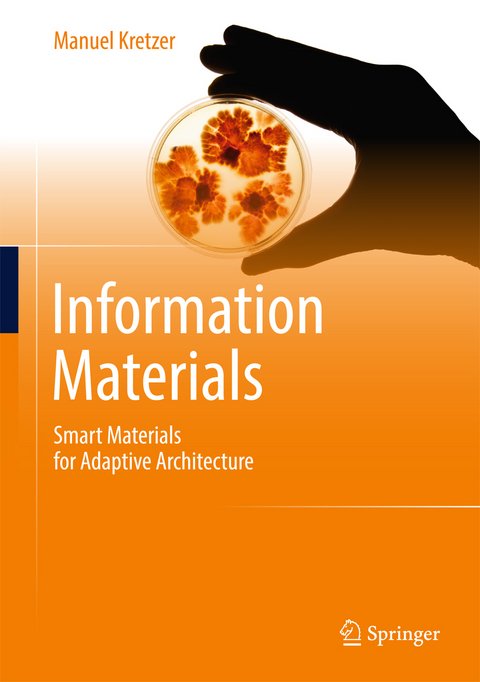
Information Materials (eBook)
XII, 191 Seiten
Springer International Publishing (Verlag)
978-3-319-35150-6 (ISBN)
This book considers the potential of new, smart materials and their use in architecture. It begins with an overview of current global tendencies (technological, demographic, and socio-anthropological) and their relevance for architectural design. Expanding upon approaches for flexible design solutions to address change and uncertainty, Dr. Kretzer begins by exploring adaptive architecture and proceeds to introduce the topic of 'information materials,' which encompasses smart and functional materials, their current usage, and their potential for the creation of future spaces. The second chapter provides a comprehensive overview of architectural materials, past and present, split into the topics: natural, industrial, synthetic, digital, and information materials. Chapter three introduces an educational approach for the mediation of information material usage in design courses and student workshops. The final section provides detailed information on a range of emerging material phenomena, including aerogels, bioluminescence, bio plastics, dye-sensitized solar cells, electroluminescent displays, electroactive polymers, soft robotics, and thermochromics. Each section explains its respective history, working principles, fabrication and (potential) usage in architecture and design, and provides hands-on tutorials on how to self-produce these materials, and displays class-tested experimental installations. The book concludes with an outlook into the domain of synthetic biology and the prospects of a 'living' architecture. It is ideal for students of structural materials engineering, architecture, and urban planning; professionals working these in areas, as well as materials science/engineering and architecture educators.
Manuel Kretzer is responsible for coordinating and leading the postgraduate Master of Advanced Studies class's digital design and production modules at ETH Zurich. His research aims at the notion of a soft and dynamic architecture with a specific focus on new (smart) material performance. In 2012 he established the materiability research network, a platform that brings together architects, artists, designers, students, scientists and researchers who share a common fascination with smart, programmable materials and their potential integration into architecture. He is also partner and co-founder of responsive design studio, based in Cologne and Zurich.
Manuel Kretzer is responsible for coordinating and leading the postgraduate Master of Advanced Studies class’s digital design and production modules at ETH Zurich. His research aims at the notion of a soft and dynamic architecture with a specific focus on new (smart) material performance. In 2012 he established the materiability research network, a platform that brings together architects, artists, designers, students, scientists and researchers who share a common fascination with smart, programmable materials and their potential integration into architecture. He is also partner and co-founder of responsive design studio, based in Cologne and Zurich.
Foreword 5
Preface 7
Contents 9
1 Current Global Challenges, the Concept of Adaptive Architecture, and the Possibilities of Information Materials 13
1.1 Introduction 13
1.2 Global Developments and Their Relevance for the Architectural Discourse 15
1.2.1 Technological Advancements 15
1.2.2 Demographic Growth 16
1.2.3 Socio-anthropological Trends 17
1.3 Challenges for Architecture and Building 18
1.3.1 Junkspace or the Loss of Architectural Identity 20
1.3.2 Superficiality and the Digitization of Materiality 20
1.4 Flexibility as a Spatial Method to Address Change and Progress 21
1.4.1 Adaptive Architecture 23
1.4.2 Types of Adaptive Architecture 24
1.4.3 Material Intelligence 24
1.5 Information Materials 25
1.5.1 Potential of Information Materials for Architectural Usage 27
1.5.2 Shortcomings of Current Information Material Usage 28
1.5.2.1 Conjunction with Rigid Materials 28
1.5.2.2 Replacement of Existing Technologies 28
1.5.2.3 Standardization and Inclusion in Established Catalogs 28
1.5.2.4 Scientific Mystification and Commercial (Un-)Availability 29
1.6 Toward a New Softness 29
1.6.1 A Different Kind of Material Thinking 30
1.6.2 Structure of the Book 31
1.6.3 Line of Argumentation 31
1.6.3.1 Chapter 2: The Ever-Changing Nature of Materiality and the Meaning of Materials in Architecture and Construction 31
1.6.3.2 Chapter 3: An Attempt for the Education of an Information Material Literacy in Respect to Emerging Materials 32
1.6.3.3 Chapter 4: A Selection of Emerging Information Materials, Their Properties, Fabrication, and Application in Speculative Spatial Installations 32
1.6.3.4 Chapter 5: Toward a New Softness 33
References 33
2 The Ever-Changing Nature of Materiality and the Meaning of Materials in Architecture and Construction 36
2.1 Introduction 36
2.1.1 Structure of the Present Chapter 38
2.2 Natural Materials 40
2.2.1 The Influence of Vitruvian Thought on Current New Materialism Positions 41
2.2.2 The Growing Detachment of Form from Materiality 43
2.2.3 The Domination of Human Intellect Over Natural Materiality 45
2.3 Industrial Materials 47
2.3.1 Durand’s Grammars in Relation to Schumacher’s Parametricism 49
2.3.2 The Intellectual Emancipation of Form from Materiality 50
2.3.3 Technological and Material Advancement During the Industrial Revolution 51
2.3.4 Functionality Takes Precedence Over Aesthetics and Form 52
2.4 Synthetic Materials 53
2.4.1 The Age of Plastics 54
2.4.2 Utopian Visions for a Better Tomorrow 55
2.5 Intermediate Summary and Conclusion 56
2.6 Digital Materials 57
2.6.1 The Emergence of Digital Design and Fabrication Techniques 59
2.6.2 New Instruments for the Architectural Design Practice 60
2.6.3 The Digital Chain: From Design to Production 62
2.7 Information Materials 63
2.7.1 Programmable Matter 63
2.7.2 The Soft Kinetics of Smart Materials 64
2.7.3 Definitions of Smart Materials 65
2.7.4 Concepts for Information Materials Usage in Architecture 67
2.7.5 Material Behavior in Regards to Energy, Time, and Space 69
2.8 Final Summary and Conclusion 71
References 73
3 Materiability—An Attempt for the Education of an Information Material Literacy in Respect to Emerging Materials 77
3.1 Introduction 77
3.2 The Process of Physical Making 80
3.2.1 The Inherent Dynamics of Information Materials 81
3.2.2 The Educational Framework of the Materiability Approach 81
3.3 Access to Information 83
3.3.1 Approaches for the Mediation of Material Knowledge 85
3.3.2 The Materiability Research Network: Access to Information Materials 86
3.4 Information Material Literacy 87
3.4.1 Collective Making in the Third Industrial Revolution 88
3.4.2 The Materiability Research Network: A Growing Community 89
3.5 Summary and Conclusion 91
References 92
4 A Selection of Emerging Information Materials, Their Properties, Fabrication, and Application in Speculative Spatial Installations 94
4.1 Introduction 94
4.2 Aerogels 95
4.2.1 History 95
4.2.2 Material Structure and Synthesis 96
4.2.2.1 Sol-Gel Process 97
4.2.2.2 Supercritical Drying 97
4.2.2.3 Supercritical CO2 Drying 98
4.2.2.4 Freeze-Drying 98
4.2.2.5 Ambient Pressure Drying 99
4.2.3 Fabrication 99
4.2.3.1 Materials and Tools 99
4.2.3.2 Steps 99
4.2.4 Applications 104
4.3 Bioluminescence 104
4.3.1 History 105
4.3.2 Material Structure and Operation 105
4.3.2.1 Insects 106
4.3.2.2 Foxfire 106
4.3.2.3 Luminous Bacteria 106
4.3.2.4 Deep-Sea Bioluminescence 107
4.3.2.5 Synthetic Bioluminescence 108
4.3.3 Fabrication 108
4.3.3.1 Materials and Tools 108
4.3.3.2 Steps 109
4.3.4 Applications 110
4.4 Bioplastics 111
4.4.1 History 111
4.4.2 Material Structure and Synthesis 112
4.4.2.1 Polysaccharides 113
4.4.2.2 Proteins 113
4.4.2.3 Polyhydroxyalkanoates 113
4.4.2.4 Polylactides 114
4.4.2.5 Polycaprolactones 114
4.4.2.6 Polyamides 114
4.4.3 Fabrication 115
4.4.3.1 Materials and Tools 115
4.4.3.2 Steps 115
4.4.3.3 Alternative Recipes 117
4.4.4 Case Studies 117
4.4.4.1 Phototropia (2012) 117
4.4.4.2 Bioplastic Formfinding Workshop (2012) 118
4.4.5 Applications 119
4.5 Dye-Sensitized Solar Cells 120
4.5.1 History 121
4.5.2 Material Structure and Operation 121
4.5.3 Fabrication 122
4.5.3.1 Materials and Tools 123
4.5.3.2 Steps 123
4.5.4 Case Studies 125
4.5.4.1 Phototropia (2012) 125
4.5.5 Applications 128
4.6 Electroluminescent Displays 128
4.6.1 History 129
4.6.2 Material Structure and Operation 130
4.6.3 Fabrication 131
4.6.3.1 Materials and Tools 131
4.6.3.2 Steps 132
4.6.4 Case Studies 135
4.6.4.1 Material Animation (2011) 135
4.6.4.2 Actuated Matter (2011) 137
4.6.4.3 Luminous Textiles (2015) 138
4.6.5 Applications 138
4.7 Electroactive Polymers 139
4.7.1 History 139
4.7.2 Material Structure and Operation 140
4.7.3 Fabrication 141
4.7.3.1 Materials and Tools 142
4.7.3.2 Steps 142
4.7.4 Case Studies 144
4.7.4.1 ShapeShift (2010) 145
4.7.4.2 Animated Textiles (2012) 146
4.7.5 Applications 146
4.8 Soft Robotics 147
4.8.1 Material Structure and Operation 148
4.8.1.1 Locomotion 148
4.8.1.2 Gripping 149
4.8.1.3 Camouflage 149
4.8.1.4 Immediacy 149
4.8.2 Fabrication 150
4.8.2.1 Materials and Tools 150
4.8.2.2 Steps 150
4.8.3 Case Studies 152
4.8.3.1 Soft Motion and Liquids (2012) 152
4.8.4 Applications 153
4.9 Thermochromics 154
4.9.1 History 154
4.9.2 Material Structure and Operation 155
4.9.2.1 Leuco Dye Systems 155
4.9.2.2 Liquid Crystal Systems 156
4.9.3 Fabrication 157
4.9.3.1 Materials and Tools 158
4.9.3.2 Steps 158
4.9.4 Case Studies 161
4.9.4.1 Resinance (2013) 162
4.9.4.2 Resinance 2.0 (2013) 165
4.9.4.3 Dynamics in Extreme Environments (2015) 166
4.9.5 Applications 168
4.10 Summary and Conclusion 169
References 170
5 Towards a New Softness 176
5.1 Introduction and Book Summary 176
5.2 Thinking Information Materials 178
5.2.1 How Has Material Development and Usage Evolved in Architecture Over the Course of Time and How Has This Influenced the Practice and Education of the Architect? 178
5.2.2 What Is the Current Meaning and Usage of Information Materials in Architecture and How Might It Change in the Future? 179
5.2.3 What Are Didactic Models that Focus on the Mediation of Dynamics, Processes, and Behaviors and How Can Explorative Material Research Become a Vital Aspect of Architectural Education? 180
5.2.4 How Can a Distinct Pedagogic Approach Be Evaluated and How Can Research Results Be Disseminated to a Large, Global Audience? 181
5.3 Liquid Architecture 182
5.4 Towards a New Softness 184
References 187
Appendix A 189
Glossary 196
| Erscheint lt. Verlag | 3.11.2016 |
|---|---|
| Zusatzinfo | XII, 191 p. 226 illus., 193 illus. in color. |
| Verlagsort | Cham |
| Sprache | englisch |
| Themenwelt | Geisteswissenschaften |
| Sozialwissenschaften ► Pädagogik | |
| Technik ► Architektur | |
| Technik ► Bauwesen | |
| Technik ► Maschinenbau | |
| Schlagworte | adaptive architecture • Aerogels • architectural education • Bioluminescence • Bioplastics • dye-sensitized solar cells • Electroactive Polymers • Electroluminescent displays • Functional materials in architecture • Industrial materials • Natural Materials • Smart Materials in architecture • Soft Robotics • Thermochromics |
| ISBN-10 | 3-319-35150-8 / 3319351508 |
| ISBN-13 | 978-3-319-35150-6 / 9783319351506 |
| Informationen gemäß Produktsicherheitsverordnung (GPSR) | |
| Haben Sie eine Frage zum Produkt? |
 PDF (Wasserzeichen)
DRM: Digitales Wasserzeichen
Dieses eBook enthält ein digitales Wasserzeichen und ist damit für Sie personalisiert. Bei einer missbräuchlichen Weitergabe des eBooks an Dritte ist eine Rückverfolgung an die Quelle möglich.
Dateiformat: PDF (Portable Document Format)
Mit einem festen Seitenlayout eignet sich die PDF besonders für Fachbücher mit Spalten, Tabellen und Abbildungen. Eine PDF kann auf fast allen Geräten angezeigt werden, ist aber für kleine Displays (Smartphone, eReader) nur eingeschränkt geeignet.
Systemvoraussetzungen:
PC/Mac: Mit einem PC oder Mac können Sie dieses eBook lesen. Sie benötigen dafür einen PDF-Viewer - z.B. den Adobe Reader oder Adobe Digital Editions.
eReader: Dieses eBook kann mit (fast) allen eBook-Readern gelesen werden. Mit dem amazon-Kindle ist es aber nicht kompatibel.
Smartphone/Tablet: Egal ob Apple oder Android, dieses eBook können Sie lesen. Sie benötigen dafür einen PDF-Viewer - z.B. die kostenlose Adobe Digital Editions-App.
Buying eBooks from abroad
For tax law reasons we can sell eBooks just within Germany and Switzerland. Regrettably we cannot fulfill eBook-orders from other countries.
aus dem Bereich


