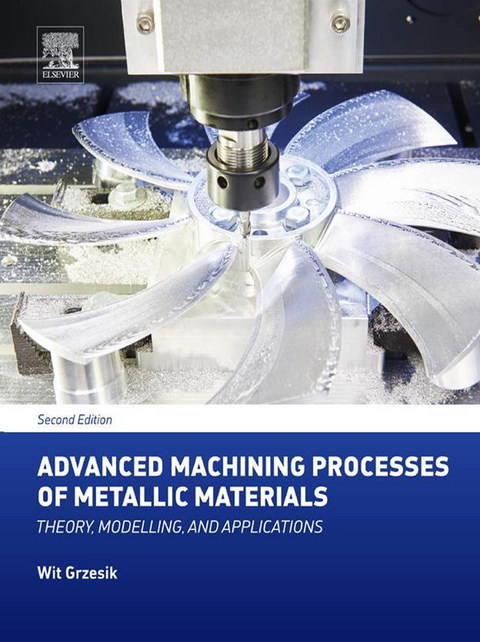
Advanced Machining Processes of Metallic Materials (eBook)
608 Seiten
Elsevier Science (Verlag)
978-0-444-63720-8 (ISBN)
Wit Grzesik, MSc, PhD, DScProfessor of Mechanical Engineering, obtained an M.Sc. in mechanical engineering from the Technical University of Wroclaw, Poland, in 1973, a Ph.D. in manufacturing engineering from this university in 1981, and a D.Sc. (habilitation) in mechanical engineering from Warsaw University of Technology in 1988. From 1973 to 1975 he worked in industry as a design engineer. In 1975 he joined the Technical University of Opole, Poland. He has been a faculty member in the Department of Manufacturing Engineering as Assistant Professor from 1982 to 1988, Associate Professor from 1988 to 1991 and Professor to 1999. At present he is a Full Professor and Chairman of the Department of Manufacturing Engineering and Production Automation at the Technical University of Opole.He has published more than 140 papers in journals and conference proceedings, two research monographs on metal cutting mechanics and machinability of austenitic stainless steels, and three books on machining of metallic materials, advanced coatings for engineering applications and programming of CNC machine tools. His research interests include the theory and modeling of metal removal processes, monitoring of manufacturing processes, surface integrity, quality engineering and CAD/CAM and modern manufacturing systems.Currently, he is a Member of two Sections of the Polish Academy of Science, and a Member of ESAFORM and a Senior Member of the NAMRI/SME (U.S.)
Advanced Machining Processes of Metallic Materials: Theory, Modelling and Applications, Second Edition, explores the metal cutting processes with regard to theory and industrial practice. Structured into three parts, the first section provides information on the fundamentals of machining, while the second and third parts include an overview of the effects of the theoretical and experimental considerations in high-level machining technology and a summary of production outputs related to part quality. In particular, topics discussed include: modern tool materials, mechanical, thermal and tribological aspects of machining, computer simulation of various process phenomena, chip control, monitoring of the cutting state, progressive and hybrid machining operations, as well as practical ways for improving machinability and generation and modeling of surface integrity. This new edition addresses the present state and future development of machining technologies, and includes expanded coverage on machining operations, such as turning, milling, drilling, and broaching, as well as a new chapter on sustainable machining processes. In addition, the book provides a comprehensive description of metal cutting theory and experimental and modeling techniques, along with basic machining processes and their effective use in a wide range of manufacturing applications. The research covered here has contributed to a more generalized vision of machining technology, including not only traditional manufacturing tasks, but also potential (emerging) new applications, such as micro and nanotechnology. - Includes new case studies illuminate experimental methods and outputs from different sectors of the manufacturing industry- Presents metal cutting processes that would be applicable for various technical, engineering, and scientific levels- Includes an updated knowledge of standards, cutting tool materials and tools, new machining technologies, relevant machinability records, optimization techniques, and surface integrity
| Erscheint lt. Verlag | 15.11.2016 |
|---|---|
| Sprache | englisch |
| Themenwelt | Technik ► Maschinenbau |
| ISBN-10 | 0-444-63720-6 / 0444637206 |
| ISBN-13 | 978-0-444-63720-8 / 9780444637208 |
| Informationen gemäß Produktsicherheitsverordnung (GPSR) | |
| Haben Sie eine Frage zum Produkt? |
 EPUB (Adobe DRM)
Kopierschutz: Adobe-DRM
Adobe-DRM ist ein Kopierschutz, der das eBook vor Mißbrauch schützen soll. Dabei wird das eBook bereits beim Download auf Ihre persönliche Adobe-ID autorisiert. Lesen können Sie das eBook dann nur auf den Geräten, welche ebenfalls auf Ihre Adobe-ID registriert sind.
Details zum Adobe-DRM
Dateiformat: EPUB (Electronic Publication)
EPUB ist ein offener Standard für eBooks und eignet sich besonders zur Darstellung von Belletristik und Sachbüchern. Der Fließtext wird dynamisch an die Display- und Schriftgröße angepasst. Auch für mobile Lesegeräte ist EPUB daher gut geeignet.
Systemvoraussetzungen:
PC/Mac: Mit einem PC oder Mac können Sie dieses eBook lesen. Sie benötigen eine
eReader: Dieses eBook kann mit (fast) allen eBook-Readern gelesen werden. Mit dem amazon-Kindle ist es aber nicht kompatibel.
Smartphone/Tablet: Egal ob Apple oder Android, dieses eBook können Sie lesen. Sie benötigen eine
Geräteliste und zusätzliche Hinweise
Buying eBooks from abroad
For tax law reasons we can sell eBooks just within Germany and Switzerland. Regrettably we cannot fulfill eBook-orders from other countries.
aus dem Bereich