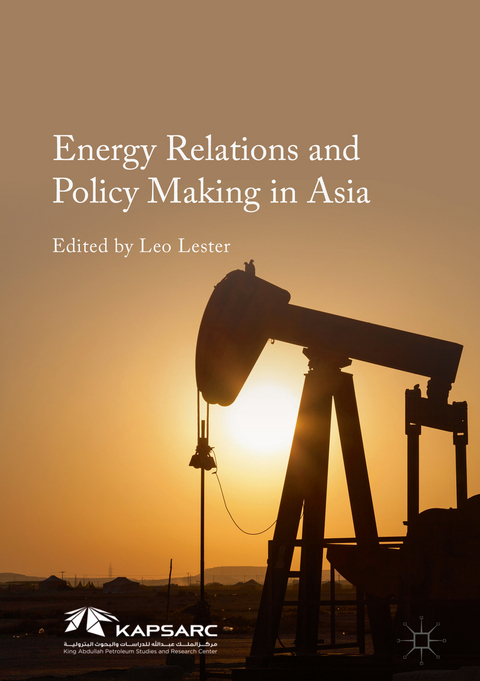
Energy Relations and Policy Making in Asia (eBook)
XXVI, 326 Seiten
Springer Singapore (Verlag)
978-981-10-1094-1 (ISBN)
This volume goes beyond a conventional analysis of Asia's energy relationships and explores the premise that energy relations in Asia in the 21st century should reinforce mutual interdependence. Conventional analyses of international energy relations stress the asymmetric nature of the risks and costs of disruptions to energy flows. Energy suppliers (net exporters) are concerned with the cost of a buyer looking elsewhere; energy consumers (net importers) are preoccupied with the costs associated with an interruption of supply. This perspective reflects the current transactional nature of energy relations and is clearly observed in the energy dynamics between countries in the Gulf Cooperation Council (GCC) and the economies of Northeast Asia (NEA).
As the economies of both the GCC and NEA have enlarged there is under-recognized potential for a move away from narrow transactional relations to broader, interdependent ones. This collection of essays from leading energy, strategic, and economic policy think tanks focused on how energy relations are forming in the 21st century offers energy scholars and policy makers answers to what these increasingly close relationships mean for international politics and trade.
Leo Lester is a Research Fellow leading KAPSARC's China and North East Asia research portfolio. Before joining KAPSARC, he worked in strategy and portfolio development for an international oil company.
This volume goes beyond a conventional analysis of Asia's energy relationships and explores the premise that energy relations in Asia in the 21st century should reinforce mutual interdependence. Conventional analyses of international energy relations stress the asymmetric nature of the risks and costs of disruptions to energy flows. Energy suppliers (net exporters) are concerned with the cost of a buyer looking elsewhere; energy consumers (net importers) are preoccupied with the costs associated with an interruption of supply. This perspective reflects the current transactional nature of energy relations and is clearly observed in the energy dynamics between countries in the Gulf Cooperation Council (GCC) and the economies of Northeast Asia (NEA). As the economies of both the GCC and NEA have enlarged there is under-recognized potential for a move away from narrow transactional relations to broader, interdependent ones. This collection of essays from leading energy, strategic, and economic policy think tanks focused on how energy relations are forming in the 21st century offers energy scholars and policy makers answers to what these increasingly close relationships mean for international politics and trade.
Leo Lester is a Research Fellow leading KAPSARC’s China and North East Asia research portfolio. Before joining KAPSARC, he worked in strategy and portfolio development for an international oil company.
Part 11.GCC-NEA Oil Trade: Competition in Asian Oil Markets and the Russian ‘Pivot’ East – KAPSARC (GCC)2.Potential impact of methane hydrate development on GCC and NEA energy trade – MASDAR (GCC)3.Effects of Oil Price Volatility on Bilateral Trade between China and GCC – State Information Center (NEA)4.Market and Hierarchical Interactions between East and West Asian Oil Sectors: Theory and Practice – DERASAT (GCC)5.From GCC-Asian Energy-oriented Trade to Comprehensive Trade and Investment Links: A Case Study of Taiwan – Chung-Hua Institution for Economic Research and CTCI Foundation (NEA)Part 26.Changes in the Chinese natural gas market and their potential impacts on the relationship between China and GCC countries – Shanghai Fudan University (NEA)7.Impacts of PV Adoption in Qatar on LNG Exports Northeast Asia and Ensuring Environmental Benefits – QEERI (GCC)8.The Dynamics of Energy Geopolitics in the Gulf and Qatar’s foreign relations with East Asia – Qatar University (GCC)Part 39.Evaluating the impact of oil exports in GCC countries on China’s oil security – Chinese Academy of Sciences (NEA)10.Assessing the Impact of Political Disruptions on Crude Oil Trade – KAPSARC (GCC)11.Commercial Stockpiling: An Alternative for Joint Stockpiling of Oil in North East Asia – KEEI (NEA)Part 412.Energy embodiments of the GCC and NEA countries – Renmin University of China (NEA)13.Analysis of cooperation potential on low-carbon energy between GCC and NEA – International Energy Research Center (NEA)14.An era of collaboration to promote energy efficiency – Institute of Energy Economics, Japan (NEA)
| Erscheint lt. Verlag | 31.10.2016 |
|---|---|
| Zusatzinfo | XXVI, 326 p. 16 illus. in color. |
| Verlagsort | Singapore |
| Sprache | englisch |
| Themenwelt | Naturwissenschaften ► Biologie ► Ökologie / Naturschutz |
| Technik ► Elektrotechnik / Energietechnik | |
| Wirtschaft ► Volkswirtschaftslehre | |
| Schlagworte | Energy Policy • Energy Policy and International Relations • Energy Security • Middle East-China Trade • One Belt, One Road |
| ISBN-10 | 981-10-1094-3 / 9811010943 |
| ISBN-13 | 978-981-10-1094-1 / 9789811010941 |
| Informationen gemäß Produktsicherheitsverordnung (GPSR) | |
| Haben Sie eine Frage zum Produkt? |
 PDF (Wasserzeichen)
DRM: Digitales Wasserzeichen
Dieses eBook enthält ein digitales Wasserzeichen und ist damit für Sie personalisiert. Bei einer missbräuchlichen Weitergabe des eBooks an Dritte ist eine Rückverfolgung an die Quelle möglich.
Dateiformat: PDF (Portable Document Format)
Mit einem festen Seitenlayout eignet sich die PDF besonders für Fachbücher mit Spalten, Tabellen und Abbildungen. Eine PDF kann auf fast allen Geräten angezeigt werden, ist aber für kleine Displays (Smartphone, eReader) nur eingeschränkt geeignet.
Systemvoraussetzungen:
PC/Mac: Mit einem PC oder Mac können Sie dieses eBook lesen. Sie benötigen dafür einen PDF-Viewer - z.B. den Adobe Reader oder Adobe Digital Editions.
eReader: Dieses eBook kann mit (fast) allen eBook-Readern gelesen werden. Mit dem amazon-Kindle ist es aber nicht kompatibel.
Smartphone/Tablet: Egal ob Apple oder Android, dieses eBook können Sie lesen. Sie benötigen dafür einen PDF-Viewer - z.B. die kostenlose Adobe Digital Editions-App.
Buying eBooks from abroad
For tax law reasons we can sell eBooks just within Germany and Switzerland. Regrettably we cannot fulfill eBook-orders from other countries.
aus dem Bereich