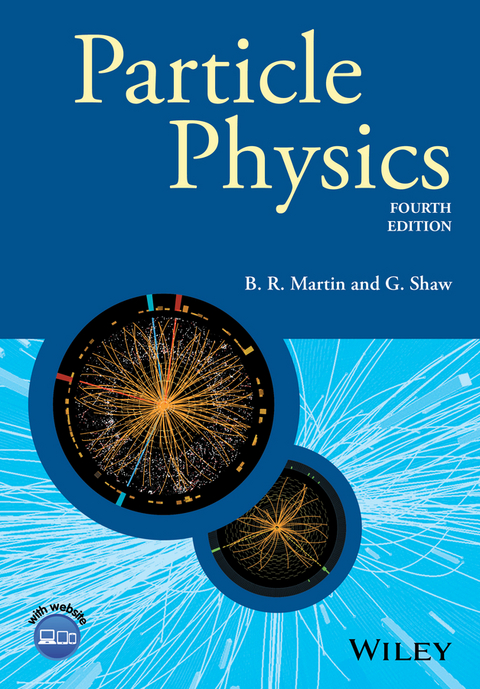
Particle Physics (eBook)
John Wiley & Sons (Verlag)
978-1-118-91229-4 (ISBN)
An accessible and carefully structured introduction to Particle Physics, including important coverage of the Higgs Boson and recent progress in neutrino physics.
- Fourth edition of this successful title in the Manchester Physics series
- Includes information on recent key discoveries including: An account of the discovery of exotic hadrons, byond the simple quark model; Expanded treatments of neutrino physics and CP violation in B-decays; An updated account of 'physics beyond the standard model', including the interaction of particle physics with cosmology
- Additional problems in all chapters, with solutions to selected problems available on the book's website
- Advanced material appears in optional starred sections
Professor Brian R Martin, Emeritus, Department of Physics & Astronomy, University College London, UK
Brian Martin was a full-time member of staff of the Department of Physics & Astronomy at UCL from 1968 to 1995, including a decade from 1994 to 2004 as Head of the Department. He retired in 2005 and now holds the title of Emeritus Professor of Physics. He has extensive experience of teaching undergraduate mathematics classes at all levels and experience of other universities via external examining for first degrees at Imperial College and Royal Holloway College London. He was also the external member of the General Board of the Department of Physics at Cambridge University that reviewed the whole academic programme of that department, including teaching.
Dr Graham Shaw, School of Physics & Astronomy, The University of Manchester, UK
Graham Shaw (http://www.hep.man.ac.uk/u/graham/) was a full-time member of staff of the School of Physics & Astronomy at Manchester University until September 2009. He continued to teach part-time until September 2012 and currently holds an honorary position in the department. He has extensive experience of teaching undergraduate physics and the associated mathematics and was a member of the school's Teaching Committee and Course Director of the Honours School of Mathematics and Physics for many years.
An accessible and carefully structured introduction to Particle Physics, including important coverage of the Higgs Boson and recent progress in neutrino physics. Fourth edition of this successful title in the Manchester Physics series Includes information on recent key discoveries including: An account of the discovery of exotic hadrons, byond the simple quark model; Expanded treatments of neutrino physics and CP violation in B-decays; An updated account of physics beyond the standard model , including the interaction of particle physics with cosmology Additional problems in all chapters, with solutions to selected problems available on the book s website Advanced material appears in optional starred sections
Professor Brian R Martin, Emeritus, Department of Physics & Astronomy, University College London, UK Brian Martin was a full-time member of staff of the Department of Physics & Astronomy at UCL from 1968 to 1995, including a decade from 1994 to 2004 as Head of the Department. He retired in 2005 and now holds the title of Emeritus Professor of Physics. He has extensive experience of teaching undergraduate mathematics classes at all levels and experience of other universities via external examining for first degrees at Imperial College and Royal Holloway College London. He was also the external member of the General Board of the Department of Physics at Cambridge University that reviewed the whole academic programme of that department, including teaching. Dr Graham Shaw, School of Physics & Astronomy, The University of Manchester, UK Graham Shaw (http://www.hep.man.ac.uk/u/graham/) was a full-time member of staff of the School of Physics & Astronomy at Manchester University until September 2009. He continued to teach part-time until September 2012 and currently holds an honorary position in the department. He has extensive experience of teaching undergraduate physics and the associated mathematics and was a member of the school's Teaching Committee and Course Director of the Honours School of Mathematics and Physics for many years.
Particle Physics 3
Contents 9
Editors' preface to the Manchester Physics Series 15
Authors' preface 17
Suggested Short Course 19
Notes 21
Starred material 21
Website 21
Data 21
Problems 21
Illustrations 21
Physical Constants, Conversion Factors and Natural Units 23
1 Some basic concepts 25
1.1 Introduction 25
1.2 Antiparticles 27
1.2.1 Relativistic wave equations 27
1.2.2 Hole theory and the positron 30
1.3 Interactions and Feynman diagrams 33
1.3.1 Basic electromagnetic processes 34
1.3.2 Real processes 35
1.3.3 Electron–positron pair production and annihilation 37
1.3.4 Other processes 39
1.4 Particle exchange 39
1.4.1 Range of forces 39
1.4.2 The Yukawa potential 41
1.4.3 The zero-range approximation 42
1.5 Units and dimensions 43
2 Leptons and the weak interaction 48
2.1 Lepton multiplets and lepton numbers 48
2.1.1 Electron neutrinos 49
2.1.2 Further generations 52
2.2 Leptonic weak interactions 55
2.2.1 W± and Z0 exchange 55
2.2.2 Lepton decays and universality 57
2.3 Neutrino masses and neutrino mixing 59
2.3.1 Neutrino mixing 59
2.3.2 Neutrino oscillations 62
2.3.3 Neutrino masses 70
2.3.4 Lepton numbers revisited 72
3 Quarks and hadrons 76
3.1 Quarks 77
3.2 General properties of hadrons 79
3.3 Pions and nucleons 82
3.4 Strange particles, charm and bottom 85
3.5 Short-lived hadrons 90
3.6 Allowed and exotic quantum numbers 96
4 Experimental methods 101
4.1 Overview 101
4.2 Accelerators and beams 103
4.2.1 Linear accelerators 104
4.2.2 Cyclic accelerators 105
4.2.3 Fixed-target machines and colliders 107
4.2.4 Neutral and unstable particle beams 109
4.3 Particle interactions with matter 110
4.3.1 Short-range interactions with nuclei 110
4.3.2 Ionisation energy losses 113
4.3.3 Radiation energy losses 116
4.3.4 Interactions of photons in matter 117
4.3.5 Ranges and interaction lengths 118
4.4 Particle detectors 119
4.4.1 Introduction 120
4.4.2 Gaseous ionisation detectors 121
4.4.3 Semiconductor detectors 127
4.4.4 Scintillation counters 128
4.4.5 ?erenkov counters and transition radiation 129
4.4.6 Calorimeters 133
4.5 Detector systems and accelerator experiments 136
4.5.1 Discovery of the W± and Z0 bosons 137
4.5.2 Some modern detector systems 141
4.6 Non-accelerator experiments 145
5 Space–time symmetries 150
5.1 Translational invariance 151
5.2 Rotational invariance 153
5.2.1 Angular momentum conservation 153
5.2.2 Classification of particles 156
5.2.3 Angular momentum in the quark model 158
5.3 Parity 159
5.3.1 Leptons and antileptons 161
5.3.2 Quarks and hadrons 163
5.3.3 Parity of the charged pion 164
5.3.4 Parity of the photon 165
5.4 Charge conjugation 166
5.4.1 ?0 and ? decays 168
5.5 Positronium 169
*5.5.1 Fine structure 171
*5.5.2 C parity and annihilations 172
*5.6 Time reversal 173
5.6.1 Principle of detailed balance 175
5.6.2 Spin of the charged pion 176
6 The quark model 179
6.1 Isospin symmetry 180
6.1.1 Isospin quantum numbers 181
6.1.2 Allowed quantum numbers 182
6.1.3 An example: the sigma (?) baryons 183
6.1.4 The u, d quark mass splitting 185
6.2 The lightest hadrons 186
6.2.1 The light mesons 186
6.2.2 The light baryons 188
*6.2.3 Baryon magnetic moments 191
*6.2.4 Hadron mass splittings 193
6.3 The L = 0 heavy quark states 198
6.4 Colour 201
6.4.1 Colour charges and confinement 202
*6.4.2 Colour wavefunctions and the Pauli principle 206
6.5 Charmonium and bottomonium 208
6.5.1 Charmonium 209
6.5.2 Bottomonium 213
*6.5.3 The quark–antiquark potential 213
7 QCD, jets and gluons 217
7.1 Quantum chromodynamics 217
7.1.1 The strong coupling constant 221
7.1.2 Screening, antiscreening and asymptotic freedom 223
*7.1.3 Exotic hadrons 225
*7.1.4 The quark–gluon plasma 232
7.2 Electron–positron annihilation 234
7.2.1 Two-jet events 235
7.2.2 Three-jet events 237
7.2.3 The total cross-section 238
8 Quarks and partons 241
8.1 Elastic electron scattering: the size of the proton 241
8.1.1 Static charge distributions 242
8.1.2 Proton form factors 243
*8.1.3 The basic cross-section formulas 245
8.2 Inelastic electron and muon scattering 246
8.2.1 Bjorken scaling 248
8.2.2 The parton model 250
8.2.3 Parton distributions and scaling violations 252
8.3 Inelastic neutrino scattering 255
8.3.1 Quark identification and quark charges 258
*8.4 Other processes 260
8.4.1 Lepton pair production 263
8.4.2 Jets in pp collisions 266
8.5 Current and constituent quarks 267
9 Weak interactions: quarks and leptons 272
9.1 Charged current reactions 274
9.1.1 W±–lepton interactions 274
9.1.2 Lepton–quark symmetry and mixing 278
9.1.3 W boson decays 282
*9.1.4 Selection rules in weak decays 283
9.2 The third generation 286
9.2.1 More quark mixing 287
9.2.2 Properties of the top quark 289
*9.2.3 Discovery of the top quark 291
10 Weak interactions: electroweak unification 300
10.1 Neutral currents and the unified theory 301
10.1.1 The basic vertices 301
10.1.2 The unification condition and the W± and Z0 masses 303
10.1.3 Electroweak reactions 305
10.1.4 Z0 formation: how many generations are there? 308
10.2 Gauge invariance and the Higgs boson 311
10.2.1 Unification and the gauge principle 313
10.2.2 Particle masses and the Higgs field 314
10.2.3 Properties of the Higgs boson 318
10.2.4 The discovery of the Higgs boson 321
11 Discrete symmetries: C, P, CP and CPT 332
11.1 P violation, C violation and CP conservation 332
11.1.1 Muon decay symmetries 334
11.1.2 Left-handed neutrinos and right-handed antineutrinos 336
11.1.3 Pion and muon decays revisited 338
11.2 CP violation and particle–antiparticle mixing 340
11.2.1 CP eigenstates of neutral kaons 340
11.2.2 The discovery of CP violation 343
*11.2.3 CP-violating K0 decays 345
11.2.4 Flavour oscillations and the CPT theorem 348
11.2.5 Direct CP violation in decay rates 352
11.2.6 B0 ? B0 mixing 353
*11.2.7 CP violation in interference 359
*11.2.8 Derivation of the mixing formulas 362
11.3 CP violation in the standard model 364
12 Beyond the standard model 370
12.1 Grand unification 371
12.1.1 Quark and lepton charges 373
12.1.2 The weak mixing angle 373
12.1.3 Proton decay 374
12.2 Supersymmetry 378
12.2.1 The search for supersymmetry 380
12.3 Strings and things 382
12.4 Particle physics and cosmology 384
12.4.1 Dark matter 384
12.4.2 Matter–antimatter asymmetry 391
12.4.3 CP violation and electric dipole moments 393
12.4.4 Axions and the strong CP problem 395
12.5 Dirac or Majorana neutrinos? 397
12.5.1 Double beta decay 399
Appendix A Relativistic kinematics 407
A.1 The Lorentz transformation for energy and momentum 407
A.2 The invariant mass 409
A.2.1 Beam energies and thresholds 409
A.2.2 Masses of unstable particles 411
*A.3 Transformation of the scattering angle 412
Appendix B Amplitudes and cross-sections 416
B.1 Rates and cross-sections 416
B.2 The total cross-section 418
B.3 Differential cross-sections 419
*B.4 The scattering amplitude 421
B.5 The Breit–Wigner formula 424
*B.5.1 Decay distributions 425
*B.5.2 Resonant cross-sections 428
Appendix *C The isospin formalism 432
C.1 Isospin operators 433
C.2 Isospin states 435
C.3 Isospin multiplets 435
C.3.1 Hadron states 436
C.4 Branching ratios 438
C.5 Spin states 440
Appendix D Gauge theories 442
D.1 Electromagnetic interactions 443
D.2 Gauge transformations 444
D.3 Gauge invariance and the photon mass 445
D.4 The gauge principle 447
D.5 The Higgs mechanism 449
D.5.1 Charge and current densities 449
D.5.2 Spin-0 bosons 451
D.5.3 Spontaneous symmetry breaking 452
D.6 Quantum chromodynamics 453
D.7 Electroweak interactions 458
D.7.1 Weak isospin 458
D.7.2 Gauge invariance and charged currents 460
D.7.3 The unification condition 461
D.7.4 Spin structure and parity violation 464
Appendix E Answers to selected questions 467
References 472
Index 475
Supplemental Images 481
EULA 485
| Erscheint lt. Verlag | 7.11.2016 |
|---|---|
| Reihe/Serie | Manchester Physics Series |
| The Manchester Physics Series | The Manchester Physics Series |
| Sprache | englisch |
| Themenwelt | Naturwissenschaften ► Physik / Astronomie ► Atom- / Kern- / Molekularphysik |
| Naturwissenschaften ► Physik / Astronomie ► Hochenergiephysik / Teilchenphysik | |
| Technik | |
| Schlagworte | Astronomie • Astronomie u. Astrophysik • Astronomy & Astrophysics • Exotic hadrons • Higgs-Boson • Kern- u. Hochenergiephysik • Matter and Forces • Neutrino Physics • Nuclear & High Energy Physics • Particle physics • Particle Physics and Cosmology • Physics • Physik • Teilchenphysik |
| ISBN-10 | 1-118-91229-2 / 1118912292 |
| ISBN-13 | 978-1-118-91229-4 / 9781118912294 |
| Informationen gemäß Produktsicherheitsverordnung (GPSR) | |
| Haben Sie eine Frage zum Produkt? |
 PDF (Adobe DRM)
Kopierschutz: Adobe-DRM
Adobe-DRM ist ein Kopierschutz, der das eBook vor Mißbrauch schützen soll. Dabei wird das eBook bereits beim Download auf Ihre persönliche Adobe-ID autorisiert. Lesen können Sie das eBook dann nur auf den Geräten, welche ebenfalls auf Ihre Adobe-ID registriert sind.
Details zum Adobe-DRM
Dateiformat: PDF (Portable Document Format)
Mit einem festen Seitenlayout eignet sich die PDF besonders für Fachbücher mit Spalten, Tabellen und Abbildungen. Eine PDF kann auf fast allen Geräten angezeigt werden, ist aber für kleine Displays (Smartphone, eReader) nur eingeschränkt geeignet.
Systemvoraussetzungen:
PC/Mac: Mit einem PC oder Mac können Sie dieses eBook lesen. Sie benötigen eine
eReader: Dieses eBook kann mit (fast) allen eBook-Readern gelesen werden. Mit dem amazon-Kindle ist es aber nicht kompatibel.
Smartphone/Tablet: Egal ob Apple oder Android, dieses eBook können Sie lesen. Sie benötigen eine
Geräteliste und zusätzliche Hinweise
Buying eBooks from abroad
For tax law reasons we can sell eBooks just within Germany and Switzerland. Regrettably we cannot fulfill eBook-orders from other countries.
aus dem Bereich