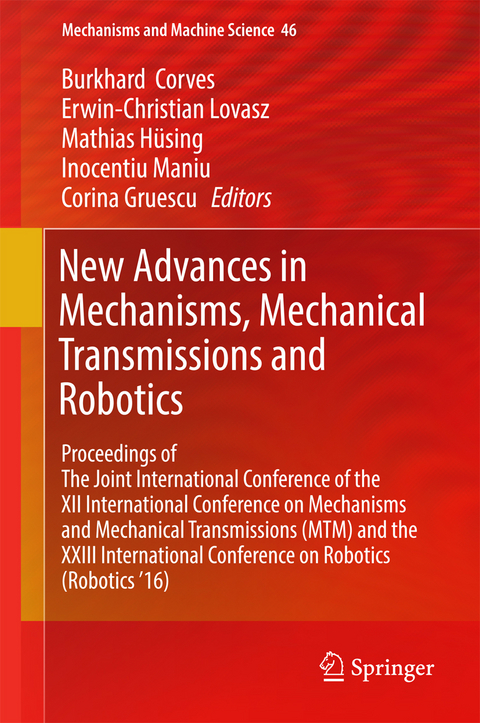
New Advances in Mechanisms, Mechanical Transmissions and Robotics (eBook)
XVII, 497 Seiten
Springer International Publishing (Verlag)
978-3-319-45450-4 (ISBN)
Preface 6
Organization 8
Contents 10
Abstracts of Keynote Speeches 15
MTM—Mechanisms—Analysis and Synthesis 18
1 Optimal Design of a Grasping Device Through Simplified Pose Synthesis of a Four-Bar Linkage 19
Abstract 19
1 Introduction 19
2 Structure and Actuation Design 20
3 Limitations in Applying the Five-Pose Synthesis 22
4 Chebyshev Spacing Method Applied in Pose Synthesis 23
5 Simplified Four-Pose Synthesis Method 25
6 Theoretical Precision of the Grasping Device 27
7 Conclusions 28
References 28
2 Modified Method of the Kinematic Analysis of Planar Linkage Mechanism for Non-stationary Motion Modes 30
Abstract 30
1 Introduction 30
2 Analysis of Velocities of the Mechanism Linkages 32
3 Analysis of Accelerations of Mechanism Linkages 35
4 Conclusions 38
References 38
3 A Type Synthesis Method for Parallel Mechanisms Based on SAKCs 39
Abstract 39
1 Introduction 40
2 Mechanism Composition Principles and New Expression Based on SAKCs 40
2.1 Coupling Degree of a SAKC 40
2.2 A New Composition Expression of the PM Based on SAKC 41
3 Basic Types of SAKCs 42
3.1 All Possible SAKC Basic Types 42
3.2 Common SAKC Structures 43
4 Type Synthesis Method Based on SAKCs 44
4.1 Virtual POC Set of a SAKC Structure 44
4.2 Type Synthesis Method Based on SAKCs 45
5 Conclusions 48
Appendix: Classification of SAKC Structures Based on Virtual POC Set 49
References 50
4 Matlab GUI for SVAJ Cam Analysis Diagrams 51
Abstract 51
1 Introduction 52
2 General Description of the GL 112 Cam Analysis Apparatus 52
3 The Svaj Diagrams Application 54
4 Conclusions 58
References 58
5 On the Kinematic Analysis of a Sixth Class Mechanism 60
Abstract 60
1 Introduction 61
2 Kinematic Analysis of a Sixth Class Mechanism 62
2.1 Transmission Function of 0-Order 62
2.2 Transmission Function of 1st-Order. Velocities’ Distribution 64
3 Numerical Example and Proposed Application 66
4 Conclusions 70
References 70
6 Zero-Free-Length Elastic Systems for Static Balancing 71
Abstract 71
1 Introduction 71
2 Zero-Free-Length Elastic Systems 74
3 Example 77
4 Conclusions 77
References 77
7 Analytic and FEM Study of Load Distribution on the Length of Spline Joints Under Pure Torque 80
Abstract 80
1 Introduction 80
2 Analytic Model 82
3 FEM Model 83
4 Results Comparison 86
5 Conclusions 86
References 87
8 Dimensional Synthesis of Planar Parallel Manipulator Using Geared Linkages with Linear Actuation as Kinematic Chains 88
Abstract 88
1 Introduction 88
2 Synthesis of the 3-R(RPRGR)RR Manipulator 90
3 Numerical Examples 93
4 Conclusions 95
References 95
MTM—Dynamics of Mechanisms and Machines 97
The Concept of Natural Motionfor Pick and Place Operations 98
1 Introduction 98
2 The Concept of Natural Motion 99
3 Natural Motion of a Five Bar Linkage 100
3.1 Kinematic and Dynamic Model 101
3.2 Determination of the Appropriate Springs and Trajectory 101
3.3 Estimation of the Energy Consumption 103
4 Results 103
5 Conclusion and Outlook 106
References 106
10 Structural Synthesis of Planar Geared Linkage Mechanisms as Multibody Systems 108
Abstract 108
1 Introduction 108
2 Structural Synthesis of Mechanisms as Multibody Systems 109
3 Conclusions 114
Acknowledgments 115
References 115
11 Dynamics of a Vertical Unbalanced Gyroscopic Rotor with Nonlinear Characteristics 116
Abstract 116
1 Introduction 116
2 Rotor Motion Equations 117
3 Amplitude-Frequency and Phase-Frequency Characteristics and Stability of Oscillations 119
4 Numerical Results and Assessment of Parameters Impact 120
5 Conclusions 122
References 123
MTM—Mechanical Transmissions 124
12 Edge Tooth Addendum Thickness of Hindley Worm 125
Abstract 125
1 Introduction 125
2 Equations of Hindley Worm Surface and Its Axial Tooth Profile 126
3 Top Thickness Computation of Edge Tooth 128
4 Numerical Examples and Discussion 130
5 Conclusions 132
Acknowledgments 132
References 132
13 A Single Speed (CVT) Transmission 133
Abstract 133
1 Introduction 133
2 Kinematic Analysis of the Planetary Train with Two Carriers 134
3 Start-up of Mechanism with Two Carriers 137
4 Conclusion 138
References 139
14 An Approach for Modelling Harvester Head Mechanism in the Harvesting Process of Hardwood Stands 140
Abstract 140
1 Introduction 141
2 Geometric Modelling of Crooked Trunks 142
3 Modelling Building Blocks 143
3.1 Cutting Model 143
3.2 Feeding Model 145
4 Delimbing Process Simulation 146
5 Conclusions 147
Acknowledgments 147
References 147
15 Novel Speed Increaser Used in Counter-Rotating Wind Turbines 149
Abstract 149
1 Introduction 150
2 Problem Formulation 151
3 Transmission Modelling 151
4 Numerical Simulations: Results and Discussions 154
5 Conclusions 156
Acknowledgments 156
References 156
MTM—Micromechanisms and Microactuators 158
16 On Application Melnikov Method to Detecting the Edge of Chaos for a Micro-Cantilever 159
Abstract 159
1 Introduction 159
2 The Dynamics Modeling of Micro-Cantilever 160
3 Melnikov Function and Its Solutions 161
3.1 Melnikov Function 161
3.2 Analytical Solution of Melnikov Function 163
3.3 Numerical Solution of Melnikov Function 163
4 The Conditions of Chaos Occurrence and Results 164
5 Conclusions 166
Acknowledgments 166
References 166
MTM—Computational and Experimental Methods 168
17 Use of the Structomatic Method to Perform the Forward Kinematic and Kinetostatic Analyses of a Hydraulic Excavator 169
Abstract 169
1 Introduction 170
2 Structomatic Analysis 172
3 Kinematic Analysis 172
4 Kinetostatic Analysis 173
5 Implementation and Results 175
6 Conclusion 176
References 177
18 Application of a Cam Workbench for Education in Mechanical Engineering 178
Abstract 178
1 Introduction 179
2 Requirements of a Cam Workbench for Education 179
3 Conceptual Design of the Cam Workbench 180
3.1 Realized Transfer Function 180
3.2 Determination of the Cam Dimension 182
3.3 Calculation of the Cam Surface 183
4 Embodiment Design of the Workbench 185
5 Conclusions 186
References 187
19 Kinematic Characterization of the Origami Spring Based on a Spherical 6R Linkage 188
Abstract 188
1 Introduction 188
2 Features of the Origami Spring 189
3 Theoretical Kinematic Characterization 191
4 Practical Kinematic Characterization 192
5 Conclusions 196
References 197
20 Scaled Test Stand Simulation for Studying the Behavior of Anti-lock Brake Systems on Bumpy Roads 198
Abstract 198
1 Introduction 198
2 The Scaled Stand Design Concept 199
3 Solution Implementation 202
3.1 System Scaling 202
3.2 Profile Generation 204
4 Simulation Results 204
5 Conclusions 205
References 206
MTM—Terminology 207
21 Activities of Russian—Speaking Scientists in Development of MMS Terminology 208
Abstract 208
1 Introduction 209
2 Activities at Preparation of “IFToMM Terminology” 209
3 Individual Sections of the IFToMM Terminology 211
3.1 Gearing Terminology 211
3.2 Quality Factors of Machines and Their Components 212
4 Separate Projects for Gearing Terminology 212
5 Conclusions 213
Acknowledgments 214
22 State of Art in Separate Sections of MMS Terminology and Some Proposals 216
Abstract 216
1 Introductions 217
2 Proposals for “Biomechanics” Terminology 217
3 The Current State and Proposals for Development of Gearing Terminology 218
4 The State of Terminology in the Field of Mechatronics 218
5 Transportation Machinery and Logistics 220
6 The Proposals for Section of Quality Factors of Machines 220
7 Compliant Mechanisms 221
8 Conclusions 222
Acknowledgments 222
References 222
Robotics—Mechanical Design of Robot Architecture 225
23 Design Solutions to Simplify the Calibration of a Robotic Flexible Manufacturing System 226
Abstract 226
1 Introduction 226
2 Calibration Solutions Using a Common Base Plate 227
3 Design Solutions for Uncoupling the Position Movements 230
4 Conclusions 234
References 234
Robotics—Mobile Robots 236
24 Reconbot: A Reconfigurable Rescue Robot Composed of Serial-Parallel Hybrid Upper Humanoid Body and Track Mobile Platform 237
Abstract 237
1 Introduction 238
2 Robot Structures for Complex Environments 238
3 Reconbot Concept and Mechanism Design 239
4 Mobility Analysis 239
4.1 Screw System of Single Offset URU Branch Chain 240
4.2 Mobility Analysis of the Offset 2-URU PM 241
4.3 Reconfigurable Functions Description 242
5 Locomotion and Manipulation Functions 244
6 Conclusions 244
Acknowledgments 244
References 244
Kinematics Modelling of Mobile Robot with Articulated Limbs Without Wheel Slip 246
1 Introduction 246
2 Kinematics Modelling of Holonomic Constraints 247
3 Differential Kinematics Model of the Robot 250
4 Results of Simulation 252
5 Conclusions 253
References 253
26 Experimental Platform for Hexapod Locomotion 254
Abstract 254
1 Introduction 255
2 The Hexapod Mobile Robot 255
2.1 Leg Design and Kinematics 255
2.2 Workspace Analysis of the Leg 256
2.3 Hexapod Robot Model 257
3 Software Platform for Hexapod Robot Simulations 257
4 Experiments in Locomotion 259
4.1 Locomotion Strategy on a Spiral Stair 259
5 Conclusions 261
References 261
27 Quadcopter Propeller Design and Performance Analysis 263
Abstract 263
1 Introduction 263
2 Propeller Performance Parameters 264
3 Propeller Design Profile 266
4 Simulation Results and Discussions 267
5 Conclusions 270
Acknowledgments 270
References 270
A Method for Structural Synthesis of Cooperative Mobile Manipulators 272
1 Introduction 273
2 Specific Approach of Structural Synthesis of m-Bots and p-Bots 273
2.1 Structural Parameters 274
2.2 Specifications of the m-Bots/p-Bots and Simplifying Hypotheses 274
3 Application of the Approach for the Design of m-Bots/p-Bots 276
4 Conclusion 279
References 279
29 Mobile Robot Used to Collect Data from a Difficult Access Area 280
Abstract 280
1 Introduction 280
2 Mobile Robots 282
3 The Presentation of the Mobile Robot and Its Electronic Design 283
4 Conclusions 287
References 288
Robotics—Parallel Robots 289
30 Extended Procedure for Stiffness Modeling Based on the Matrix Structure Analysis 290
Abstract 290
1 Introduction 290
2 Methods of Stiffness Analysis—State of the Art 291
3 Extended Procedure for Stiffness Modeling 292
3.1 Elements and Element Stiffness Matrices 292
3.2 Stiffness Modeling by Matrix Assembly 295
3.3 Implementation of the Extended Procedure 295
4 Application and Validation for the Example Structure PARAGGRIP 297
5 Conclusions 299
Acknowledgments 299
References 299
31 Translational Parallel Manipulator with Pa2 Kinematic Joints 302
Abstract 302
1 Introduction 303
2 PMs with Pa and Pa2 Pairs 303
3 Pa2 Kinematic Joint Study 304
4 Position Problems of the 3-PPa2 PM 306
4.1 Direct Position Problem of 3-PPa2 PM 306
4.2 Inverse Position Problem of 3-PPa2 PM 307
4.3 Workspace 308
5 Singularities 308
6 Conclusions 309
References 309
32 Synthesis and Modeling of Redundantly Actuated Parallel Kinematic Manipulators—An Approach to Efficient Motion Design 311
Abstract 311
1 Introduction 312
2 Selection of the Kinematic Structure 313
3 Inverse Kinematics Problem 313
4 Inverse Dynamics Problem 315
5 Simulation Modeling 317
6 Discussion and Outlook 319
References 319
33 6-PSS Based Parallel Manipulators 321
Abstract 321
1 Introduction 321
2 6-PSS Kinematic Model 322
3 6-PSS Joint Parallel Structure 324
4 6-PSS Joint Parallel Manipulator 325
5 Single Actuator Spatial Manipulator 327
6 Conclusions 329
References 329
Robotics—Sensors and Actuators in Robotics 330
34 Compliant Rotary Actuator Driven by Shape Memory Alloy 331
Abstract 331
1 Introduction 331
2 Recall About Shape-Memory Alloys 332
3 Design of a Helical Rotary Actuator 332
4 Experimental Setup and Processing 334
5 Results 335
6 Conclusions 337
Acknowledgments 337
References 337
35 Modelling and Simulation of Linear Actuators in Mechatronic Systems 339
Abstract 339
1 Introduction 339
2 Mechatronic Philosophy and Parallel Robot Design 340
3 Linear Actuator Simulation and Experimental Analysis 343
4 Conclusions 346
References 346
Robotics—Robotic Control Systems 347
36 Dynamic Control for a Class of Continuum Robotic Arms 348
Abstract 348
1 Introduction 349
2 Technological Model 350
3 Mathematical Model 351
4 Control Algorithm 352
5 Experimental Results 353
6 Conclusions 354
Appendix 355
References 356
Actuator Design for Stabilizing Single Tendon Platforms 357
1 Introduction 357
2 Control Moment Gyroscopes 358
3 Forces to Compensate 360
4 Proposed Setup 361
5 Summary and Outlook 363
References 363
38 Model-Based Stability Prediction of a Machining Robot 365
Abstract 365
1 Introduction 366
2 Dynamic Modeling of the ABB IRB Robot 367
2.1 Model Calibration 368
3 Stability Lobes Diagram of a Robot Machining Operation 370
4 Conclusions 372
Acknowledgments 372
References 372
Robotics—Biomedical Engineering 374
Augmented PID Control of a 2PPR-2PRP Planar Parallel Manipulator for Lower Limb Rehabilitation Applications 375
1 Introduction 376
2 Kinematic Model of the Proposed System 377
3 Dynamics of the Proposed Manipulator 378
4 Augmented PID Position Tracking Control Scheme 379
5 Controller Performance Analyses Through Simulations 380
6 Concluding Remarks 382
References 382
40 Human Motion Characterization Using Wireless Inertial Sensors 384
Abstract 384
1 Introduction 384
2 Measurement—Method and Technology 385
3 Results of Experiments 388
4 Conclusions 391
Acknowledgments 391
References 391
41 Trajectory Analysis for Modified Jansen Leg Mechanism Configuration 392
Abstract 392
1 Introduction 393
2 Kinematic Position Analysis of Leg Mechanism 394
3 Analysis of Modified Jansen Leg Mechanism Path Curves 396
4 Conclusions 398
References 399
42 Development of an Assisting Instrument of Standing-Up Motion Using Driving Springs for Elderly Persons 400
Abstract 400
1 Introduction 400
2 Motion Analysis of a Standing-Up Motion 401
3 Structure of an Assisting Instrument 403
4 Design of a Hip Joint Assisting Mechanism 404
5 Design of a Knee Joint Assisting Mechanism 405
6 Verifications of a Prototype Instrument 407
7 Conclusions 407
References 407
43 An Evolutionary Computational Algorithm for Trajectory Planning of an Innovative Parallel Robot for Brachytherapy 409
Abstract 409
1 Introduction 410
2 PARA-BRACHYROB System Description 411
3 The Algorithm for Planning BT Needles Trajectories 412
4 Implementation Details and Results 414
5 Conclusions 416
Acknowledgments 416
References 416
44 Inverse Kinematics and Dynamics of an Overconstrained Manipulator for Upper Extremity Rehabilitation 418
Abstract 418
1 Introduction 418
2 Manipulator and the Rehabilitation Task 419
2.1 Kinematic Analysis 420
2.2 Dynamic Analysis 421
3 Conclusions and Future Work 424
References 424
Robotics—Teleoperation, Haptics, Virtual Reality 425
45 Image Processing Based Stiffness Mapping of a Haptic Device 426
Abstract 426
1 Introduction 426
2 Background Information 427
3 Experimental Setup 428
4 Experimentation Methodology 429
5 Experimental Test Results 430
6 Discussions and Conclusions 432
Acknowledgments 433
References 433
Robotics—Compliant Structures 434
Kinematic Analysis of a FlexibleTensegrity Robot 435
1 Introduction 435
2 Fundamentals of Nonlinear Analysis of Flexible Bars 436
3 Kinematic Analysis of the 2 DoF Parallel Continuum Robot 439
4 Numerical and Experimental Validation 440
5 Conclusions 442
References 442
47 Adaptive Compliant Gripper Finger with Embedded Contracting and Extending Actuators 443
Abstract 443
1 Introduction 443
2 Synthesis Methodology 445
3 FEM Analysis of the Adaptive Compliant Gripper Finger with Embedded Contracting and Extending Actuators 447
4 Conclusions 449
References 450
48 Kinematic and Dynamic Analysis of a 4DOF Parallel Robot with Flexible Links 451
Abstract 451
1 Introduction 451
2 Problem Formulation 452
3 Effects of Links Flexibility on Robot Behaviour 454
4 Influence of Friction on Driving Forces 456
5 Conclusions 458
References 458
Robotics—Robotic Applications 460
49 Automated Handling and Draping of Reinforcing Textiles—Challenges and Developments 461
Abstract 461
1 Introduction 462
2 Task Definition 463
2.1 Demonstrator Part 463
2.2 Drape Paths 463
3 Development of Subsystems 464
3.1 Grippers 464
3.2 End-Effector 466
3.3 Sensor Systems 467
4 Conclusions 468
Acknowledgments 468
References 468
Author Index 470
| Erscheint lt. Verlag | 30.9.2016 |
|---|---|
| Reihe/Serie | Mechanisms and Machine Science | Mechanisms and Machine Science |
| Zusatzinfo | XVII, 497 p. 275 illus. |
| Verlagsort | Cham |
| Sprache | englisch |
| Themenwelt | Technik ► Maschinenbau |
| Wirtschaft ► Betriebswirtschaft / Management ► Logistik / Produktion | |
| Schlagworte | CAD in mechanism and machine design • Computational and Experimental Methods • Dynamics of mechanisms and machines • intelligent control systems • mechanical design • Mechanical design of robot architecture • mechanical transmissions • Micromechanisms and Microactuators • parallel robots • Precision mechanics |
| ISBN-10 | 3-319-45450-1 / 3319454501 |
| ISBN-13 | 978-3-319-45450-4 / 9783319454504 |
| Informationen gemäß Produktsicherheitsverordnung (GPSR) | |
| Haben Sie eine Frage zum Produkt? |
 PDF (Wasserzeichen)
DRM: Digitales Wasserzeichen
Dieses eBook enthält ein digitales Wasserzeichen und ist damit für Sie personalisiert. Bei einer missbräuchlichen Weitergabe des eBooks an Dritte ist eine Rückverfolgung an die Quelle möglich.
Dateiformat: PDF (Portable Document Format)
Mit einem festen Seitenlayout eignet sich die PDF besonders für Fachbücher mit Spalten, Tabellen und Abbildungen. Eine PDF kann auf fast allen Geräten angezeigt werden, ist aber für kleine Displays (Smartphone, eReader) nur eingeschränkt geeignet.
Systemvoraussetzungen:
PC/Mac: Mit einem PC oder Mac können Sie dieses eBook lesen. Sie benötigen dafür einen PDF-Viewer - z.B. den Adobe Reader oder Adobe Digital Editions.
eReader: Dieses eBook kann mit (fast) allen eBook-Readern gelesen werden. Mit dem amazon-Kindle ist es aber nicht kompatibel.
Smartphone/Tablet: Egal ob Apple oder Android, dieses eBook können Sie lesen. Sie benötigen dafür einen PDF-Viewer - z.B. die kostenlose Adobe Digital Editions-App.
Buying eBooks from abroad
For tax law reasons we can sell eBooks just within Germany and Switzerland. Regrettably we cannot fulfill eBook-orders from other countries.
aus dem Bereich