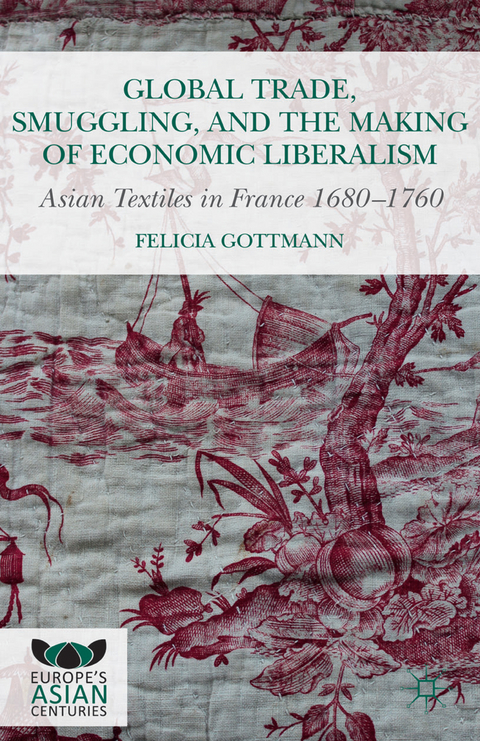
Global Trade, Smuggling, and the Making of Economic Liberalism (eBook)
XIV, 266 Seiten
Palgrave Macmillan UK (Verlag)
978-1-137-44488-2 (ISBN)
Imported from India, China, the Levant, and Persia and appreciated for their diversity, designs, fast bright colours and fine weave, Asian textiles became so popular in France that in 1686 the state banned their import, consumption and imitation. A fateful decision. This book tells the story of smuggling on a vast scale, savvy retailers and rebellious consumers. It also reveals how reformers in the French administration itself sponsored a global effort to acquire the technological know-how necessary to produce such textiles and how the vitriolic debates surrounding the eventual abolition of the ban were one of the decisive moments in the development of Enlightenment economic liberalism.
Felicia Gottmann is Leverhulme ECR Fellow at the University of Dundee's Scottish Centre for Global History, UK. After receiving her D.Phil from Oxford University in 2010, she was a Research Fellow on the ERC-funded project 'Europe's Asian Centuries: Trading Eurasia 1600-1830' at the University of Warwick.
Imported from India, China, the Levant, and Persia and appreciated for their diversity, designs, fast bright colours and fine weave, Asian textiles became so popular in France that in 1686 the state banned their import, consumption and imitation. A fateful decision. This book tells the story of smuggling on a vast scale, savvy retailers and rebellious consumers. It also reveals how reformers in the French administration itself sponsored a global effort to acquire the technological know-how necessary to produce such textiles and how the vitriolic debates surrounding the eventual abolition of the ban were one of the decisive moments in the development of Enlightenment economic liberalism.
Felicia Gottmann is Leverhulme ECR Fellow at the University of Dundee's Scottish Centre for Global History, UK. After receiving her D.Phil from Oxford University in 2010, she was a Research Fellow on the ERC-funded project 'Europe's Asian Centuries: Trading Eurasia 1600-1830' at the University of Warwick.
Cover 1
Half Title 2
Title Page 4
Copyright Page 5
Table of Contents 8
List of Illustrations 9
Acknowledgements 12
Introduction 15
Part I Global Textiles 26
Prologue: Three French Women and Their Troublesome Textiles 27
1 Global Fabrics: The French Trade in Asian and Asian-Style Textiles 30
Part II Smuggling 62
2 Smuggling Textiles into France 63
3 Smuggled Textiles Worn in France: The Politics of Privilege and the Violence of Fashion 93
Part III The Making of Economic Liberalism 113
4 The State of Knowledge 114
5 Enlightenment Campaigning 148
Conclusion 187
Appendices 192
I French East India Company Textile imports 192
II French Levant Trade Textile Imports 193
III A Comparison of French Textile Imports via the Levant and via the East India Companies 200
IV Convictions by the Commission de Valence 201
Notes 203
Select Bibliography 244
Index 265
| Erscheint lt. Verlag | 19.5.2016 |
|---|---|
| Reihe/Serie | Europe's Asian Centuries | Europe's Asian Centuries |
| Zusatzinfo | XIV, 266 p. |
| Verlagsort | London |
| Sprache | englisch |
| Themenwelt | Geisteswissenschaften ► Geschichte ► Regional- / Ländergeschichte |
| Geschichte ► Teilgebiete der Geschichte ► Kulturgeschichte | |
| Sozialwissenschaften ► Politik / Verwaltung | |
| Technik | |
| Wirtschaft ► Volkswirtschaftslehre ► Makroökonomie | |
| Schlagworte | Bibliography • cotton • Early Modern France • East India Companies • economic liberalism • Enlightenment • France • global trade • India • Levant Trade • mercantilism • Political Economy • Politics • Smuggling • Technology Transfer • Textiles • Trade |
| ISBN-10 | 1-137-44488-6 / 1137444886 |
| ISBN-13 | 978-1-137-44488-2 / 9781137444882 |
| Informationen gemäß Produktsicherheitsverordnung (GPSR) | |
| Haben Sie eine Frage zum Produkt? |
 PDF (Wasserzeichen)
DRM: Digitales Wasserzeichen
Dieses eBook enthält ein digitales Wasserzeichen und ist damit für Sie personalisiert. Bei einer missbräuchlichen Weitergabe des eBooks an Dritte ist eine Rückverfolgung an die Quelle möglich.
Dateiformat: PDF (Portable Document Format)
Mit einem festen Seitenlayout eignet sich die PDF besonders für Fachbücher mit Spalten, Tabellen und Abbildungen. Eine PDF kann auf fast allen Geräten angezeigt werden, ist aber für kleine Displays (Smartphone, eReader) nur eingeschränkt geeignet.
Systemvoraussetzungen:
PC/Mac: Mit einem PC oder Mac können Sie dieses eBook lesen. Sie benötigen dafür einen PDF-Viewer - z.B. den Adobe Reader oder Adobe Digital Editions.
eReader: Dieses eBook kann mit (fast) allen eBook-Readern gelesen werden. Mit dem amazon-Kindle ist es aber nicht kompatibel.
Smartphone/Tablet: Egal ob Apple oder Android, dieses eBook können Sie lesen. Sie benötigen dafür einen PDF-Viewer - z.B. die kostenlose Adobe Digital Editions-App.
Buying eBooks from abroad
For tax law reasons we can sell eBooks just within Germany and Switzerland. Regrettably we cannot fulfill eBook-orders from other countries.
aus dem Bereich