Networks and New Services: A Complete Story (eBook)
186 Seiten
Springer International Publishing (Verlag)
978-3-319-33995-5 (ISBN)
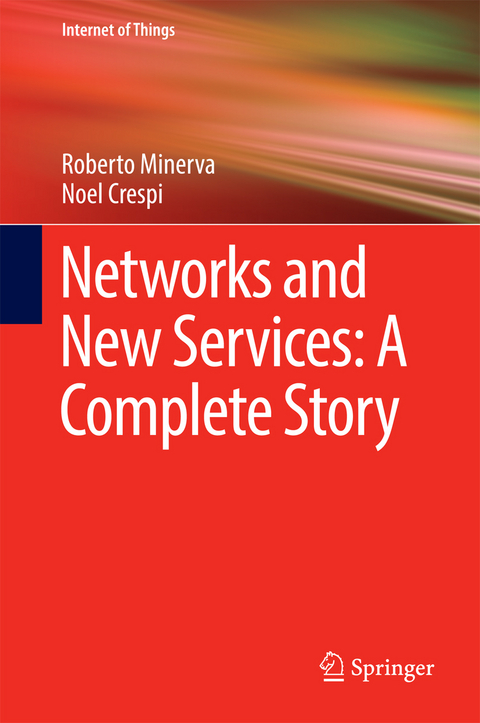
This book shines a spotlight on software-centric networks and their emerging service environments. The authors examine the road ahead for connectivity, for both humans and 'things', considering the rapid changes that have shaken the industry.
The book analyses major catalytic shifts that are shaping the communications world: softwarization, virtualization, and cloud computing. It guides the reader through a maze of possible architectural choices, driven by discriminating and sometimes conflicting business considerations. The new ICT capabilities lead us toward smarter environments and to an ecosystem where applications are backed up by shared networking facilities, instead of networks that support their own applications. Growing user awareness is a key driver towards the softwarization process.
Softwarization disrupts the current status quo for equipment, development, networks, operations and business. It changes radically the value chain and the involved stakeholders. The dilemma is between a 'slow burn' traditional step-by-step approach and a bold transformation of the whole infrastructure and business models. This book is essential reading for those seeking to build user-centric communication networks that support independent agile and smart applications.
'The book gives an insightful account of modern telecom networks, pinpointing the radical transformations of the last 20 years. This is the perfect read for those who are interested in the grand challenges of networks and in the socio-economic reasons why the telecom industry to embrace the Internet of Things and cyber-physical systems.'
Prof. Antonio Liotta, Eindhoven University of Technology
'This book fulfills an urgent need to thoroughly analyze the entanglement of network and software architectures by taking into account the increasing softwarization. It highlights important issues behind today's business models and opens the road for sustainable future approaches to provide user appreciated valuable services.'
Dr. Eng. Hendrik Berndt, former CTO of NTT DOCOMO Communications Laboratories Europe
Noël Crespi holds Masters degrees from the Universities of Orsay and Canterbury, a Diplome d'ingénieur from Telecom ParisTech and a Ph.D and Habilitation from Paris VI University. From 1993-95 he worked at CLIP, Bouygues Telecom, before joining France Telecom R&D in 1995 where he was involved in Intelligent Network paradigms for value added services. For Orange he led the Mobicarte prepaid service project to define, architect and deploy an infrastructure that hosted more than 10 million mobile subscribers. He has played a key role in standardisation as a delegate in a number of committees and as the editor for CAMEL, the Intelligent Network standard for mobile networks. He was appointed as the coordinator for France Telecom's standardisation activities for Core Network and then for all GSM/UMTS standards at the ETSI plenary committee.
In 1999, he joined Nortel Networks as telephony programme manager for France and Middle East-Africa. He was responsible for the evolution of the switching area, and led key programmes for the evolution of Nortel products. He has also worked for ETSI as an independent contractor. He joined Institut Mines-Telecom in 2002 and is currently Professor and MSc Programme Director, leading the Service Architecture Laboratory. He coordinates the standardisation activities for Institut Telecom at ETSI, 3GPP and ITU-T. He is also adjunct professor at KAIST (Korea), and is on the 4-person Scientific Advisory Board of FTW (Austria). His current research interests are in Service Architectures, Communication Services, Social Networks, and Internet of Things/Services. He is the author/co-author of 250 articles and contributions in standardisation
Roberto Minerva, has a Master Degree in Computer Science from Bari University, Italy, and a Ph.D in computer Science and Telecommunications from Telecom Sud Paris, France. Roberto is the head of Innovative Architectures group within the Future Centre in the Strategy Department of Telecom Italia. His job is to create advanced scenarios derived from the application of emerging ICT technologieswith innovative business models especially in the area of IoT, distributed computing, programmable networks and personal data. He held many responsibilities within Telecom Italia Lab: Network Intelligence, Wireless Architecture and Business Services Area Manager.Roberto is also a contract Professor at Turin's Polytechnics teaching a course on mobile services. Roberto is the Chairman of the IEEE IoT Initiative aiming at creating within IEEE a large technical community and to leverage the knowledge and skills available within IEEE. Since 1987 he has been involved in the development of Service Architectures for Telecom (TINA, OSA/Parlay and SIP), inactivities related to IMS, and in the definition of services for the Business market (context-awareness, ambient intelligence and automotive). More recently his contribution is in the area of new architectures for the service provision with particular attention to data centric and user centric solutions. Under this perspective he is currently involved in Telecom Italia activities related to Big Data, architecture for IoT, and ICT technologies for leveraging Cultural Heritage.
Noël Crespi holds Masters degrees from the Universities of Orsay and Canterbury, a Diplome d’ingénieur from Telecom ParisTech and a Ph.D and Habilitation from Paris VI University. From 1993-95 he worked at CLIP, Bouygues Telecom, before joining France Telecom R&D in 1995 where he was involved in Intelligent Network paradigms for value added services. For Orange he led the Mobicarte prepaid service project to define, architect and deploy an infrastructure that hosted more than 10 million mobile subscribers. He has played a key role in standardisation as a delegate in a number of committees and as the editor for CAMEL, the Intelligent Network standard for mobile networks. He was appointed as the coordinator for France Telecom’s standardisation activities for Core Network and then for all GSM/UMTS standards at the ETSI plenary committee.In 1999, he joined Nortel Networks as telephony programme manager for France and Middle East-Africa. He was responsible for the evolution of the switching area, and led key programmes for the evolution of Nortel products. He has also worked for ETSI as an independent contractor. He joined Institut Mines-Telecom in 2002 and is currently Professor and MSc Programme Director, leading the Service Architecture Laboratory. He coordinates the standardisation activities for Institut Telecom at ETSI, 3GPP and ITU-T. He is also adjunct professor at KAIST (Korea), and is on the 4-person Scientific Advisory Board of FTW (Austria). His current research interests are in Service Architectures, Communication Services, Social Networks, and Internet of Things/Services. He is the author/co-author of 250 articles and contributions in standardisationRoberto Minerva, has a Master Degree in Computer Science from Bari University, Italy, and a Ph.D in computer Science and Telecommunications from Telecom Sud Paris, France. Roberto is the head of Innovative Architectures group within the Future Centre in the Strategy Department of Telecom Italia. His job is to create advanced scenarios derived from the application of emerging ICT technologieswith innovative business models especially in the area of IoT, distributed computing, programmable networks and personal data. He held many responsibilities within Telecom Italia Lab: Network Intelligence, Wireless Architecture and Business Services Area Manager.Roberto is also a contract Professor at Turin’s Polytechnics teaching a course on mobile services. Roberto is the Chairman of the IEEE IoT Initiative aiming at creating within IEEE a large technical community and to leverage the knowledge and skills available within IEEE. Since 1987 he has been involved in the development of Service Architectures for Telecom (TINA, OSA/Parlay and SIP), inactivities related to IMS, and in the definition of services for the Business market (context-awareness, ambient intelligence and automotive). More recently his contribution is in the area of new architectures for the service provision with particular attention to data centric and user centric solutions. Under this perspective he is currently involved in Telecom Italia activities related to Big Data, architecture for IoT, and ICT technologies for leveraging Cultural Heritage.
Preface 6
Acknowledgments 8
Contents 10
Abbreviation 13
List of Figures 15
List of Tables 19
1 Introduction 20
1.1 Context 20
1.2 Motivation 22
1.3 Focus of the Book 24
1.4 Organization of the Book 27
Bibliography 28
2 Service Control Paradigms and Network Architectures 29
2.1 Introduction 29
2.2 Services 31
2.3 Interaction and Control Paradigms 35
2.4 Network Architectures and Distributed Platforms 42
2.4.1 Distributed Platforms as a Means to Cope with Network Fallacies 43
2.4.1.1 The Client–Server Paradigm as Supported by IT Technologies 43
2.4.1.2 The Client–Server Paradigm as Supported by Web Technologies 44
2.4.2 Control Paradigms and Network Architectures 45
2.4.2.1 The C-S Control Paradigm 48
2.4.2.2 The Network Intelligence Control Paradigm 48
2.4.2.3 The Peer-to-Peer Control Paradigm 52
2.5 Service Architectures 53
2.5.1 The Web and IT Views on Service Architectures 53
2.5.2 The Network Intelligence View on Service Architectures 57
2.5.3 The Peer-to-Peer View on Service Architectures 59
2.6 Findings 63
Bibliography 64
3 Technological Evolution of the ICT Sector 70
3.1 Introduction 70
3.2 The ICT Ecosystem 71
3.3 Data Center Evolution 74
3.4 Resource Virtualization 77
3.5 Distributed Applications and Technologies 79
3.6 Harvesting Data: Big Data and Personal Data 82
3.7 Disruptions in Identity Management 84
3.8 Cloud Computing and Beyond 86
3.8.1 A Market-Driven Evolution of Cloud Computing 89
3.8.2 Some Technology Trends in Cloud Computing 89
3.9 Terminals and Devices Evolution 97
3.10 Findings 99
Bibliography 101
4 The New Network 105
4.1 Introduction 105
4.2 Ossification of the Internet, and the Future Internet 107
4.3 Virtualized Networks 111
4.4 Toward Software-Defined Networks 113
4.5 Information Centric Networks 115
4.6 Cognitive Networks 118
4.6.1 General Principles 121
4.7 Disruptive Approaches 123
4.7.1 Local Area Networks 124
4.7.2 Community Networks 124
4.7.3 Military Communication (MilCom) 125
4.8 Findings 126
Bibliography 128
5 Emerging Services 131
5.1 Introduction 131
5.2 New Communication Services 134
5.3 From Cloud to Everything as a Services (XaaS) 140
5.3.1 Cloud Computing Services from a Telco Perspective 140
5.3.2 On the Cloud Business Ecosystem 141
5.3.3 On the Cloud Technical Framework 145
5.3.4 Examples of Telco Services in a Cloud Context 147
5.3.5 An Agenda for Telco-Oriented Cloud Platforms 151
5.4 Bank of User Data 152
5.4.1 The Value of (User) Data 153
5.4.2 Toward an Architecture for Dealing with Aggregated Data 155
5.5 Smart Environments 158
5.6 Internet with Things 162
5.6.1 The Value of the Internet of Things 163
5.6.2 Toward a Platform for the Internet with Things 165
5.6.3 Virtualization-Enabled Scenarios 171
5.6.4 Virtual Continuum 171
5.6.5 Virtual Terminal 173
5.7 Findings 176
Bibliography 179
6 TelCos Approach to Services 182
6.1 Introduction 182
6.2 The Network Intelligence Legacy 184
6.3 About Network APIs 191
6.4 The Recurring Myth of Quality of Service and Quality of Experience 195
6.5 Conclusions 197
Bibliography 199
| Erscheint lt. Verlag | 29.9.2016 |
|---|---|
| Reihe/Serie | Internet of Things | Internet of Things |
| Zusatzinfo | XIX, 186 p. 90 illus., 83 illus. in color. |
| Verlagsort | Cham |
| Sprache | englisch |
| Themenwelt | Mathematik / Informatik ► Informatik ► Netzwerke |
| Mathematik / Informatik ► Informatik ► Web / Internet | |
| Technik ► Nachrichtentechnik | |
| Schlagworte | Cloud Computing • cloud services • Evolution of networks • network virtualization • Software-Defined Networks • Softwarization of Networks • Telecommunication Ecosystems • User-centric Networks |
| ISBN-10 | 3-319-33995-8 / 3319339958 |
| ISBN-13 | 978-3-319-33995-5 / 9783319339955 |
| Informationen gemäß Produktsicherheitsverordnung (GPSR) | |
| Haben Sie eine Frage zum Produkt? |
 PDF (Wasserzeichen)
DRM: Digitales Wasserzeichen
Dieses eBook enthält ein digitales Wasserzeichen und ist damit für Sie personalisiert. Bei einer missbräuchlichen Weitergabe des eBooks an Dritte ist eine Rückverfolgung an die Quelle möglich.
Dateiformat: PDF (Portable Document Format)
Mit einem festen Seitenlayout eignet sich die PDF besonders für Fachbücher mit Spalten, Tabellen und Abbildungen. Eine PDF kann auf fast allen Geräten angezeigt werden, ist aber für kleine Displays (Smartphone, eReader) nur eingeschränkt geeignet.
Systemvoraussetzungen:
PC/Mac: Mit einem PC oder Mac können Sie dieses eBook lesen. Sie benötigen dafür einen PDF-Viewer - z.B. den Adobe Reader oder Adobe Digital Editions.
eReader: Dieses eBook kann mit (fast) allen eBook-Readern gelesen werden. Mit dem amazon-Kindle ist es aber nicht kompatibel.
Smartphone/Tablet: Egal ob Apple oder Android, dieses eBook können Sie lesen. Sie benötigen dafür einen PDF-Viewer - z.B. die kostenlose Adobe Digital Editions-App.
Buying eBooks from abroad
For tax law reasons we can sell eBooks just within Germany and Switzerland. Regrettably we cannot fulfill eBook-orders from other countries.
aus dem Bereich