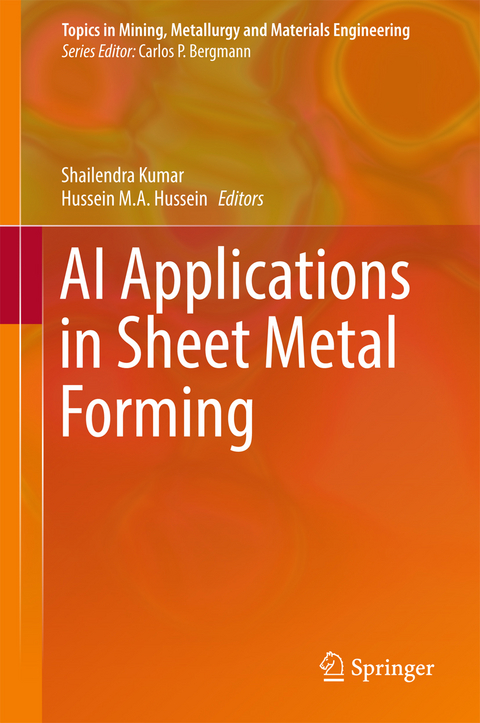
AI Applications in Sheet Metal Forming (eBook)
XII, 290 Seiten
Springer Singapore (Verlag)
978-981-10-2251-7 (ISBN)
This book comprises chapters on research work done around the globe in the area of artificial intelligence (AI) applications in sheet metal forming. The first chapter offers an introduction to various AI techniques and sheet metal forming, while subsequent chapters describe traditional procedures/methods used in various sheet metal forming processes, and focus on the automation of those processes by means of AI techniques, such as KBS, ANN, GA, CBR, etc. Feature recognition and the manufacturability assessment of sheet metal parts, process planning, strip-layout design, selecting the type and size of die components, die modeling, and predicting die life are some of the most important aspects of sheet metal work. Traditionally, these activities are highly experience-based, tedious and time consuming. In response, researchers in several countries have applied various AI techniques to automate these activities, which are covered in this book. This book will be useful for engineers workingin sheet metal industries, and will serve to provide future direction to young researchers and students working in the area.
Dr. Shailendra Kumar is an Associate Professor in the Mechanical Engineering Department at S.V. National Institute of Technology, Surat, India. He received his Bachelor’s degree in Production Engineering from the Regional Institute of Technology (presently National Institute of Technology), Jamshedpur, India in 1999 and his PhD from the Faculty of Engineering & Technology, Maharshi Dayanand University, Rohtak, India in 2007. His main research interests are in the area of press tool design, AI applications in manufacturing, KBS/expert systems for die design, sheet metal forming, CAPP, CAD/CAM and non-traditional manufacturing. He has successfully completed one research project for the Department of Science and Technology, Government of India and engaged in three more research projects sanctioned by national and international agencies. Three PhD scholars and 22 M. Tech. students have completed their research work under his supervision. Dr. Kumar has more than 120 research papers in reputed journals and conferences to his credit. He serves as a reviewer for many reputed journals and is a life member of the Indian Society of Mechanical Engineers (ISME), International Association of Engineers (IAENG), and World Academy of Science, Engineering & Technology (WASET), and Senior member of Universal Association of Mechanical and Aeronautical Engineers (UAMAE), The IRED, New York, USA Dr. H.M.A. Hussein is currently serving at the Faculty of Engineering, Mechanical Engineering Department, Helwan University, Cairo, Egypt. He received his PhD in Mechanical (Production) Engineering from Helwan University, Egypt in 2008. He has also served in the tool design department of many companies. His research interests include computer aided sheet metal die design, AI applications to sheet metal forming, CAD/CAM, AutoCAD application and customization, and CAPP. He has completed many research projects in the area of design and manufacturing sanctioned by various funding agencies. He is a member of the Egyptian Syndicate of Professional Engineers, and of the Egyptian Mechanical Engineers Associations.
Foreword 6
Preface 8
Contents 10
Editors and Contributors 12
1 An Overview of Applications of Artificial Intelligence (AI) in Sheet Metal Work 14
1 Introduction 14
2 Feature Modeling: Concepts and Techniques 15
3 Modeling and Planning for Progressive Cutting Operations 16
3.1 Bending and Forming Operations in Progressive Die Design 16
3.2 Process Planning of Progressive Dies 20
3.3 Other Works Using AI Tools for Progressive Die Design and Planning 21
3.4 Summary 24
References 25
2 Generic Classification and Representation of Shape Features in Sheet-Metal Parts 27
1 Introduction 27
2 Sheet-Metal Parts 33
3 Sheet-Metal Features 33
4 Volumetric Sheet-Metal Features 35
4.1 Classification Based on Placement of 2D Profile 36
4.2 Classification Based on Shape of the 2D Profile 36
5 Deformation Sheet-Metal Features 39
5.1 Classification of Feature Faces for Deformation Sheet-Metal Features 43
5.2 Classification of Deformation Sheet-Metal Features 45
5.2.1 Number and Arrangement of Boundary Shell Faces 45
5.2.2 Number of Interior Shell Faces in a Deformation Feature 46
5.2.3 Type of Bends in a Deformation Feature 47
6 Conclusion 49
References 49
3 Feature Extraction and Manufacturability Assessment of Sheet Metal Parts 52
1 Introduction 52
2 Literature Review 55
2.1 Feature Extraction/Recognition of Sheet Metal Parts 55
2.2 Manufacturability Assessment of Sheet Metal Parts 56
3 Computer-Aided System for Automatic Feature Extraction 58
4 Knowledge-Based System for Manufacturability Assessment of Sheet Metal Parts 58
4.1 Procedure for Development of the Proposed System 63
5 Validation of the Proposed Systems FE and MCKBS 67
6 Conclusion 75
References 76
4 Knowledge-Based System for Design of Blanking Dies 78
1 Introduction 78
2 Knowledge-Based Design Rules for Blanking Dies 80
2.1 Strip Thickness 80
2.2 Contour Length 80
2.3 Main Part Dimension (Length/Width/Diameter) 81
3 Parametric Design in 2D 84
3.1 Blank Layout 84
3.2 Die Block Boundary 85
3.3 Die Block Parametres 88
3.4 Fasteners and Dowel Pin Position 88
3.5 Strip Boundary 90
3.6 Parametric Relation of Die Holder Plate 91
3.7 Parametric Relation Between Die Holder Dimension and Die-Set Selection 92
4 Parametric Design in 3D 96
5 Conclusion 101
References 102
5 Knowledge-Based System for Design of Deep Drawing Die for Axisymmetric Parts 104
1 Introduction 104
2 Literature Review 106
2.1 Computer-Aided Process Planning 106
2.2 Computer-Aided Die Design 107
2.3 Knowledge-Based Deep Drawing Die Design 108
3 Considerations for Design of Deep Drawing Die 109
3.1 Process Planning 109
3.2 Strip-Layout Design 110
3.3 Selection of Die Components 110
3.4 Modeling of Die Components and Die Assembly 111
4 Intelligent Design System: INTDDD 111
4.1 Methodology for Development of Proposed System 111
4.2 Organization of the Proposed System 114
4.2.1 Subsystem PPDDP 114
4.2.2 Subsystem ISDSL 118
4.2.3 Subsystem DDCOMP 119
4.2.4 Subsystem AUTODDMOD 119
5 Validation of the System INTDDD 122
6 Conclusion 127
References 127
6 An Integrated Approach for Optimized Process Planning of Multistage Deep Drawing 131
1 Introduction 131
2 Literature Review 132
3 Integrated AI Approach 135
4 Shape Recognition 136
5 Process Design: The Governing Rules 140
5.1 Part Geometry in Drawing Stages 141
5.1.1 Corner Radius 141
5.1.2 Cross Section 142
5.1.3 Part Height 142
5.2 Tool Design 143
5.2.1 Punch Cross Section 143
5.2.2 Die Cross Section 143
5.2.3 Die and Punch Nose Radii 144
5.2.4 Blank Holder Dimensions 144
5.3 Operating Parameters 144
5.3.1 Punch Force 144
5.3.2 Blank Holder Pressure 145
6 Optimization and Validation for Process Planning 145
6.1 Dynamic Programming Approach 146
6.2 Finite Element Modeling and Analysis 150
7 Case Studies 157
7.1 Square Box 158
7.2 Rectangular Box with Extreme Aspect Ratio 162
8 Concluding Remarks 167
References 168
7 Knowledge-Based System for Design of Deep Drawing Die for Elliptical Shape Parts 171
1 Introduction 171
2 Constitutions of the Knowledge-Based System 173
2.1 Recognition of Shape Module 173
2.2 Three-Dimensional Modeling Module 175
2.3 Blank Design Module 177
2.4 Process Planning Module 178
3 Production Rules of the Knowledge-Based System 180
4 Results and Discussion 183
4.1 The Surface Area Calculation 183
4.2 Drawing Coefficient 184
4.3 Punch and Die Radii 185
5 Conclusion 188
References 189
8 An Expert System for Automatic Design of Compound Dies 192
1 Introduction 192
2 Literature Review 194
3 Proposed Expert System: ESIDCD 197
3.1 Subsystem PPCD 199
3.2 Subsystem CDCOMP 203
3.3 Subsystem AUTOMODCD 206
4 Validation of the Proposed System 206
5 Conclusion 222
Acknowledgments 222
References 222
9 Prediction of Life of Compound Die Using Artificial Neural Network 226
1 Introduction 226
2 Proposed ANN Model for Prediction of Life of Compound Die 231
3 Validation of the Proposed ANN Model 234
4 Conclusion 249
References 250
10 Knowledge-Based System for Automatic Design of Bending Dies 253
1 Introduction 253
1.1 Design of Bending Dies 254
1.2 Knowledge-Based System 255
2 Literature Review 256
2.1 Process Planning of Bending Parts 256
2.2 Bending Die Design 257
3 Proposed KBS for Automatic Design of Bending Dies 258
3.1 Subsystem PPBP 259
3.2 Subsystem BDCOMP 270
3.3 Subsystem AUTOBDMOD 272
4 Validation of System ASDBD 275
5 Conclusions 296
References 297
| Erscheint lt. Verlag | 25.10.2016 |
|---|---|
| Reihe/Serie | Topics in Mining, Metallurgy and Materials Engineering | Topics in Mining, Metallurgy and Materials Engineering |
| Zusatzinfo | XII, 290 p. 231 illus. |
| Verlagsort | Singapore |
| Sprache | englisch |
| Themenwelt | Informatik ► Theorie / Studium ► Künstliche Intelligenz / Robotik |
| Technik ► Maschinenbau | |
| Wirtschaft ► Betriebswirtschaft / Management ► Logistik / Produktion | |
| Schlagworte | Artificial Intelligence • Bending • Blanking • Deep Drawing • Die Design • Die Life • Feature Recognition • Knowledge Based Systems for Die Design • Process Planning • sheet metal forming |
| ISBN-10 | 981-10-2251-8 / 9811022518 |
| ISBN-13 | 978-981-10-2251-7 / 9789811022517 |
| Informationen gemäß Produktsicherheitsverordnung (GPSR) | |
| Haben Sie eine Frage zum Produkt? |
 PDF (Wasserzeichen)
DRM: Digitales Wasserzeichen
Dieses eBook enthält ein digitales Wasserzeichen und ist damit für Sie personalisiert. Bei einer missbräuchlichen Weitergabe des eBooks an Dritte ist eine Rückverfolgung an die Quelle möglich.
Dateiformat: PDF (Portable Document Format)
Mit einem festen Seitenlayout eignet sich die PDF besonders für Fachbücher mit Spalten, Tabellen und Abbildungen. Eine PDF kann auf fast allen Geräten angezeigt werden, ist aber für kleine Displays (Smartphone, eReader) nur eingeschränkt geeignet.
Systemvoraussetzungen:
PC/Mac: Mit einem PC oder Mac können Sie dieses eBook lesen. Sie benötigen dafür einen PDF-Viewer - z.B. den Adobe Reader oder Adobe Digital Editions.
eReader: Dieses eBook kann mit (fast) allen eBook-Readern gelesen werden. Mit dem amazon-Kindle ist es aber nicht kompatibel.
Smartphone/Tablet: Egal ob Apple oder Android, dieses eBook können Sie lesen. Sie benötigen dafür einen PDF-Viewer - z.B. die kostenlose Adobe Digital Editions-App.
Buying eBooks from abroad
For tax law reasons we can sell eBooks just within Germany and Switzerland. Regrettably we cannot fulfill eBook-orders from other countries.
aus dem Bereich