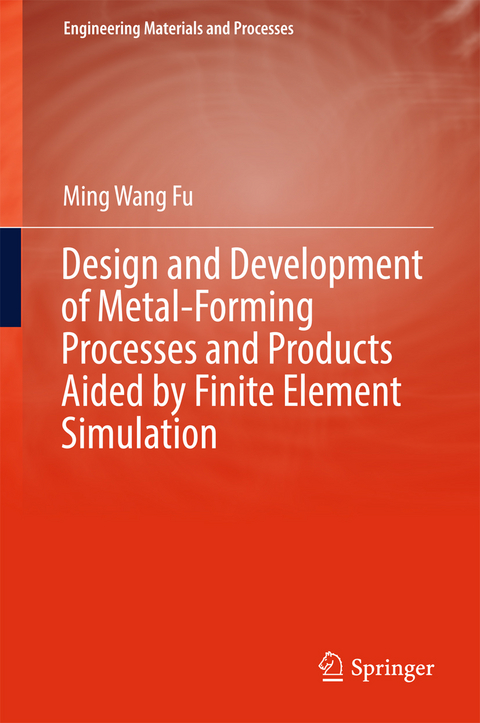
Design and Development of Metal-Forming Processes and Products Aided by Finite Element Simulation (eBook)
XV, 246 Seiten
Springer International Publishing (Verlag)
978-3-319-46464-0 (ISBN)
This book presents state-of-the-art research on forming processes and formed metal product development aided by the Finite Element Method (FEM). Using extensive and informative illustrations, tables and photographs, it systematically presents real-life case studies and established findings regarding various forming processes and methods aided by FEM simulation, and addresses various issues related to metal formed part design, process determination, die design and die service life analysis and prolongation, as well as product quality assurance and improvement.
Metal forming has been widely used in many industries. This traditional manufacturing process, however, has long been linked to many years of apprenticeship and skilled craftsmanship, and its conventional design and development paradigm appeared to involve more know-how and trial-and-error than in-depth scientific calculation, analysis and simulation. The design paradigm for forming processes and metal formed product development thus cannot meet the current demands for short development lead-times, low production costs and high product quality. With the advent of numerical simulation technologies, the design and development of forming processes and metal formed products are carried out with the aid of FEM simulation, allowing all the potential design spaces to be identified and evaluated, and the best design to ultimately be determined and implemented. Such a design and development paradigm aims at ensuring 'designing right the first time' and reducing the need for trial-and-error in the workshop. This book provides postgraduates, manufacturing engineers and professionals in this field with an in-depth understanding of the design process and sufficient knowledge to support metal formed part design, forming process determination, tooling design, and product quality assurance and control via FEM simulation.
<
Dr. Ming Wang FU (M.W. FU) has been working on metal forming and product design and development supported by computer-aided design technologies and finite element simulation for more than three decades. He is currently a faculty member at the Department of Mechanical Engineering, The Hong Kong Polytechnic University (HK PolyU). Before joined the HK PolyU in 2006, he had worked as a senior research engineer at the Singapore Institute of Manufacturing Technology from 1997 to 2006. His current endeavors are more focused on advanced materials processing and product realization at different scales and aided by experiments and numerical simulations. To date, Dr. Fu has published more than 160 SCI journal papers and three monographs on metal forming technologies, computer-aided die and mold design, and product design and development.
Dr. Ming Wang FU (M.W. FU) has been working on metal forming and product design and development supported by computer-aided design technologies and finite element simulation for more than three decades. He is currently a faculty member at the Department of Mechanical Engineering, The Hong Kong Polytechnic University (HK PolyU). Before joined the HK PolyU in 2006, he had worked as a senior research engineer at the Singapore Institute of Manufacturing Technology from 1997 to 2006. His current endeavors are more focused on advanced materials processing and product realization at different scales and aided by experiments and numerical simulations. To date, Dr. Fu has published more than 160 SCI journal papers and three monographs on metal forming technologies, computer-aided die and mold design, and product design and development.
Preface 7
Acknowledgements 10
Contents 11
1 Introduction 14
1.1 Introduction 14
1.2 Plastic Deformation of Materials 15
1.3 Forming Process 17
1.3.1 Cold Forming 17
1.3.2 Warm Forming 18
1.3.3 Hot Forming 19
1.4 Metal-Forming Process and System 20
1.5 Challenges in Metal-Formed Product Development 21
1.5.1 Multidomains Involved in Metal-Formed Product Development 23
1.5.2 Design of the Deformed Parts 26
1.5.3 Process and Process Parameter Configuration 28
1.5.4 Die Design and Its Service Life Analysis 29
1.5.5 Defect Formation, Prediction, and Avoidance 31
1.5.6 Optimization of Metal-Forming System 32
1.6 Summary 32
References 33
2 Rigid-Plastic Finite Element Method and FE Simulation 34
2.1 Introduction 34
2.2 Modeling and Simulation 36
2.3 Rigid-Plastic Finite Element Method 37
2.3.1 Cartesian Tensor Representation 37
2.3.2 Basic of Rigid-Plastic Finite Element Method 42
2.3.3 Finite Element Simulation 48
2.4 FE Simulation of Metal-Forming Systems 51
2.4.1 Modeling of Die and Workpiece 52
2.4.2 Modeling of Frictional Behaviors 54
2.5 Geometric Symmetry in FE Simulation 55
2.6 Validation and Verification of FE Simulation 59
2.7 Summary 62
References 63
3 Evaluation of Forming System Design 64
3.1 Introduction 64
3.2 Evaluation of Metal-Forming Systems 66
3.2.1 Factors Affecting the Design of Metal-Forming Systems 66
3.2.2 Design of Deformed Parts 70
3.2.2.1 Experimental Realization of the Twelve Design Scenarios 73
3.2.2.2 Simulation and Analysis of the Twelve Design Scenarios 74
3.2.3 Process and Die Design 87
3.2.4 Simulation-Aided Evaluation of Metal-Forming Systems 89
3.3 Realization of CAE Simulation 90
3.3.1 Simulation Procedure 91
3.3.2 Integrated Simulation Framework 92
3.4 Evaluation Methodology 94
3.4.1 Deformation Load 95
3.4.2 Effective Strain 95
3.4.3 Damage Factor 96
3.4.4 Maximum Effective Stress 97
3.4.5 Deformation Homogeneity 98
3.4.6 Evaluation Criterion 99
3.5 Case Studies 100
3.6 Summary 104
References 105
4 Die Design and Service Life Analysis 107
4.1 Introduction 107
4.2 Die Performance and Service Life 108
4.3 Stress-Based Die Design 110
4.3.1 Prestress in Design 111
4.3.2 Die Working Stress 116
4.4 Die Fatigue Life Analysis 120
4.4.1 Stress-Life Approach 121
4.4.2 Strain-Life Approach 122
4.4.3 Die Fatigue Life Assessment 124
4.5 Case Studies 126
4.5.1 Case Study 1 127
4.5.2 Case Study 2 128
4.5.3 Case Study 3 130
4.5.3.1 Design of Metal-Forming System 133
4.5.3.2 Integrated Simulation of Forming System 133
4.5.3.3 Procedure for Extraction of Simulation Results 136
4.6 Summary 141
References 141
5 Flow-Induced Defects in Multiscaled Plastic Deformation 143
5.1 Introduction 143
5.2 Flow-Induced Defect in Forming Processes 144
5.2.1 Flow-Induced Defect in Forming of Axisymmetric Parts with Flanged Features 147
5.2.2 Flow-Induced Defect in Forming of Non-asymmetrically Mesoscaled Parts 150
5.2.2.1 Mesoforming Experiment 150
5.2.2.2 FE Simulation 155
5.3 Defect Avoidance in Forming Process 157
5.3.1 Employment of Spring-Driven Die Insert Structure 157
5.3.1.1 Sliding Die Insert Design and Material Flow Behaviors 157
5.3.1.2 Spring and Die Insert Design Aided by FE Simulation 163
5.3.1.3 Case Studies for Folding Defect Avoidance 164
5.3.2 Feature-Based Approach for Folding Defect Avoidance 166
5.3.2.1 Feature-Based Approach 166
5.3.2.2 Detailed Approaches to Avoiding the Flow-Induced Defects 169
5.3.2.3 Physical Implementation of the Designed Forming Processes 171
5.4 Flow-Induced Defect and Size Effect in Meso- and Microforming 175
5.4.1 Experiments of Meso- and Microscaled Parts 176
5.4.1.1 Microcylindrical Compression Test 178
5.4.1.2 Microforming Experiments 179
5.4.2 Defect Analysis and Size Effect on Flow-Induced Defects 186
5.4.2.1 Geometry Size Effect on Folding Defect 187
5.4.2.2 Effect of Grain Size and Microstructure on Folding Defect 188
5.5 Summary 191
References 192
6 Ductile Fracture and Stress-Induced Defects in Multiscaled Plastic Deformation 193
6.1 Introduction 193
6.2 Ductile Fracture and Stress-Induced Defects 194
6.3 Size Effect on Ductile Fracture 198
6.3.1 Modeling of Deformation Behaviors Considering Size Effect 199
6.3.2 Surface Layer Model 200
6.3.3 Calculation and Comparison of Flow Stress Models in Simple Upsetting 202
6.3.4 Experiments and Simulations 206
6.3.5 Size Effect on Ductile Fracture 210
6.4 Hybrid Constitutive Modeling of Fracture in Microscaled Plastic Deformation 218
6.4.1 Hybrid Flow Stress Modeling 219
6.4.1.1 Macroscaled Flow Stress Modeling 219
6.4.1.2 Hybrid Constitutive Model 221
6.4.2 Methodology and Calculation 222
6.4.2.1 Coefficient Calibration Procedure of the Hybrid Constitutive Model 224
6.4.2.2 Calculation of Microscaled Deformation 226
6.4.3 Ductile Fracture Prediction 230
6.4.4 Stress-Induced Fracture Map 231
6.5 Applicability of DFCs in Microscaled Plastic Deformation 236
6.5.1 The Uncoupled DFCs 236
6.5.2 Applicability of the DFCs in Microscaled Plastic Deformation 239
6.5.2.1 Comparison of the Predicted Fracture Strain 240
6.5.2.2 Stress-Induced Fracture Map Using Different Fracture Criteria 243
6.5.2.3 The Generalized Fracture Model Formulation 245
6.6 Summary 256
References 257
| Erscheint lt. Verlag | 22.10.2016 |
|---|---|
| Reihe/Serie | Engineering Materials and Processes | Engineering Materials and Processes |
| Zusatzinfo | XV, 246 p. 167 illus. |
| Verlagsort | Cham |
| Sprache | englisch |
| Themenwelt | Mathematik / Informatik ► Informatik |
| Mathematik / Informatik ► Mathematik | |
| Technik ► Architektur | |
| Technik ► Maschinenbau | |
| Wirtschaft | |
| Schlagworte | Finite Element Method (FEM) • finite element simulation • Integrated Process and Product Development • Metal Formed Product • Metal Forming Process • Metal Forming Process Aided by Finite Element Simulation (FES) • Product Quality Control and Assurance • Simulation-based Metal Formed Product Development |
| ISBN-10 | 3-319-46464-7 / 3319464647 |
| ISBN-13 | 978-3-319-46464-0 / 9783319464640 |
| Informationen gemäß Produktsicherheitsverordnung (GPSR) | |
| Haben Sie eine Frage zum Produkt? |
 PDF (Wasserzeichen)
DRM: Digitales Wasserzeichen
Dieses eBook enthält ein digitales Wasserzeichen und ist damit für Sie personalisiert. Bei einer missbräuchlichen Weitergabe des eBooks an Dritte ist eine Rückverfolgung an die Quelle möglich.
Dateiformat: PDF (Portable Document Format)
Mit einem festen Seitenlayout eignet sich die PDF besonders für Fachbücher mit Spalten, Tabellen und Abbildungen. Eine PDF kann auf fast allen Geräten angezeigt werden, ist aber für kleine Displays (Smartphone, eReader) nur eingeschränkt geeignet.
Systemvoraussetzungen:
PC/Mac: Mit einem PC oder Mac können Sie dieses eBook lesen. Sie benötigen dafür einen PDF-Viewer - z.B. den Adobe Reader oder Adobe Digital Editions.
eReader: Dieses eBook kann mit (fast) allen eBook-Readern gelesen werden. Mit dem amazon-Kindle ist es aber nicht kompatibel.
Smartphone/Tablet: Egal ob Apple oder Android, dieses eBook können Sie lesen. Sie benötigen dafür einen PDF-Viewer - z.B. die kostenlose Adobe Digital Editions-App.
Buying eBooks from abroad
For tax law reasons we can sell eBooks just within Germany and Switzerland. Regrettably we cannot fulfill eBook-orders from other countries.
aus dem Bereich