


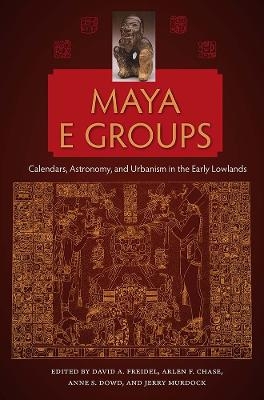
Maya E Groups
Calendars, Astronomy, and Urbanism in the Early Lowlands
Seiten
2017
University Press of Florida (Verlag)
978-0-8130-5435-3 (ISBN)
University Press of Florida (Verlag)
978-0-8130-5435-3 (ISBN)
- Lieferbar
- Versandkostenfrei
- Auch auf Rechnung
- Artikel merken
In ancient Maya cities, ""E Groups"" are sets of buildings aligned with the movements of the sun. This volume presents new archaeological data to reveal that E Groups were constructed earlier than previously thought - in fact, they are the earliest identifiable architectural plan at many Maya settlements.
In ancient Maya cities, “E Groups” are sets of buildings aligned with the movements of the sun. This volume presents new archaeological data to reveal that E Groups were constructed earlier than previously thought—in fact, they are the earliest identifiable architectural plan at many Maya settlements. More than just astronomical observatories or calendars, E Groups were gathering places for emerging communities and centers of ritual: the very first civic-religious public architecture in the Maya lowlands. Investigating a wide variety of E Group sites in different contexts, this volume pieces together the development of social and political complexity in the ancient Maya civilization.
A volume in the series Maya Studies, edited by Diane Z. Chase and Arlen F. Chase.
In ancient Maya cities, “E Groups” are sets of buildings aligned with the movements of the sun. This volume presents new archaeological data to reveal that E Groups were constructed earlier than previously thought—in fact, they are the earliest identifiable architectural plan at many Maya settlements. More than just astronomical observatories or calendars, E Groups were gathering places for emerging communities and centers of ritual: the very first civic-religious public architecture in the Maya lowlands. Investigating a wide variety of E Group sites in different contexts, this volume pieces together the development of social and political complexity in the ancient Maya civilization.
A volume in the series Maya Studies, edited by Diane Z. Chase and Arlen F. Chase.
David A. Freidel is professor of anthropology at Washington University in St. Louis. Arlen F. Chase is professor of anthropology at the University of Nevada, Las Vegas. Anne S. Dowd, principal archaeologist at ArchæoLOGIC USA, LLC, is coeditor of Cosmology, Calendars, and Horizon-Based Astronomy in Ancient Mesoamerica. Jerry Murdock is a member of the Board of Trustees for the Santa Fe Institute and the Aspen Institute.
| Erscheinungsdatum | 08.08.2017 |
|---|---|
| Reihe/Serie | Maya Studies |
| Zusatzinfo | 132 black & white illustrations, 10 maps |
| Verlagsort | Florida |
| Sprache | englisch |
| Maße | 155 x 233 mm |
| Gewicht | 1080 g |
| Themenwelt | Geisteswissenschaften ► Archäologie |
| Naturwissenschaften ► Physik / Astronomie ► Astronomie / Astrophysik | |
| Sozialwissenschaften ► Ethnologie | |
| Sozialwissenschaften ► Soziologie | |
| Technik ► Architektur | |
| ISBN-10 | 0-8130-5435-4 / 0813054354 |
| ISBN-13 | 978-0-8130-5435-3 / 9780813054353 |
| Zustand | Neuware |
| Informationen gemäß Produktsicherheitsverordnung (GPSR) | |
| Haben Sie eine Frage zum Produkt? |
Mehr entdecken
aus dem Bereich



aus dem Bereich
Kompendium & Nachschlagewerk in 3 Bänden
Buch | Hardcover (2025)
Eigenverlag Dr. Erik Wischnewski
CHF 179,95
was haben Kunst, Musik oder Religion mit Mathematik am Hut?
Buch | Softcover (2025)
Springer Berlin (Verlag)
CHF 34,95


