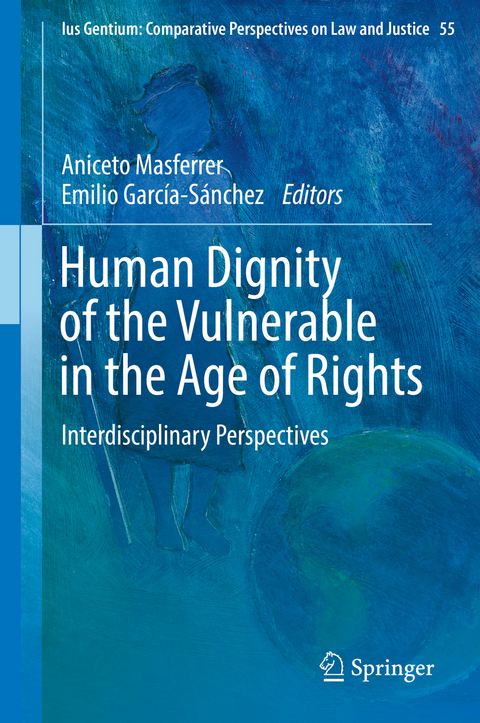
Human Dignity of the Vulnerable in the Age of Rights (eBook)
XV, 338 Seiten
Springer International Publishing (Verlag)
978-3-319-32693-1 (ISBN)
This volume is devoted to exploring a subject which, on the surface, might appear to be just a trending topic. In fact, it is much more than a trend. It relates to an ancient, permanent issue which directly connects with people's life and basic needs: the recognition and protection of individuals' dignity, in particular the inherent worthiness of the most vulnerable human beings. The content of this book is described well enough by its title: 'Human Dignity of the Vulnerable in the Age of Rights'. Certainly, we do not claim that only the human dignity of vulnerable people should be recognized and protected. We rather argue that, since vulnerability is part of the human condition, human vulnerability is not at odds with human dignity. To put it simply, human dignity is compatible with vulnerability.
A concept of human dignity which discards or denies the dignity of the vulnerable and weak is at odds with the real human condition. Even those individuals who might seem more skilled and talented are fragile, vulnerable and limited. We need to realize that human condition is not limitless. It is crucial to re-discover a sense of moderation regarding ourselves, a sense of reality concerning our own nature. Some lines of thought take the opposite view. It is sometimes argued that humankind is - or is called to be - powerful, and that the time will come when there will be no vulnerability, no fragility, no limits at all. Human beings will become like God (or what believers might think God to be). This perspective rejects human vulnerability as in intrinsic evil. Those who are frail or weak, who are not autonomous or not able to care for themselves, do not possess dignity. In this volume it is claimed that vulnerability is an inherent part of human condition, and because human dignity belongs to all individuals, laws are called to recognize and protect the rights of all of them, particularly of those who might appear to be more vulnerable and fragile.
Aniceto Masferrer is Professor of Legal History and teaches legal history and comparative law at the Faculty of Law, University of Valencia, Spain. He is the author of eight books (including his Spanish Legal Traditions. A Comparative Legal History Outline (Madrid, 2009; 2012, 2nd ed,)) and the editor of six (including Masferrer, A (ed.), Post 9/11 and the State of Permanent Legal Emergency: Security and Human Rights in Countering Terrorism (Springer, 2012), Masferrer, A & Walker, C (eds.) Counter-Terrorism, Human Rights And The Rule Of Law. Crossing Legal Boundaries in Defence of the State (Edward Elgar Publishing, 2013), and Masferrer, A., La Codificación española. Una aproximación doctrinal e historiográfica a sus influencias extranjeras, y a la francesa en particular (Thomson Reuters-Aranzadi, 2014)), and sixty book chapters/articles published in Spanish, European and American law journals. He has published extensively on criminal law from an historical and comparative perspective, as well as on the codification movement and fundamental rights in the Western legal tradition. He has been a fellow researcher at the Institute Max-Planck for European Legal History (2000-03), Visiting Professor at the University of Cambridge (2005), Visiting Scholar at Harvard Law School (2006-07) and at Melbourne Law School (2008), and Visiting Professor at the University of Tasmania (2010), Visiting Scholar at Louisiana State University - The Paul M. Hebert Law Center - (2013), Visiting Scholar at George Washington University Law School (as the Recipient of the Richard & Diane Cummins Legal History Research Grant for 2014), and Visiting Professor at the École Normale Supérieure - Paris (2015). He has lectured at universities around the world (France, Germany, Belgium, The Netherlands, Malta, Israel, United Kingdom, Sweden, Norway, USA, Canada, Australia and New Zealand). He is a member of the advisory board of several Spanish, European, Anglo-American and Asian Law Journals, and the Chief Editor of GLOSSAE. European Journal of Legal History. He is member of the American Society for Legal History, the current president of the European Society for Comparative Legal History (from 2010), and vice-president of the Fundación Universitas. He is also the Director of the Institute for Social, Political and Legal Studies, member of the Spanish Royal Academy of Jurisprudence and Legislation, and board member of the Valencian Committee for European Affairs.
Emilio García-Sánchez is Biologist and Postgraduate Masters in Bioethics (University of Navarra, 2010). He defended his thesis Master on The return of virtue bioethics to the crisis of nature. He currently teaches Bioethics at the Faculties of Medicine and Nursing CEU Cardenal Herrera University (Valencia, Spain). He is the main researcher of Bioethics Research Group at his university. His main lines of research are ethical and sociological analysis of human vulnerability in today's culture: health and bioethical implications. He has published two articles on the recognition of the nature and dignity in the terminally ill. The latest in the Journal of Bioethics: 'The rescue of the human in the patient who dies' (2012). He was also the Editor of the issue nr 77 (vol. 23: 'Eugenics in Today's Society') of the Journal of Bioethics (May 2012). He is currently working on bioethical issues raised by the aesthetic medicine. He has published an article on this subject: 'The tyranny of perfection. Bioethical Implications' (July 2013). He was Visiting Scholar at Institute of Ethics (Dublin City University) (July-September 2014) and at Kennedy Institute of Ethics (Georgetown University, Washington DC) (August-November 2015).Aniceto Masferrer is Professor of Legal History and teaches legal history and comparative law at the Faculty of Law, University of Valencia, Spain. He is the author of eight books (including his Spanish Legal Traditions. A Comparative Legal History Outline (Madrid, 2009; 2012, 2nd ed,)) and the editor of six (including Masferrer, A (ed.), Post 9/11 and the State of Permanent Legal Emergency: Security and Human Rights in Countering Terrorism (Springer, 2012), Masferrer, A & Walker, C (eds.) Counter-Terrorism, Human Rights And The Rule Of Law. Crossing Legal Boundaries in Defence of the State (Edward Elgar Publishing, 2013), and Masferrer, A., La Codificación española. Una aproximación doctrinal e historiográfica a sus influencias extranjeras, y a la francesa en particular (Thomson Reuters-Aranzadi, 2014)), and sixty book chapters/articles published in Spanish, European and American law journals. He has published extensively on criminal law from an historical and comparative perspective, as well as on the codification movement and fundamental rights in the Western legal tradition. He has been a fellow researcher at the Institute Max-Planck for European Legal History (2000-03), Visiting Professor at the University of Cambridge (2005), Visiting Scholar at Harvard Law School (2006-07) and at Melbourne Law School (2008), and Visiting Professor at the University of Tasmania (2010), Visiting Scholar at Louisiana State University – The Paul M. Hebert Law Center – (2013), Visiting Scholar at George Washington University Law School (as the Recipient of the Richard & Diane Cummins Legal History Research Grant for 2014), and Visiting Professor at the École Normale Supérieure – Paris (2015). He has lectured at universities around the world (France, Germany, Belgium, The Netherlands, Malta, Israel, United Kingdom, Sweden, Norway, USA, Canada, Australia and New Zealand). He is a member of the advisory board of several Spanish, European, Anglo-American and Asian Law Journals, and the Chief Editor of GLOSSAE. European Journal of Legal History. He is member of the American Society for Legal History, the current president of the European Society for Comparative Legal History (from 2010), and vice-president of the Fundación Universitas. He is also the Director of the Institute for Social, Political and Legal Studies, member of the Spanish Royal Academy of Jurisprudence and Legislation, and board member of the Valencian Committee for European Affairs. Emilio García-Sánchez is Biologist and Postgraduate Masters in Bioethics (University of Navarra, 2010). He defended his thesis Master on The return of virtue bioethics to the crisis of nature. He currently teaches Bioethics at the Faculties of Medicine and Nursing CEU Cardenal Herrera University (Valencia, Spain). He is the main researcher of Bioethics Research Group at his university. His main lines of research are ethical and sociological analysis of human vulnerability in today's culture: health and bioethical implications. He has published two articles on the recognition of the nature and dignity in the terminally ill. The latest in the Journal of Bioethics: ‘The rescue of the human in the patient who dies’ (2012). He was also the Editor of the issue nr 77 (vol. 23: ‘Eugenics in Today's Society’) of the Journal of Bioethics (May 2012). He is currently working on bioethical issues raised by the aesthetic medicine. He has published an article on this subject: “The tyranny of perfection. Bioethical Implications” (July 2013). He was Visiting Scholar at Institute of Ethics (Dublin City University) (July-September 2014) and at Kennedy Institute of Ethics (Georgetown University, Washington DC) (August-November 2015).
Preface
and Acknowledgements.- 1. Vulnerability and Human Dignity in the Age of Rights; Aniceto Masferrer and Emilio García-Sánchez.- PART I: Human Dignity of the Vulnerable: Ethical and
Anthropological Perspectives.- 2. Vulnerability as a Part of Human Nature; Alfredo Marcos.- 3. Ethics of Vulnerability; Adela Cortina and Jesús Conill.- 4. Vulnerable: To be between life and
death; Aquilino Cayuela.- 5. The
Vulnerability of Life in the Philosophy of Hans Jonas; Paolo Becchi and oberto Franzini Tibaldeo.- PART II: Human Dignity of the Vulnerable: Biomedical and
Sociological Perspectives.- 6. Biotechnologies inside the self: new
challenges in clinical ontology; Luis Echarte.- 7. Paradoxes of authenticity: a
neuroscientific approach to personal identity; Luis Echarte.- 8. Vulnerability at the end
of life: A medical perspective; Joaquim Bosch and oan Vidal.- 9. Cosmetic Vulnerability. The new
face of human fragility; Emilio García-Sánchez.- PART III: Human Dignity of the Vulnerable in the Age of
Rights: Historical, Legal Philosophical and Political Perspectives.- 10. Taking Human Dignity more Humanely A Historical Contribution to the Ethical Foundations of Constitutional Democracy; Aniceto Masferrer.- 11. Is vulnerability the foundation of
human rights?; Roberto Andorno.- 12. The final fragility of the human being
and the ‘right’ to die: biojuridical considerations; Claudio Sartea.- 13. Taking Vulnerability Seriously: What
Does It Change for Bioethics and Politics?; Corine Pelluchon.- 14. The principle of respect for human
vulnerability and assisted reproductive technologies; Vicente Bellver.
| Erscheint lt. Verlag | 26.8.2016 |
|---|---|
| Reihe/Serie | Ius Gentium: Comparative Perspectives on Law and Justice | Ius Gentium: Comparative Perspectives on Law and Justice |
| Zusatzinfo | XV, 338 p. |
| Verlagsort | Cham |
| Sprache | englisch |
| Themenwelt | Geisteswissenschaften ► Philosophie ► Ethik |
| Recht / Steuern ► Allgemeines / Lexika | |
| Recht / Steuern ► EU / Internationales Recht | |
| Technik | |
| Schlagworte | Bioethics and Human Rights • Bioethics and Politics • Biojuridical confusions • Crisis of human vulnerability • Dignity and Human Rights • Ethical grounds of democracy • Fragility of the human being • Human dignity • Human Dignity and Fundamental Rights • Human Rights • Human Vulnerability in Hans Jonas' Thought • Influence of aesthetic medicine • Medicalization of emotions • ‘right’ to die • vulnerability • Vulnerability and Human Nature • Vulnerability at the end of life • Vulnerability Bioethics • Vulnerability, dignity and compassion |
| ISBN-10 | 3-319-32693-7 / 3319326937 |
| ISBN-13 | 978-3-319-32693-1 / 9783319326931 |
| Informationen gemäß Produktsicherheitsverordnung (GPSR) | |
| Haben Sie eine Frage zum Produkt? |
 PDF (Ohne DRM)
Digital Rights Management: ohne DRM
Dieses eBook enthält kein DRM oder Kopierschutz. Eine Weitergabe an Dritte ist jedoch rechtlich nicht zulässig, weil Sie beim Kauf nur die Rechte an der persönlichen Nutzung erwerben.
Dateiformat: PDF (Portable Document Format)
Mit einem festen Seitenlayout eignet sich die PDF besonders für Fachbücher mit Spalten, Tabellen und Abbildungen. Eine PDF kann auf fast allen Geräten angezeigt werden, ist aber für kleine Displays (Smartphone, eReader) nur eingeschränkt geeignet.
Systemvoraussetzungen:
PC/Mac: Mit einem PC oder Mac können Sie dieses eBook lesen. Sie benötigen dafür einen PDF-Viewer - z.B. den Adobe Reader oder Adobe Digital Editions.
eReader: Dieses eBook kann mit (fast) allen eBook-Readern gelesen werden. Mit dem amazon-Kindle ist es aber nicht kompatibel.
Smartphone/Tablet: Egal ob Apple oder Android, dieses eBook können Sie lesen. Sie benötigen dafür einen PDF-Viewer - z.B. die kostenlose Adobe Digital Editions-App.
Buying eBooks from abroad
For tax law reasons we can sell eBooks just within Germany and Switzerland. Regrettably we cannot fulfill eBook-orders from other countries.
aus dem Bereich