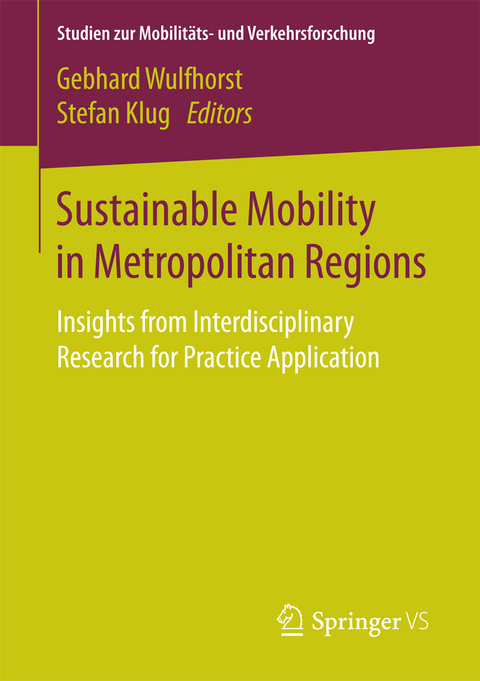
Sustainable Mobility in Metropolitan Regions (eBook)
XII, 224 Seiten
Springer Fachmedien Wiesbaden GmbH (Verlag)
978-3-658-14428-9 (ISBN)
Dr. Stefan Klug is the coordinator of the mobil.LAB Doctoral Research Group, Technical University of Munich.
Prof. Dr.-Ing. Gebhard Wulfhorst is Professor of Urban Structure and Transport Planning, Technical University of Munich.Dr. Stefan Klug is the coordinator of the mobil.LAB Doctoral Research Group, Technical University of Munich.
Sustainable Mobility in Metropolitan Regions – Insights from interdisciplinary research for practice applications 6
Contents 11
Abbreviations 13
1 Sustainable Mobility in the Metropolitan Region of Munich: An Introduction 14
1 Sustainable Development 14
2 Mobility 17
3 Metropolitan regions 23
4 Sustainable mobility in metropolitan regions 25
References 27
Part I Innovative Policy Approaches 29
2A Governance Approach to Sustainable Mobility 30
1 Introduction 31
2 The concept of governance 31
2.1 Relevance of the governance concept for sustainable mobility 34
2.2 Connecting Munich with a governance approach: The case of cycling 37
3 Conclusion 40
References 42
3 Policies to Achieve Environmental Goals in the Built Environment 43
1 Introduction 44
2 Environmental impacts from the built environment 44
3 The significance of a multi-scale approach in the urban region of Munich 46
4 Policy recommendations to achieve environmental goals 49
4.1 Methodology 50
4.2 Government directives 51
4.3 Building rating systems 52
4.4 Urban-scale projects 53
4.5 Urban form development 55
4.6 Stakeholder actions 56
4.7 Relating actions to environmental goals 57
5 Discussion 58
6 Conclusions 58
References 59
Part II Specific Target Groups 62
4Sustainable Tourist Mobility: Implications for Urban Destination Management 63
1 Introduction: The importance of sustainable tourist mobility in urban areas 63
2 Tourism in Munich 64
3 The surveys 65
3.1 Research objectives and data collection 65
3.2 Respondent profiles 66
3.3 Summary of main findings 67
3.4 Implications for sustainable tourist mobility policies 67
4 Conclusions 69
References 70
5Corporate Mobility: When and Why Does it Become a Burden? 72
1 Living and working in a mobile and connected world 73
2 Sustainable mobility for mobile individuals 74
3 Existing concepts of mobility management 75
4 When does corporate mobility become a burden? 76
4.1 Stresses and strains of corporate mobility requirements 77
4.2 Corporate mobility: impacts on work-life balance 81
5 Corporate mobility is more than movement 84
5.1 The journey to and from work: commuting 84
5.2 Business travel 85
5.3 Changing workplaces 86
6 The outlook for corporate mobility management: toward a sustainable direction from the perspective of employees 87
References 87
6Social Sustainability and Mobility: The Case of Low-Income Groups 90
1 Introduction 90
2 Conceptual background: social sustainability and mobility 91
2.1 Bringing it together: sustainability and mobility 91
2.2 Mobility as key for participation and barriers to self-determined mobility 93
2.3 The matter of location: accessibility and residential location 95
3 A case study of the Munich region: what do we know about residential and mobility choices of low-income groups? 97
3.1 The case study area 97
3.2 Focus on low-income groups 98
4 Conclusion 103
References 104
7‘Knowledge-Workers’: A Conceptual Framework on Commuting Patterns 106
1 Introduction 107
2 Conceptual background 108
2.1 Interrelation between commuting, decision makers, and spatial context 108
2.2 Knowledge workers 109
2.3 Choice of residential location 110
2.4 Choice of workplace location 111
2.5 Commuting time and distance 111
3 Research hypotheses 112
4 Methodology 113
4.1 Research area and data 113
4.2 Methods of analysis 114
5 Findings 116
5.1 The spatial distribution of employment centers 116
5.3 Spatial extent of commuting 118
5.4 Commuting to and from the city of Munich 120
5 Discussion and conclusion 123
6 Next steps in research 124
References 126
Part III Options of Change 129
8Sharp Increases in Mobility Costs: A Trigger for Sustainable Mobility 130
1 Background and problem statement 131
2 Methodological approaches 133
2.1 Scan: Adapting the vulnerability assessment 134
2.2 Explore: Developing individual storylines with shock scenarios 135
2.3 Prepare: Including monetary budgets in accessibility analyses 136
3 Analysis within the study region 137
3.1 Scan on a regional level by vulnerability assessment 137
4 Explore on an individual household level by storylines with stress tests 142
4.1 Current mobility behavior 143
4.2 Shock scenario: US$200/barrel (increase to 2.11 €/L) 144
4.3 Shock scenario: Tripling of oil price (increase to 4.65 €/L) 144
4.4 Intermediate conclusions 146
5 Preparing decision makers by isocost accessibility analyses 147
5.1 Current situation and outcomes 147
6 Suggestions for local and regional development strategies 153
6.1 Local level: municipalities 153
6.2 Regional level: District and public transport authorities 154
6.3 Upper levels: State of Bavaria, Federal, EU 156
7 Discussion and further research 156
References 157
9Handling Non-Motorized Trips in Travel Demand Models 159
1 Introduction 159
2 Modeling Non-Motorized Trips 161
2.1 Regional Modeling of Non-Motorized Trips 162
2.2 Relationship between Intrazonal Travel and Non-Motorized Trips 164
3 Mitigating the Intrazonal Problem for Non-Motorized Modeling 165
3.1 Estimating Intrazonal Impedances 165
4 Existing Methods for Estimating Intrazonal Impedances 166
5 Developed Method for Estimating Intrazonal Impedances 167
5.1 Reducing Analysis Zone Size 168
6 Ongoing Research 170
6.1 Validating Methods for Estimating Intrazonal Impedances 171
6.2 Determining Optimal Zone Resolution 171
7 Conclusion and Outlook 172
References 173
10 Pedelecs as New Tools for Active Mobility: ‘Cheating’ or Sustainable Transportation? 176
1 Introduction 176
2 Images of cycling around the world 178
3 Pedelecs and their sustainable dimensions 180
4 Images and stereotypes of pedelecs, and the resulting limitations on adoption 183
5 An outlook for planning strategies and a basis for future research 186
References 189
Part IV Conclusions and Outlook 192
11 Individual Contributions Toward a Common Objective 193
1 Introduction 194
2 The common objectives 194
3 The individual perspective 196
4 The need to integrate land use and transport 198
5 Conclusion: Factors contributing to sustainable mobility 199
12 Perspectives on Sustainable Mobility in Metropolitan Regions: Shaping Mobility Cultures 202
1 Background 203
1.1 Objectives for continuous research on disruptive realities 203
1.2 Mobility culture as a framework for strategic orientations 205
2 Future research and development directions 207
2.1 New mobility concepts: from selling cars to delivering services 207
2.2 New mobility practices: from mode split to reflexive action 210
2.3 New mobility policies: from transport departments to mobility networks 212
2.4 Shaping sustainable mobility cultures: from theory to practice 215
3 Perspectives on implementing sustainable mobility in metropolitan regions 217
References 218
Contributors 223
| Erscheint lt. Verlag | 26.8.2016 |
|---|---|
| Reihe/Serie | Studien zur Mobilitäts- und Verkehrsforschung | Studien zur Mobilitäts- und Verkehrsforschung |
| Zusatzinfo | XII, 224 p. 35 illus. |
| Verlagsort | Wiesbaden |
| Sprache | englisch |
| Themenwelt | Sozialwissenschaften ► Politik / Verwaltung |
| Sozialwissenschaften ► Soziologie ► Spezielle Soziologien | |
| Technik ► Architektur | |
| Schlagworte | Environmental Development • Landscape/Regional and Urban Planning • metropolitan regions • Mobility Costs • Neighborhood mobility • Sustainable Mobility • urban geography and urbanism |
| ISBN-10 | 3-658-14428-9 / 3658144289 |
| ISBN-13 | 978-3-658-14428-9 / 9783658144289 |
| Informationen gemäß Produktsicherheitsverordnung (GPSR) | |
| Haben Sie eine Frage zum Produkt? |
 PDF (Wasserzeichen)
DRM: Digitales Wasserzeichen
Dieses eBook enthält ein digitales Wasserzeichen und ist damit für Sie personalisiert. Bei einer missbräuchlichen Weitergabe des eBooks an Dritte ist eine Rückverfolgung an die Quelle möglich.
Dateiformat: PDF (Portable Document Format)
Mit einem festen Seitenlayout eignet sich die PDF besonders für Fachbücher mit Spalten, Tabellen und Abbildungen. Eine PDF kann auf fast allen Geräten angezeigt werden, ist aber für kleine Displays (Smartphone, eReader) nur eingeschränkt geeignet.
Systemvoraussetzungen:
PC/Mac: Mit einem PC oder Mac können Sie dieses eBook lesen. Sie benötigen dafür einen PDF-Viewer - z.B. den Adobe Reader oder Adobe Digital Editions.
eReader: Dieses eBook kann mit (fast) allen eBook-Readern gelesen werden. Mit dem amazon-Kindle ist es aber nicht kompatibel.
Smartphone/Tablet: Egal ob Apple oder Android, dieses eBook können Sie lesen. Sie benötigen dafür einen PDF-Viewer - z.B. die kostenlose Adobe Digital Editions-App.
Buying eBooks from abroad
For tax law reasons we can sell eBooks just within Germany and Switzerland. Regrettably we cannot fulfill eBook-orders from other countries.
aus dem Bereich