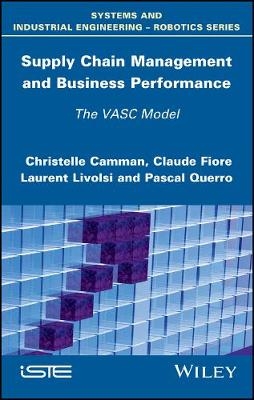
Supply Chain Management and Business Performance
ISTE Ltd and John Wiley & Sons Inc (Verlag)
978-1-78630-074-4 (ISBN)
The great number of possible strategies makes this type of management very complex, and the actual deployment of strategic choices is often limited by a lack of overall coherence within the organization.
This problem calls for an appropriate and renewed response. In strategic management today, a closer, permanent dialogue is needed between operational and financial performance.
Based on a supply chain approach, the Value Added Supply Chain (VASC) model focuses on driving operational performance, but aims to achieve a greater and more dynamic integration between these two dimensions of the company's value creation.
Christelle Camman is Assistant Professor in Business Administration at Aix-Marseille University and researcher at CRET-LOG in France. Her research interests focus on the management of supply chain strategies and organizations. Claude Fiore Professor in Business Administration at Aix-Marseille University in France, specializing on the themes of management of financial and operational performances, and the control of management. Laurent Livolsi is Assistant Professor in Business Administration at Aix-Marseille University and researcher at CRET-LOG in France. He is director of the SNCF Logistics Chair in "Structuring and Management of Supply Chains". Pascal Querro is co-founder of the supply chain consulting firm VINCIA Consulting and Associate Professor at Aix-Marseille University in France. He has been assisting major international groups in their operational transformation projects in the supply chain for 25 years.
Acknowledgments ix
Foreword xi
Introduction xv
Chapter 1 Managing Performance: Objectives and Managers’ Needs 1
1.1 Towards greater organizational agility 2
1.1.1 Some basic trends and their impacts on businesses 3
1.1.2 The evolution of business models: some examples from different sectors 10
1.1.3 Divergences, but above all, major trends in performance management 38
1.2 Needs and objectives of the CEO and the Board 45
1.2.1 The objectives of the CEO and the Board 46
1.2.2 Needs in terms of information quality and responsiveness 55
1.3 Financial directors’ needs and objectives 58
1.3.1 The involvement of a Chief Financial Officer (CFO) in the strategic process: from business model to business plan 60
1.3.2 Optimizing the business’ finance structure 66
1.3.3 New objectives in financial strategies 70
1.4 Supply chain management and operations management 81
1.4.1 Supply chain management: definition and positioning 81
1.4.2 Objectives that require a transverse approach 88
1.5 Conclusion 97
Chapter 2 Management Techniques and Tools 99
2.1 Tools for managers 100
2.1.1 Tools for measuring the creation of value 100
2.1.2 Tools for managing the value chain or the strategy deployment chain 105
2.2 Tools at the disposal of CFOs 116
2.2.1 The difficult reconciliation of time horizons 117
2.2.2 The importance of management control as a support for financial steering 127
2.3 The supply chain manager’s tools 142
2.3.1 Repository of good practices 142
2.3.2 Organizational models adapted to transversal management 150
2.3.3 Tools for operational steering and their connection with financial steering 158
2.3.4 New tools for more financial objectives 166
2.4 Conclusion 174
Chapter 3 New Ways to Steer Supply Chain Performance 177
3.1 Supply chain management through improvement of operational performance 184
3.1.1 Performance steering and the value creation process 184
3.1.2 Value tree (modeling financial equations) 187
3.1.3 The link between business indicators and financial strategy 191
3.1.4 Supply chain business model 198
3.1.5 From business model to steering supply chain value creation 200
3.2 Impacts of operational performance on financial management 202
3.2.1 The interrelations between changes in cost structure and EBITDA 204
3.2.2 The interrelations between changes in depreciation periods and cash flow 208
3.2.3 The interrelations between changes in stock levels and WCR 210
3.2.4 The cohesion of financing the supply chain business 211
3.3 Organization of the VASC model 213
3.3.1 A representation of the organization in terms of supply chain 214
3.3.2 An approach to steering the VASC model 220
3.4 Conclusion 225
Conclusion 229
Bibliography 235
Index 245
| Erscheinungsdatum | 16.06.2017 |
|---|---|
| Verlagsort | London |
| Sprache | englisch |
| Maße | 158 x 234 mm |
| Gewicht | 567 g |
| Themenwelt | Technik |
| Wirtschaft ► Betriebswirtschaft / Management ► Logistik / Produktion | |
| ISBN-10 | 1-78630-074-5 / 1786300745 |
| ISBN-13 | 978-1-78630-074-4 / 9781786300744 |
| Zustand | Neuware |
| Informationen gemäß Produktsicherheitsverordnung (GPSR) | |
| Haben Sie eine Frage zum Produkt? |
aus dem Bereich