


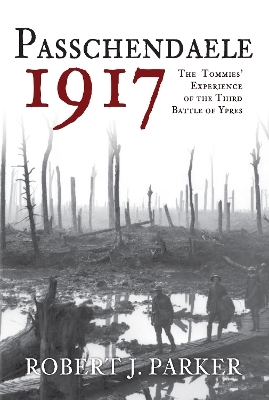
Passchendaele 1917
The Tommies' Experience of the Third Battle of Ypres
Seiten
2017
Amberley Publishing (Verlag)
978-1-4456-5571-0 (ISBN)
Amberley Publishing (Verlag)
978-1-4456-5571-0 (ISBN)
- Keine Verlagsinformationen verfügbar
- Artikel merken
A new centenary history of the infamous Western Front campaign for the Belgian village of Passchendaele fought from 31 July - 10 November 1917.
It seems absurd to claim it, but the Battle of Passchendaele was in many ways worse than the Somme. The British offensive, also known as the Third Battle of Ypres, was launched on the Belgium battlefield at 3.30 a.m. on 31 July 1917. It was a massive effort by General Sir Douglas Haig and the British Army to achieve a strategic breakthrough and defeat Germany. Attrition would defeat a Germany that was, many believed, ‘on the ropes’. Just one more ‘big push’ would secure victory – yet it failed.
Passchendaele continued until November 1917 and became synonymous with the tragedy of the Great War: abominable weather, mud and filth; horrific injuries inflicted by increasingly industrialised warfare including tanks, gas, mines and flamethrowers; the enormous casualties (600,000) and the futility of the operation all combined to form a nightmare vision of war in the trenches. What was life like for the ordinary British soldier? Was the whole bloody effort necessary or were there alternatives? What, if anything, did it achieve? Passchendaele 1917 answers these questions while reminding us of the sacrifices and heroism of the soldiers who fought it.
It seems absurd to claim it, but the Battle of Passchendaele was in many ways worse than the Somme. The British offensive, also known as the Third Battle of Ypres, was launched on the Belgium battlefield at 3.30 a.m. on 31 July 1917. It was a massive effort by General Sir Douglas Haig and the British Army to achieve a strategic breakthrough and defeat Germany. Attrition would defeat a Germany that was, many believed, ‘on the ropes’. Just one more ‘big push’ would secure victory – yet it failed.
Passchendaele continued until November 1917 and became synonymous with the tragedy of the Great War: abominable weather, mud and filth; horrific injuries inflicted by increasingly industrialised warfare including tanks, gas, mines and flamethrowers; the enormous casualties (600,000) and the futility of the operation all combined to form a nightmare vision of war in the trenches. What was life like for the ordinary British soldier? Was the whole bloody effort necessary or were there alternatives? What, if anything, did it achieve? Passchendaele 1917 answers these questions while reminding us of the sacrifices and heroism of the soldiers who fought it.
Robert J. Parker has been a school teacher for over thirty years. He has Bachelors &Masters degrees in history & combines his passion for the history of WW1 & WW2 with frequent travel to the battlefield sites. He has spent several months based in France studying the remains of the D-Day landings. He has visited six continents and over fifty countries, making more than forty separate trips to the United Kingdom alone. He lives in Indiana, USA.
| Erscheinungsdatum | 28.09.2017 |
|---|---|
| Zusatzinfo | 16 Plates, color |
| Verlagsort | Chalford |
| Sprache | englisch |
| Maße | 156 x 235 mm |
| Gewicht | 580 g |
| Themenwelt | Geschichte ► Allgemeine Geschichte ► Neuzeit (bis 1918) |
| Geschichte ► Allgemeine Geschichte ► 1918 bis 1945 | |
| Geisteswissenschaften ► Geschichte ► Hilfswissenschaften | |
| Sozialwissenschaften ► Politik / Verwaltung | |
| Technik ► Architektur | |
| ISBN-10 | 1-4456-5571-3 / 1445655713 |
| ISBN-13 | 978-1-4456-5571-0 / 9781445655710 |
| Zustand | Neuware |
| Informationen gemäß Produktsicherheitsverordnung (GPSR) | |
| Haben Sie eine Frage zum Produkt? |
Mehr entdecken
aus dem Bereich

aus dem Bereich
Geschichte einer wilden Handlung
Buch | Hardcover (2024)
C.H.Beck (Verlag)
CHF 47,60


