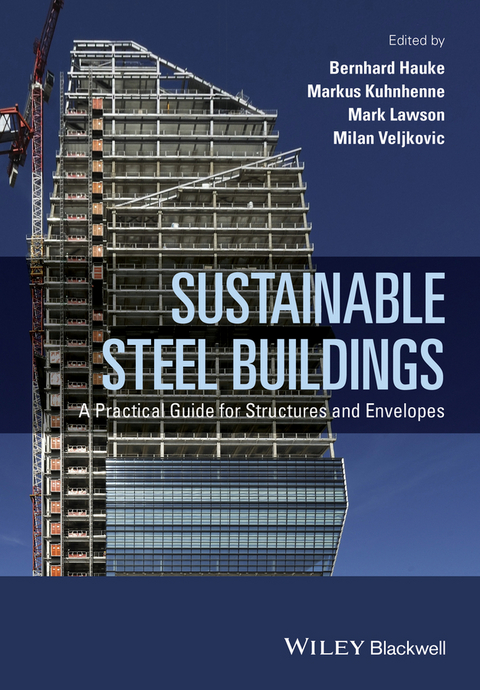
Sustainable Steel Buildings (eBook)
John Wiley & Sons (Verlag)
978-1-118-74081-1 (ISBN)
Bernhard Hauke ist Geschäftsführer von bauforumstahl, der die deutsche Stahlindustrie repräsentierenden Organisation. Mit einem Abschluss als Bauingenieur (Dipl.-Ing.) und einem PhD im Hoch- und Tiefbau war Dr. Hauke vor seiner Zeit bei bauforumstahl als Bauingenieur, Planungsleiter und später als Leiter des Bereichs Steel Design der Hochtief Construction AG tätig. Oliver Hechler ist wissenschaftlicher Mitarbeiter an der Fakultät für Naturwissenschaften, Technologie und Kommunikation der Universität Luxemburg. Markus Kuhnhenne arbeitet am Institut für Stahlbau an der RWTH Aachen.
Sustainable Steel Buildings reviews steel and its potential as a sustainable building material and shows how steel can be used to deliver buildings and structures with a high level of sustainability. The book's main focus is on the advantages and disadvantages of steel and how those characteristics can be used under a range of international certification systems (DGNB, LEED, BREEAM, openhouse etc).
The Editors Bernhard Hauke is CEO of bauforumstahl, the association of the German Steel Construction Industry Markus Kuhnhenne is Professor of Sustainability of Metal Constructions at RWTH Aachen University Mark Lawson is Professor of Construction Systems at the University of Surrey Milan Veljkovic is Professor of Steel and Composite Structures at the Technical University of Delft
List of contributors
1. Foreword
2. What does "Sustainable construction" mean? - An overview
3. Basic principles of sustainability assessment
4. Sustainable Steel Construction
5. Sustainability Certification Labels for Buildings
6. Case Studies and Life Cycle Assessment Comparisons
Index
Chapter 1
What does ‘sustainable construction’ mean? An overview
Sustainable construction is a relatively new subject with which many of those involved in planning and construction are not familiar. It has been covered in numerous technical papers, but few of them present specific measures for implementing sustainability in the building and construction industry. This publication aims to improve the information available to those working in the construction sector using examples and guidance on steel construction in particular. The background and basic principles of how to achieve sustainable construction are presented and dealt with in a clearly structured manner. This publication also aims to convey a comprehensive understanding of sustainability and identifies the opportunities and essentials that can result from sensible implementation of sustainable steel construction strategies. The latest developments in steel construction provide a means to measure the success of the building and construction industry.
1.1 INTRODUCTION
Diana Fischer, Bernhard Hauke, Luis Braganca, Joana Andrade and Ricardo Mateus
The term ‘sustainable’ was first used in forestry to convey the idea that only as many trees could be felled in a given time period as were capable of growing again during the same period. A definition of the term ‘sustainability’ that is common today in the context of society can be found in the Brundtland report of the United Nations, which was published in 1987: ‘Sustainable development is development that meets the needs of the present without compromising the ability of future generations to meet their own needs’ [1]. These needs can be of an ecological, economic or social nature. A development or action is only sustainable if a minimum level of satisfaction is achieved in all areas and can be maintained in the future.
In 1992, the Earth Summit was held in Rio de Janeiro. It was an unprecedented event and attempted to establish sustainable development policies at a global scale. Among other documents, Agenda 21 was born during this conference [2]. It sought to move the interpretation of the sustainable development concept from just environmental protection to improvement of life quality and well‐being, generation equity, ethics and healthy conditions [3].
Twenty years later, a new summit took place in Rio – Rio +20 Conference. The two main themes discussed were (1) a green economy in the context of sustainable development and poverty eradication; and (2) the institutional framework for sustainable development. Although still concerned with environmental and economic issues, this summit concluded that eradicating poverty is the greatest global challenge nowadays.
A shift in how sustainable development is seen is apparent. It started only as an environmental concern, and currently the social aspects of sustainability are highlighted. This shows the importance of going beyond environmental protection and considering also both the economic and social aspects. It implies that environmental protection is linked to maintaining and improving equity of the present and future generations, as follows: Sustainable development should be promoted by ‘sustained, inclusive and equitable economic growth, creating greater opportunities for all, reducing inequalities, raising basic standards of living, fostering equitable social development and inclusion, and promoting integrated and sustainable management of natural resources and ecosystems that supports, inter alia, economic, social and human development while facilitating ecosystem conservation, regeneration and restoration and resilience in the face of new and emerging challenges’ [4].
Thus, the sustainability concept is based on the interrelation of three fields: environment, society and economy. A sustainable model should stimulate and pursue agreement and equality among the three (Figure 1.1).
Figure 1.1 Three main overlapping fields defining sustainable development.
© bauforumstahl.
1.1.1 The influence of the building sector
The building sector’s influence on the above‐mentioned problems is often underestimated. In 2013, €1162 billion was invested in construction in the countries of the European Union (EU‐28). At the same time, the building sector was responsible for 8.8% of the EU‐28 gross domestic product (GDP), providing 29% of the industrial employment and representing 6.4% of the total employment in Europe [5]. From the environmental side, the construction sector is responsible for 34.2% of the total waste produced in EU‐28 in 2010 (851.6 million tonnes) [6]. In 2012, it was responsible for 11.7% of the greenhouse gases emission in EU‐28 and accounts for approximately 47% of raw materials extraction. Besides economic and environmental impacts, the construction industry plays a major role in society. The employment of millions of world citizens depends directly and indirectly on construction. Buildings, roads, bridges and even water and energy infrastructures are all products from this industry. Buildings have a major influence on people’s lives and well‐being. In the past 60 years the world population has doubled, and most of our lives are spent inside buildings of all types.
Taking a closer look at buildings, their impact on people’s lives is considerable. Data from the World Health Organization confirms that 90% of a person’s lifetime is spent inside buildings [7]. With the current patterns, the expansion of the built environment will affect the natural habitats on more than 70% of earth’s land by 2032 [8]. The economic influence of the property sector has also increased. Properties are now closely linked to the global finance markets via funds and credit guarantees. The last financial crisis showed the macroeconomic impacts that property can have. This clearly demonstrates that acting responsibly in the building sector can also result in an important contribution to preservation of the environment and conservation of resources as well as to economic efficiency.
This background data shows the influence of construction on the three pillars of sustainability. Charles Kibert defended this importance during the first international conference on sustainable construction in Tampa in 1994. He introduced the concept of ‘sustainable construction’ as being ‘the creation and the responsible management of a healthy built environment based on resource efficient and ecological principles’ [9]. He highlighted the need for a life‐cycle approach considering the impacts from the raw materials’ extraction to the building’s demolition [10]. With this holistic view, the following principles to achieve construction sustainability can be defined:
- efficiently use resources to avoid depletion of raw materials (energy, water and soil);
- protect ecosystems (waste, emissions, pollutants, land use);
- recycle materials in their end of life and use recyclable resources;
- eliminate hazardous products;
- minimize costs over the entire building’s life‐cycle;
- promote health, safety and well‐being conditions for the inhabitants, neighbours and workers.
The growing shortage of resources and the high levels of emissions and waste production were the motivation for promoting sustainable construction more strongly. The building fabric plays a key role with regard to the primary energy consumption and global warming potential of buildings because it strongly affects the energy consumption that occurs during the building’s life. Statutory requirements in the form of energy‐saving ordinances and thermal efficiency of the building fabric and building services lead to lower energy use during the lifetime of a building. The choice of construction materials used is more important because they are increasingly also impacting the ecological quality of construction during its life cycle. Three questions particularly relevant here are: (1) What environmental impacts occur during production? As a matter of principle, materials and products with a small ecological footprint should be used as much as possible; specifically, construction materials should consume little energy and water during their production and should not contribute to emissions over their life and when dismantled at the end of their life (see below). (2) How much ‘construction’ can be achieved using a unit of the product, in other words how efficiently can the product be used? It is not sufficient to merely compare eco‐relevant indicators in order to determine the ecological significance of a construction product.
It is also necessary to check how much functionality the use of a construction product offers, for example, how much useful area can be achieved using a kilogram of a construction material or what energy savings thermal insulation brings during the course of the life cycle. Here, comparisons are mostly only possible at building level; for example, lighter construction allows a certain method of construction and reduced foundation sizes. Environmental performance indicators can only be used to compare construction materials directly if the choice is between products of a similar type from different manufacturers. (3) What happens to the construction material if the building is dismantled? Reuse, recycling or disposal site? The question of whether a construction product can be reused or has to be disposed of after dismantling plays a...
| Erscheint lt. Verlag | 24.8.2016 |
|---|---|
| Sprache | englisch |
| Themenwelt | Technik ► Architektur |
| Technik ► Bauwesen | |
| Schlagworte | Advantages of Steel as a Building Material • Background to Sustainable Building • Basic Concepts of Sustainable Construction • Bauingenieur- u. Bauwesen • Civil Engineering & Construction • Construction of Buildings • Construction: Sustainability • Design of Buildings • Design Tools for Delivery of Sustainable Buildings • Disadvantages of Steel as a Building Material • Examples of Sustainable Steel Buildings • Hochbau • Inherent Sustainability • Methods for the Delivery of Sustainable Buildings • Nachhaltiges Bauen • Operation of buildings • Stahlbau • Stahlhochbau u. Brückenbau • Stahlhochbau u. Brückenbau • Steel Construction & Bridge Engineering • Steel Construction Products • Steel in Construction Applications • Steel Performance • sustainability • Sustainability Certification Systems • Sustainability of Steel • Sustainable Building Material • Sustainable Steel Buildings |
| ISBN-10 | 1-118-74081-5 / 1118740815 |
| ISBN-13 | 978-1-118-74081-1 / 9781118740811 |
| Informationen gemäß Produktsicherheitsverordnung (GPSR) | |
| Haben Sie eine Frage zum Produkt? |
 EPUB (Adobe DRM)
Kopierschutz: Adobe-DRM
Adobe-DRM ist ein Kopierschutz, der das eBook vor Mißbrauch schützen soll. Dabei wird das eBook bereits beim Download auf Ihre persönliche Adobe-ID autorisiert. Lesen können Sie das eBook dann nur auf den Geräten, welche ebenfalls auf Ihre Adobe-ID registriert sind.
Details zum Adobe-DRM
Dateiformat: EPUB (Electronic Publication)
EPUB ist ein offener Standard für eBooks und eignet sich besonders zur Darstellung von Belletristik und Sachbüchern. Der Fließtext wird dynamisch an die Display- und Schriftgröße angepasst. Auch für mobile Lesegeräte ist EPUB daher gut geeignet.
Systemvoraussetzungen:
PC/Mac: Mit einem PC oder Mac können Sie dieses eBook lesen. Sie benötigen eine
eReader: Dieses eBook kann mit (fast) allen eBook-Readern gelesen werden. Mit dem amazon-Kindle ist es aber nicht kompatibel.
Smartphone/Tablet: Egal ob Apple oder Android, dieses eBook können Sie lesen. Sie benötigen eine
Geräteliste und zusätzliche Hinweise
Buying eBooks from abroad
For tax law reasons we can sell eBooks just within Germany and Switzerland. Regrettably we cannot fulfill eBook-orders from other countries.
aus dem Bereich