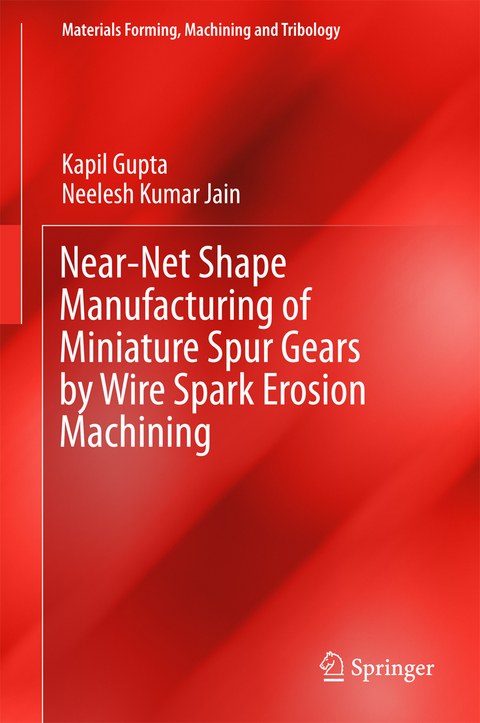
Near-Net Shape Manufacturing of Miniature Spur Gears by Wire Spark Erosion Machining (eBook)
135 Seiten
Springer Singapore (Verlag)
978-981-10-1563-2 (ISBN)
Kapil Gupta is a Postdoctoral Research Fellow in the Department of Mechanical Engineering Science at University of Johannesburg. He received his PhD in mechanical engineering with specialization in Manufacturing Engineering from Indian Institute of Technology Indore, India in 2014. Advanced machining processes, sustainable manufacturing, precision engineering and gear technology are his areas of interests. Dr Gupta has published five SCI Journal articles and delivered presentations at some prestigious international conferences. He also possesses five years of professional experience in the academic and research environment. He is an active member of American Society of Mechanical Engineers (ASME) and a reviewer for some international journals of repute.
Neelesh Kumar Jain is currently Professor of Mechanical Engineering and Dean Academic Affairs at Indian Institute of Technology Indore, India. He obtained his PhD in Mechanical Engineering from Indian Institute of Technology Kanpur, India in 2003. His areas of research interest include advanced and hybrid machining processes, and gear technology. Dr Jain has successfully supervised several PhD scholars and graduate and undergraduate theses. Over one hundred journal and conference articles have been published under his authorship. He is also the head of Centre of Excellence (an international research lab) in Gear Engineering at IIT Indore. He is handling consultancy and project work in association with several corporations and also with the Government of India. He is also engaged in writing book chapters and books for some reputed international publishers.
This work describes an experimental investigation with the aim to evaluate and establish wire spark erosion machining (WSEM) as a viable alternative for high quality miniature gear manufacturing. External spur type miniature brass (ASTM 858) gears with 12 teeth, 9.8 mm outside diameter and 5 mm face width were manufactured by WSEM. The research work was accomplished in four distinct experimental stages viz., preliminary, pilot, main and confirmation. The aim, scope and findings of each stage are progressively presented and discussed. In essence, the investigation found that it was possible to manufacture miniature gears to high quality by using WSEM. Gears up to DIN 5 quality with a good surface finish (1.2 um average roughness) and satisfactory surface integrity were achieved. The results suggest that WSEM should be considered a viable alternative to conventional miniature gear manufacturing techniques and that in some instances it may even be superior. This work will prove useful toresearchers and professionals in the field of miniature and micro-scale manufacturing and machining.
Kapil Gupta is a Postdoctoral Research Fellow in the Department of Mechanical Engineering Science at University of Johannesburg. He received his PhD in mechanical engineering with specialization in Manufacturing Engineering from Indian Institute of Technology Indore, India in 2014. Advanced machining processes, sustainable manufacturing, precision engineering and gear technology are his areas of interests. Dr Gupta has published five SCI Journal articles and delivered presentations at some prestigious international conferences. He also possesses five years of professional experience in the academic and research environment. He is an active member of American Society of Mechanical Engineers (ASME) and a reviewer for some international journals of repute. Neelesh Kumar Jain is currently Professor of Mechanical Engineering and Dean Academic Affairs at Indian Institute of Technology Indore, India. He obtained his PhD in Mechanical Engineering from Indian Institute of Technology Kanpur, India in 2003. His areas of research interest include advanced and hybrid machining processes, and gear technology. Dr Jain has successfully supervised several PhD scholars and graduate and undergraduate theses. Over one hundred journal and conference articles have been published under his authorship. He is also the head of Centre of Excellence (an international research lab) in Gear Engineering at IIT Indore. He is handling consultancy and project work in association with several corporations and also with the Government of India. He is also engaged in writing book chapters and books for some reputed international publishers.
Preface 6
Contents 9
About the Authors 12
1 Introduction 13
1.1 Introduction to Miniature Gears 13
1.2 Quality Aspects of Miniature Gears 15
1.2.1 Micro-geometry 17
1.2.1.1 Form Errors 17
1.2.1.2 Location Errors 18
1.2.2 Macro-geometry 19
1.2.3 Tooth Flank Topography 19
1.2.4 Surface Roughness 19
1.2.5 Microstructure and Micro-hardness 22
1.3 Conventional Methods of Miniature Gear Manufacture 23
1.3.1 Material Removal Processes 23
1.3.2 Forming Processes 24
1.3.3 Additive Processes 25
References 26
2 Overview of Wire Spark Erosion Machining (WSEM) 28
2.1 Introduction to WSEM 29
2.2 Process Parameters of WSEM 30
2.3 Advantages and Limitations of WSEM 31
2.4 Applications of WSEM 32
2.5 Machining of Gears by Spark-Erosion Processes 32
2.6 Spark Erosion Machining of Miniature Gears State-of-the-Art 34
2.6.1 Spark-Erosion Machining of Gears 34
2.6.2 Wire Spark-Erosion Machining of Gears 38
2.7 Conclusions and Scope of Spark Erosion Machining of Miniature Gears 43
References 43
3 Planning, Design and Details of Experimental Investigation 45
3.1 Introduction to Design of Experiments 45
3.1.1 Response Surface Methodology (RSM) 47
3.2 Experimental Plan for Wire Spark Erosion Machining of Miniature Gears 51
3.2.1 Trial Experiments 54
3.2.2 Pilot Experiments 54
3.2.3 Main Experiments 55
3.2.4 Confirmation Experiments 55
3.3 Evaluation of Gear Quality and WSEM Productivity 56
3.3.1 Evaluation of Micro-geometry and Macro-geometry of Miniature Gears 57
3.3.2 Evaluation of Surface Roughness 59
3.3.3 Characterization of Subsurface Integrity 60
3.3.3.1 Microstructure Examination 60
3.3.3.2 Micro-hardness Measurement 60
3.3.4 WSEM Process Productivity and Evaluation 60
3.4 Procedure of Experimentation 61
3.5 Methods and Tools for Data Analysis 62
3.5.1 Analysis of Variance (ANOVA) 62
3.5.2 Model Adequacy Checking 64
References 65
4 Experimental Results and Analysis 66
4.1 Conclusions from Trial Experiments 66
4.2 Results of Pilot Experiments and Their Analysis 66
4.2.1 Analysis of Micro-geometry 67
4.2.2 Analysis of Surface Roughness 70
4.2.3 Analysis of the Best Quality Miniature Gear 72
4.2.3.1 Micro-geometry 73
4.2.3.2 Flank Surface Topography 73
4.2.3.3 Macro-geometry 73
4.2.3.4 Surface Roughness and Bearing Area Curve 75
4.2.3.5 Microstructure and Micro-hardness 75
4.3 Conclusions from Pilot Experiments 80
4.4 Results of Main Experiments and Their Analysis 81
4.4.1 Effect of WSEM Process Parameters and Their Interactions 81
4.4.1.1 Effect of Pulse-on Time 81
4.4.1.2 Effect of Pulse-Off Time 86
4.4.1.3 Effect of Voltage 89
4.4.1.4 Effect of Wire Feed Rate 89
4.4.1.5 Effects of Significant Interactions 92
4.5 Conclusions from Main Experiments 94
References 94
5 Modelling and Optimization 96
5.1 Modelling of WSEM Process 96
5.1.1 Modelling Using Regression Analysis 96
5.1.1.1 Regression Models for Micro-geometry 98
5.1.1.2 Regression Models for Surface Roughness 99
5.1.1.3 Regression Model for Gear Cutting Rate 100
5.1.2 Modeling Using Artificial Neural Network (ANN) 100
5.1.2.1 ANN Model for Micro-geometry 103
5.1.2.2 ANN Model for Surface Roughness 103
5.1.2.3 ANN Model for Gear Cutting Rate 104
5.1.3 Comparison of Regression Models and ANN Models 105
5.2 Optimization of WSEM Process 105
5.2.1 Optimization Using Desirability Analysis 107
5.2.1.1 Optimization for Micro-geometry 108
5.2.1.2 Optimization for Surface Roughness 109
5.2.1.3 Optimization for Gear Cutting Rate 110
5.2.2 Multi-objective Optimization 111
5.2.2.1 Response Surface Methodology Based Desirability Analysis Approach 111
5.2.2.2 Back Propagation Neural Network Integrated Genetic Algorithm Approach 112
5.3 Experimental Validation of Optimization Results 116
5.3.1 For Micro-geometry 116
5.3.2 For Surface Roughness 119
5.3.3 For Gear Cutting Rate 119
5.3.4 For Multi-objective Optimization 119
5.4 Quality Aspects of Miniature Gears Manufactured at Optimized WSEM Parameters 121
5.4.1 Micro-geometry 121
5.4.2 Macro-geometry 124
5.4.3 Bearing Area Curve 124
5.4.4 Subsurface Integrity 125
References 126
6 Comparative Study, Conclusions and Future Avenues 127
6.1 Comparison Between Wire Spark Erosion Machining and Hobbing 127
6.1.1 Micro-geometry and Macro-geometry 128
6.1.2 Surface Roughness and Flank Surface Topography 128
6.1.3 Micro-hardness 130
6.1.4 Micrographs 130
6.1.5 Comparison Based on Other Capabilities 133
6.2 Significant Achievements, Conclusions and Avenues for Future Research 133
References 134
Appendix A 135
Appendix B 136
Index 141
| Erscheint lt. Verlag | 18.8.2016 |
|---|---|
| Reihe/Serie | Materials Forming, Machining and Tribology | Materials Forming, Machining and Tribology |
| Zusatzinfo | XIII, 135 p. 62 illus., 31 illus. in color. |
| Verlagsort | Singapore |
| Sprache | englisch |
| Themenwelt | Technik ► Maschinenbau |
| Wirtschaft ► Betriebswirtschaft / Management ► Logistik / Produktion | |
| Schlagworte | Gear Manufacturing • Geometric Accuracy • Miniature Gear • Surface Integrity • Wire Spark Erosion |
| ISBN-10 | 981-10-1563-5 / 9811015635 |
| ISBN-13 | 978-981-10-1563-2 / 9789811015632 |
| Informationen gemäß Produktsicherheitsverordnung (GPSR) | |
| Haben Sie eine Frage zum Produkt? |
 PDF (Wasserzeichen)
DRM: Digitales Wasserzeichen
Dieses eBook enthält ein digitales Wasserzeichen und ist damit für Sie personalisiert. Bei einer missbräuchlichen Weitergabe des eBooks an Dritte ist eine Rückverfolgung an die Quelle möglich.
Dateiformat: PDF (Portable Document Format)
Mit einem festen Seitenlayout eignet sich die PDF besonders für Fachbücher mit Spalten, Tabellen und Abbildungen. Eine PDF kann auf fast allen Geräten angezeigt werden, ist aber für kleine Displays (Smartphone, eReader) nur eingeschränkt geeignet.
Systemvoraussetzungen:
PC/Mac: Mit einem PC oder Mac können Sie dieses eBook lesen. Sie benötigen dafür einen PDF-Viewer - z.B. den Adobe Reader oder Adobe Digital Editions.
eReader: Dieses eBook kann mit (fast) allen eBook-Readern gelesen werden. Mit dem amazon-Kindle ist es aber nicht kompatibel.
Smartphone/Tablet: Egal ob Apple oder Android, dieses eBook können Sie lesen. Sie benötigen dafür einen PDF-Viewer - z.B. die kostenlose Adobe Digital Editions-App.
Buying eBooks from abroad
For tax law reasons we can sell eBooks just within Germany and Switzerland. Regrettably we cannot fulfill eBook-orders from other countries.
aus dem Bereich