Time and Methods in Environmental Interfaces Modelling
Elsevier Science Ltd (Verlag)
978-0-444-63918-9 (ISBN)
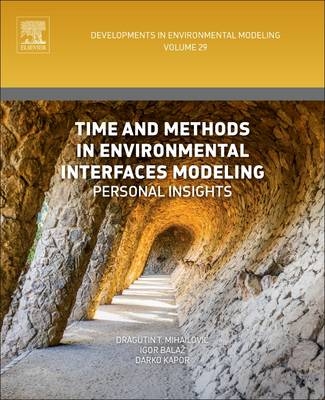
As the field of environmental science requires the application of new fundamental approaches that can lead to a better understanding of environmental phenomena, this book helps necessitate new approaches in modeling, including category theory, that follow new achievements in physics, mathematics, biology, and chemistry.
Dragutin Mihailovic is Professor in Meteorology and Environmental Fluid Mechanics at the University of Novi Sad (Serbia). He received a B.Sc. in Physics at the University of Belgrade, his M.Sc. in Meteorology at the University of Belgrade, Serbia and defended his Ph.D.Thesis in Meteorology at the University of Belgrade. He was the Visiting Professor at University at Albany, The State University of New York at Albany (USA), Visiting Scientist at University of Agriculture, Wageningen (The Netherlands) and Visiting Researcher in the Norwegian Meteorological Institute (Norway). He has more than 100 peer-reviewed scientific papers in the international journals in subjects related to land-atmosphere processes, air pollution modelling and chemical transport models, boundary layer meteorology, physics and modelling of environmental interfaces, modelling of complex biophysical systems, nonlinear dynamics and complexity. He edited five books form environmental fluid mechanics (Taylor & Francis, World Scientific and Nova Science Publishers). He was the member of the Editorial Board of Environmental Modelling and Software (1992-2010) and reviewer in several scientific journals. He was the principal investigator in a FP6 project and several international projects (Colorado State University and several European countries). Igor Balaz is Assistant Professor of Biophysics, Physics and Meteorology. He received MSc in biology and PhD in physics of complex systems at the University of Novi Sad. He is currently working within the Serbian national research project on subtopic: “Modelling of biological systems. His work is mainly focused on modeling spontaneous emergence of innovations in biological evolution. On three occasions he was the visiting researcher at the Department of Earth and Planetary Sciences, Kobe University, Japan where he worked on modeling adaptability of organization of living systems with prof. Yukio-Pegio Gunji. He was also the visiting researcher at University of Rostock, Germany (the Systems Biology and Bioinformatics research group, Institute for Informatics) and at the Friedrich-Schiller-University Jena, Germany (Bio Systems Analysis Group, Institute of Computer Science). He has over 30 peer-reviewed scientific papers in the international journals and chapters in research monographs. Darko Kapor is the retired Professor of Theoretical and Mathematical Physics. He received a B.Sc. in Physics at the University of Novi Sad, his M.Sc. in Theoretical Physics at the University of Belgrade, Serbia and defended his Ph.D.Thesis in Theoretical Physics at the University of Novi Sad. Along with his teaching activities in Physics, he also taught at the multidisciplinary studies of the Center for Meteorology and Environmental Modelling (CMEM ACIMSI) of the University of Novi Sad. His main research interest is the Theoretical Condensed Matter Physics, where he was the head of the projects financed by the Ministry for Science of the Republic of Serbia. During the last 20 years, he has developed an interest in the problems of theoretical meteorology and worked with the Meteorology group at the Faculty of Agriculture and Faculty of Sciences. He has more than 120 peer-reviewed scientific papers in the international journals and chapters in research monographs. While preparing his Ph.D.Thesis, he spent several months in French laboratories (Saclay, Orsay, Grenoble) and in 1990/91 he was the Fullbright grantee at the University of California at San Diego. For a long period he cooperated with the members of Theoretical Condensed Matter Group at KFKI MTA, Budapest, Hungary. Prof. Kapor invested a lot of effort in Physics popularization by working with talented pupils and teachers. He was the organizer of Physics problems solving contests for the elementary schools. His experience from this work was important while he coauthored textbooks in Physics for elementary and secondary schools.
Part I: Introduction
Chapter 1. Environmental interface: Definition and introductory comments
Chapter 2. Advanced theoretician's tools in the modelling of the environmental interface systems
Chapter 3. Approaches and meaning of time in the modelling of the environmental interface systems
Chapter 4. Examples of use of the formal complex analysis
Part II: Time in Environmental Interfaces Modelling
Chapter 5. Time in philosophy and physics
Chapter 6. Time in biology
Chapter 7. Functional time: Definition and examples
Part III: Use of Different Coupled Maps in the Environmental Interfaces Modelling
Chapter 8. Coupled logistic maps in the environmental interfaces modelling
Chapter 9. Logistic difference equation on extended domain
Chapter 10. Generalized logistic equation with affinity: Its use in modelling heterogeneous environmental interfaces
Chapter 11. Maps serving the different coupling in the environmental interfaces modelling in the presence of noise
Part IV: Heterarchy and Exchange Processes Between Environmental Interfaces
Chapter 12. Heterarchy as a concept in environmental interfaces modelling
Chapter 13. Heterarchy and biochemical substance exchange in a diffusively coupled ring of cells
Chapter 14. Heterarchy and albedo of the heterogeneous environmental interfaces in environmental modelling
Part V: Complexity Measures and Time Series Analysis of the Processes at the Environmental Interfaces
Chapter 15. Kolmogorov complexity and the measures based on this complexity
Chapter 16. Complexity analysis of the ionizing and nonionizing radiation time series
Chapter 17. Complexity analysis of the environmental fluid flow time series
Chapter 18. How to face the complexity of climate models?
Part VI: Phenomenon of Chaos in Computing the Environmental Interface Variables
Chapter 19. Interrelations between mathematics and environmental sciences
Chapter 20. Chaos in modelling the global climate system
Chapter 21. Chaos in exchange of vertical turbulent energy fluxes over environmental interfaces in climate models
Chapter 22. Synchronization and stability of the horizontal energy exchange between environmental interfaces in climate models
Part VII: Synchronization and Stability of the Biochemical Substance Exchange Between Cells
Chapter 23. Environmental interfaces and their stability in biological systems
Chapter 24. Synchronization of the biochemical substance exchange between cells
Chapter 25. Complexity and asymptotic stability in the process of biochemical substance exchange in multicell system
Chapter 26. Use of pseudospectra in analyzing the influence of intercellular nanotubes on cell-to-cell communication integrity
| Erscheinungsdatum | 18.11.2016 |
|---|---|
| Reihe/Serie | Developments in Environmental Modelling |
| Verlagsort | Oxford |
| Sprache | englisch |
| Maße | 191 x 235 mm |
| Gewicht | 1010 g |
| Themenwelt | Mathematik / Informatik ► Mathematik ► Angewandte Mathematik |
| Naturwissenschaften ► Biologie ► Ökologie / Naturschutz | |
| Technik ► Umwelttechnik / Biotechnologie | |
| ISBN-10 | 0-444-63918-7 / 0444639187 |
| ISBN-13 | 978-0-444-63918-9 / 9780444639189 |
| Zustand | Neuware |
| Informationen gemäß Produktsicherheitsverordnung (GPSR) | |
| Haben Sie eine Frage zum Produkt? |
aus dem Bereich