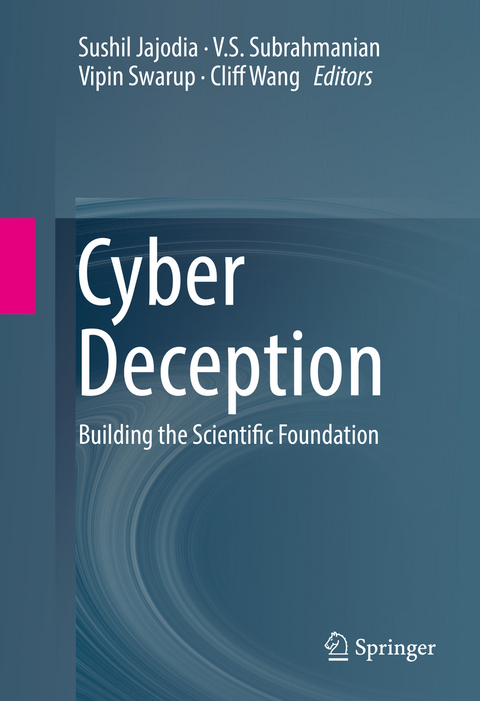
Cyber Deception (eBook)
312 Seiten
Springer International Publishing (Verlag)
978-3-319-32699-3 (ISBN)
Sushil Jajodia is University Professor, BDM International Professor, and the founding director of Center for Secure Information Systems in the Volgenau School of Engineering at the George Mason University, Fairfax, Virginia. His research interests include security, privacy, databases, and distributed systems. He is an IEEE fellow and a recipient of several awards including 2016 IEEE Computer Society Technical Achievement Award. His h-index is 90 and Erdos number is 2.V.S. Subrahmanian is Professor of Computer Science and Director of the Lab for Computational Cultural Dynamics and Director of the Center for Digital International Government at the University of Maryland. He is one of the world leaders in the development of both theoretical and practical, data-driven logical, probabilistic, and statistical methods to infer predictive models from diverse types of data sources and then using those predictive models to optimize one or more desired user/application goals.Vipin Swarup is the Chief Scientist for Cyber Security in MITRE's Cyber Security Technical Center. He leads MITRE's corporate cybersecurity research program which includes research projects in cyber analytics, active cyber defense, mobile computing security, embedded and cyber-physical systems security, and cyber resiliency. He is the recipient of MITRE’s first Technology Transfer Individual Contribution Award for entrepreneurial leadership and success in transferring MITRE innovations to the government and industry. Cliff Wang is the program director at US Army Research Office, managing a large portfolio of university research. He is also appointed as an adjunct professor at North Carolina State University. Dr. Wang is a fellow of IEEE.
Integrating Cyber-D&D into Adversary Modeling for Active Cyber Defense.- Cyber Security Deception.- Quantifying Covertness in Deceptive Cyber Deception.- Design Considerations for Building Cyber Deception Systems.- A Proactive and Deceptive Perspective for Role Detection and Concealment in Wireless Networks.- Effective Cyber Deception.- Cyber-Deception and Attribution in Capture-the-Flag Exercises.- Deceiving Attackers by Creating a Virtual Attack Surface.- Embedded Honeypotting.- Agile Virtual Infrastructure for Cyber Deception Against Stealthy DDoS Attacks.- Exploring Malicious Hacker Forums.- Anonymity in an electronic Society: A Survey.
| Erscheint lt. Verlag | 15.7.2016 |
|---|---|
| Zusatzinfo | X, 312 p. 111 illus. |
| Verlagsort | Cham |
| Sprache | englisch |
| Themenwelt | Informatik ► Netzwerke ► Sicherheit / Firewall |
| Technik ► Nachrichtentechnik | |
| Schlagworte | anonymization • Attribution • Critical Infrastructure Protection • Cyber Deception • Cyber denial • cyber security • cyber warfare • honeypots • Human Factors • Moving Target Defense • Quantification • security • wireless networks |
| ISBN-10 | 3-319-32699-6 / 3319326996 |
| ISBN-13 | 978-3-319-32699-3 / 9783319326993 |
| Informationen gemäß Produktsicherheitsverordnung (GPSR) | |
| Haben Sie eine Frage zum Produkt? |
 PDF (Wasserzeichen)
DRM: Digitales Wasserzeichen
Dieses eBook enthält ein digitales Wasserzeichen und ist damit für Sie personalisiert. Bei einer missbräuchlichen Weitergabe des eBooks an Dritte ist eine Rückverfolgung an die Quelle möglich.
Dateiformat: PDF (Portable Document Format)
Mit einem festen Seitenlayout eignet sich die PDF besonders für Fachbücher mit Spalten, Tabellen und Abbildungen. Eine PDF kann auf fast allen Geräten angezeigt werden, ist aber für kleine Displays (Smartphone, eReader) nur eingeschränkt geeignet.
Systemvoraussetzungen:
PC/Mac: Mit einem PC oder Mac können Sie dieses eBook lesen. Sie benötigen dafür einen PDF-Viewer - z.B. den Adobe Reader oder Adobe Digital Editions.
eReader: Dieses eBook kann mit (fast) allen eBook-Readern gelesen werden. Mit dem amazon-Kindle ist es aber nicht kompatibel.
Smartphone/Tablet: Egal ob Apple oder Android, dieses eBook können Sie lesen. Sie benötigen dafür einen PDF-Viewer - z.B. die kostenlose Adobe Digital Editions-App.
Buying eBooks from abroad
For tax law reasons we can sell eBooks just within Germany and Switzerland. Regrettably we cannot fulfill eBook-orders from other countries.
aus dem Bereich