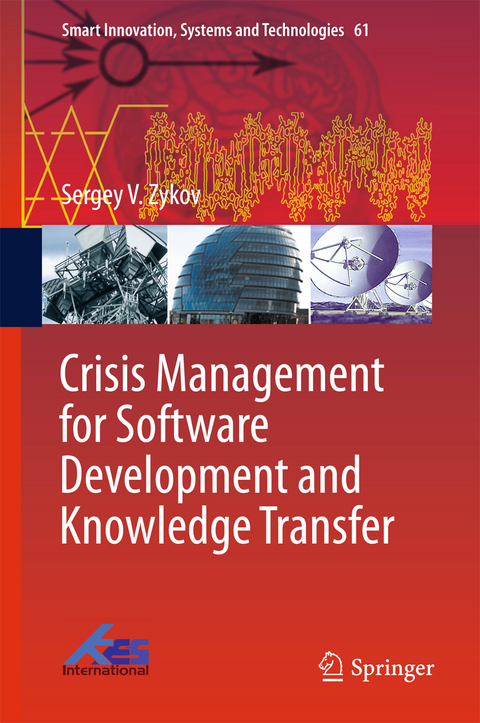
Crisis Management for Software Development and Knowledge Transfer (eBook)
133 Seiten
Springer International Publishing (Verlag)
978-3-319-42966-3 (ISBN)
This well structured book discusses lifecycle optimization of software projects for crisis management by means of software engineering methods and tools. Its outcomes are based on lessons learned from the software engineering crisis which started in the 1960s. The book presents a systematic approach to overcome the crisis in software engineering depends which not only depends on technology-related but also on human-related factors. It proposes an adaptive methodology for software product development, which optimizes the software product lifecycle in order to avoid 'local' crises of software production. The general lifecycle pattern and its stages are discussed, and their impact on the time and budget of the software product development is analyzed. The book identifies key advantages and disadvantages for various models selected and concludes that there is no 'silver bullet', or universal model, which suits all software products equally well. It approaches software architecture in terms of process, data and system perspectives and proposes an incremental methodology for crisis-agile development of large-scale, distributed heterogeneous applications. The book introduces a number of specialized approaches which are widely used in industry but are often ignored in general writings because of their vendor-specificity. In doing so, the book builds a helpful bridge from academic conceptions of software engineering to the world of software engineering practice. With its systematic coverage of different software engineering methodologies and the presented rich systems engineering examples the book will be beneficial for a broader audience.
Introduction.- Software Engineering: the End of the Crisis?.- Software Lifecycles: How Can we Optimize them?.- Software Methodologies: Are our Processes Crisis-Agile?.- Software Patterns: Ready for Crisis Development?.- Knowledge Transfer: Manageable in Crisis?.- Conclusion.
| Erscheint lt. Verlag | 30.7.2016 |
|---|---|
| Reihe/Serie | Smart Innovation, Systems and Technologies | Smart Innovation, Systems and Technologies |
| Zusatzinfo | XXIII, 133 p. 37 illus., 13 illus. in color. |
| Verlagsort | Cham |
| Sprache | englisch |
| Themenwelt | Mathematik / Informatik ► Informatik ► Software Entwicklung |
| Informatik ► Theorie / Studium ► Künstliche Intelligenz / Robotik | |
| Technik | |
| Schlagworte | Crisis Management • Intelligent tools • Lifecycle model • Lifecycle optimization • Software engineering |
| ISBN-10 | 3-319-42966-3 / 3319429663 |
| ISBN-13 | 978-3-319-42966-3 / 9783319429663 |
| Informationen gemäß Produktsicherheitsverordnung (GPSR) | |
| Haben Sie eine Frage zum Produkt? |
 PDF (Wasserzeichen)
DRM: Digitales Wasserzeichen
Dieses eBook enthält ein digitales Wasserzeichen und ist damit für Sie personalisiert. Bei einer missbräuchlichen Weitergabe des eBooks an Dritte ist eine Rückverfolgung an die Quelle möglich.
Dateiformat: PDF (Portable Document Format)
Mit einem festen Seitenlayout eignet sich die PDF besonders für Fachbücher mit Spalten, Tabellen und Abbildungen. Eine PDF kann auf fast allen Geräten angezeigt werden, ist aber für kleine Displays (Smartphone, eReader) nur eingeschränkt geeignet.
Systemvoraussetzungen:
PC/Mac: Mit einem PC oder Mac können Sie dieses eBook lesen. Sie benötigen dafür einen PDF-Viewer - z.B. den Adobe Reader oder Adobe Digital Editions.
eReader: Dieses eBook kann mit (fast) allen eBook-Readern gelesen werden. Mit dem amazon-Kindle ist es aber nicht kompatibel.
Smartphone/Tablet: Egal ob Apple oder Android, dieses eBook können Sie lesen. Sie benötigen dafür einen PDF-Viewer - z.B. die kostenlose Adobe Digital Editions-App.
Buying eBooks from abroad
For tax law reasons we can sell eBooks just within Germany and Switzerland. Regrettably we cannot fulfill eBook-orders from other countries.
aus dem Bereich