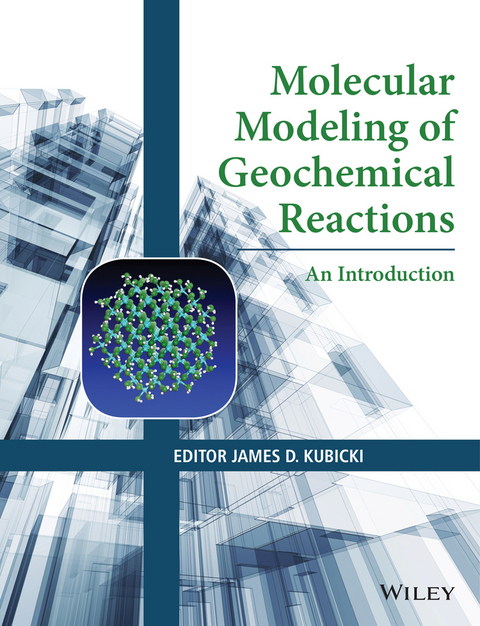
Molecular Modeling of Geochemical Reactions (eBook)
John Wiley & Sons (Verlag)
978-1-118-84516-5 (ISBN)

Professor James David Kubicki, Department of Geosciences, The Pennsylvania State University, USA Dr Kubicki has 25 years of experience in computational geochemistry across a variety of sub-disciplines. He has published on melts and glasses, high-pressure mineral physics, aqueous geochemistry, organic geochemistry, environmental geochemistry, biogeochemistry and isotopic geochemistry. He has been an editor of three books, two on computational geochemistry and one on geochemical kinetics. Dr Kubicki has been a professor at The Pennsylvania State University for 15 years and has taught about computational geochemistry in all of his graduate courses. In addition, he has participated in numerous multi-disciplinary research projects and mentored graduate and undergraduate students on computational geochemistry research methods. He has organized two workshops on methods and applications in computational geochemistry.
1
Introduction to the Theory and Methods of Computational Chemistry
David M. Sherman
School of Earth Sciences, University of Bristol, Bristol, UK
1.1 Introduction
The goal of geochemistry is to understand how the Earth formed and how it has chemically differentiated among the different reservoirs (e.g., core, mantle, crust, hydrosphere, atmosphere, and biosphere) that make up our planet. In the early years of geochemistry, the primary concern was the chemical analysis of geological materials to assess the overall composition of the Earth and to identify processes that control the Earth’s chemical differentiation. The theoretical underpinning of geochemistry was very primitive: elements were classified as chalcophile, lithophile, and siderophile (Goldschmidt, 1937), and the chemistry of the lithophile elements was explained in terms of simple models of ionic bonding (Pauling, 1929). It was not possible to develop a predictive quantitative theory of how elements partition among different phases.
In the 1950s, experimental studies began to measure how elements are partitioned between coexisting phases (e.g., solid, melt, and fluid) as a function of pressure and temperature. This motivated the use of thermodynamics so that experimental results could be extrapolated from one system to another. Equations of state were developed that were based on simple atomistic (hard-sphere) or continuum models (Born model) of liquids (e.g., Helgeson and Kirkham, 1974). This work continued on into the 1980s. By this time, computers had become sufficiently fast that atomistic simulations of geologically interesting materials were possible. However, the computational atomistic simulations were based on classical or ionic models of interatomic interactions. Minerals were modeled as being composed of ions that interact via empirical or ab initio-derived interatomic potential functions (e.g., Catlow et al., 1982; Bukowinski, 1985). Aqueous solutions were composed of ions solvated by (usually) rigid water molecules modeled as point charges (Berendsen et al., 1987). Many of these simulations have been very successful and classical models of minerals and aqueous solutions are still in use today. However, ultimately, these models will be limited in application insofar as they are not based on the real physics of the problem.
The physics underlying geochemistry is quantum mechanics. As early as the 1970s, approximate quantum mechanical calculations were starting to be used to investigate bonding and electronic structure in minerals (e.g., Tossell et al., 1973; Tossell and Gibbs, 1977). This continued into the 1980s with an emphasis on understanding how chemical bonds dictate mineral structures (e.g., Gibbs, 1982) and how the pressures of the deep earth might change chemical bonding and electronic structure (Sherman, 1991). Early work also applied quantum chemistry to understand geochemical reaction mechanisms by predicting the structures and energetics of reactive intermediates (Lasaga and Gibbs, 1990). By the 1990s, it became possible to predict the equations of state of simple minerals and the structures and vibrational spectra of gas-phase metal complexes (Sherman, 2001). As computers have become faster, it now possible to simulate liquids, such as silicate melts or aqueous solutions, using ab initio molecular dynamics.
We are now at the point where computational quantum chemistry can be used to provide a great deal on insight on the mechanisms and thermodynamics of chemical reactions of interest in geochemistry. We can predict the structures and stabilities of metal complexes on mineral surfaces (Sherman and Randall, 2003; Kwon et al., 2009) that control the fate of pollutants and micronutrients in the environment. We can predict the complexation of metals in hydrothermal fluids that determine the solubility and transport of metals leading to hydrothermal ore deposits (Sherman, 2007; Mei et al., 2013, 2015). We can predict the phase transitions of minerals that may occur in the Earth’s deep interior (Oganov and Ono, 2004; Oganov and Price, 2005). Computational quantum chemistry is now becoming a mainstream activity among geochemists, and investigations using computational quantum chemistry are now a significant contribution to work presented at major conferences on geochemistry.
Many geochemists want to use these tools, but may have come from a traditional Earth science background. The goal of this chapter is to give the reader an outline of the essential concepts that must be understood before using computational quantum chemistry codes to solve problems in geochemistry. Geochemical systems are usually very complex and many of the high-level methods (e.g., configuration interaction) that might be applied to small molecules are not practical. In this chapter, I will focus on those methods that can be usefully applied to earth materials. I will avoid being too formal and will emphasize what equations are being solved rather than how they are solved. (This has largely been done for us!) It is crucial, however, that those who use this technology be aware of the approximations and limitations. To this end, there are some deep fundamental concepts that must be faced, and it is worth starting at fundamental ideas of quantum mechanics.
1.2 Essentials of Quantum Mechanics
By the late nineteenth and early twentieth centuries, it was established that matter comprised atoms which, in turn, were made up of protons, neutrons, and electrons. The differences among chemical elements and their isotopes were beginning to be understood and systematized. Why different chemical elements combined together to form compounds, however, was still a mystery. Theories of the role of electrons in chemical bonding were put forth (e.g., Lewis, 1923), but these models had no obvious physical basis. At the same time, physicists were discovering that classical physics of Newton and Maxwell failed to explain the interaction of light and electrons with matter. The energy of thermal radiation emitted from black bodies could only be explained in terms of the frequency of light and not its intensity (Planck, 1900). Moreover, light (viewed as a wave since Young’s experiment in 1801) was found to have the properties of particles with discrete energies and momenta (Einstein, 1905). This suggests that light was both a particle and a wave. Whereas a classical particle could have any value for its kinetic and potential energies, the electrons bound to atoms were found to only have discrete (quantized) energies (Bohr, 1913). It was then hypothesized that particles such as electrons could also be viewed as waves (de Broglie, 1925); this was experimentally verified by the discovery of electron diffraction (Davisson and Germer, 1927). Readers can find an accessible account of the early experiments and ideas that led to quantum mechanics in Feynman et al. (2011).
The experimentally observed wave–particle duality and quantization of energy were explained by the quantum mechanics formalism developed by Heisenberg (1925), Dirac (1925), and Schrodinger (1926). The implication of quantum mechanics for understanding chemical bonding was almost immediately demonstrated when Heitler and London (1927) developed a quantum mechanical model of bonding in the H2 molecule. However, the real beginning of computational quantum chemistry occurred at the University of Bristol in 1929 when Lennard-Jones presented a molecular orbital theory of bonding in diatomic molecules (Lennard-Jones, 1929).
The mathematical structure of quantum mechanics is based on set of postulates:
- Postulate 1:
A system (e.g., an atom, molecule or, really, anything) is described by a wavefunction Ψ(r1, r2, …, rN, t) over the coordinates , the N-particles of the system, and time t. The physical meaning of this wavefunction is that the probability of finding the system at a set of values for the coordinates r1, r2, …, rN at a time t is |Ψ(r1, r2, …, rN, t)|2.
- Postulate 2:
For every observable (measurable) property λ of the system, there corresponds a mathematical operator that acts on the wavefunction.
Mathematically, this is expressed as follows:
Ψ is an eigenfunction of the operator with eigenvalue λ. An eigenfunction is a function associated with an operator such that if the function is operated on by the operator, the function is unchanged except for being multiplied by a scalar quantity λ. This is very abstract, but it leads to the idea of the states of a system (the eigenfunctions) that have defined observable properties (the eigenvalues). Observable properties are quantities such as energy, momentum, or position. For example, the operator for the momentum of a particle moving in the x-direction is
where i is , is Planck’s constant divided by 2π, and is the unit vector in the x-direction. Since the kinetic energy of a particle with mass m and momentum p is
the operator for the kinetic energy of a particle of mass m that is free to move in three directions (x, y, z) is
In general, the operator for the potential energy of a system is a scalar operator such that . That is, we multiply the...
| Erscheint lt. Verlag | 22.7.2016 |
|---|---|
| Sprache | englisch |
| Themenwelt | Naturwissenschaften ► Chemie ► Organische Chemie |
| Naturwissenschaften ► Geowissenschaften ► Geologie | |
| Technik | |
| Schlagworte | Aqueous geochemistry • Boden- u. Geochemie • Chemie • Chemistry • Computational Chemistry • Computational Chemistry & Molecular Modeling • Computational Chemistry u. Molecular Modeling • earth sciences • Environmental Chemistry • Geochemie • Geochemie, Mineralogie • Geochemistry • Geochemistry & Minerology • Geowissenschaften • Isotope geochemistry • Kinetics • Molecular Modeling • molekulare Modellierung • Petroleum Geochemistry • Soil & Geochemistry • spectroscopy • thermodynamics |
| ISBN-10 | 1-118-84516-1 / 1118845161 |
| ISBN-13 | 978-1-118-84516-5 / 9781118845165 |
| Informationen gemäß Produktsicherheitsverordnung (GPSR) | |
| Haben Sie eine Frage zum Produkt? |
 EPUB (Adobe DRM)
Kopierschutz: Adobe-DRM
Adobe-DRM ist ein Kopierschutz, der das eBook vor Mißbrauch schützen soll. Dabei wird das eBook bereits beim Download auf Ihre persönliche Adobe-ID autorisiert. Lesen können Sie das eBook dann nur auf den Geräten, welche ebenfalls auf Ihre Adobe-ID registriert sind.
Details zum Adobe-DRM
Dateiformat: EPUB (Electronic Publication)
EPUB ist ein offener Standard für eBooks und eignet sich besonders zur Darstellung von Belletristik und Sachbüchern. Der Fließtext wird dynamisch an die Display- und Schriftgröße angepasst. Auch für mobile Lesegeräte ist EPUB daher gut geeignet.
Systemvoraussetzungen:
PC/Mac: Mit einem PC oder Mac können Sie dieses eBook lesen. Sie benötigen eine
eReader: Dieses eBook kann mit (fast) allen eBook-Readern gelesen werden. Mit dem amazon-Kindle ist es aber nicht kompatibel.
Smartphone/Tablet: Egal ob Apple oder Android, dieses eBook können Sie lesen. Sie benötigen eine
Geräteliste und zusätzliche Hinweise
Buying eBooks from abroad
For tax law reasons we can sell eBooks just within Germany and Switzerland. Regrettably we cannot fulfill eBook-orders from other countries.
aus dem Bereich