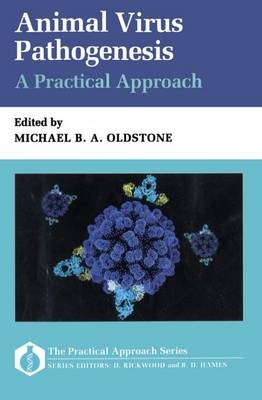
Animal Virus Pathogenesis: A Practical Approach
Oxford University Press (Verlag)
978-0-19-963101-8 (ISBN)
- Titel ist leider vergriffen;
keine Neuauflage - Artikel merken
The study of animal virus pathogenesis - how viruses cause disease - is an important and rapidly developing area, especially so since the development of AIDS and the consequent increase in research activity. Viruses can cause disease in two distinct ways. They can alter the cell and damage it directly by shutting down its basic mechanisms or by producing toxins or by breaking the cell membrane. Alternatively the virus can alter a cell's function without destroying
it, for instance, in the case of a nerve cell the virus may alter synthesis of neurotransmitters. In contrast to the stricken cells damaged by viral infection, in this second type of infection the cells appear normal when examined by physical means, e.g. microscopy, and by most biochemical assays,
e.g. total cellular RNA.
Understanding viral pathogenesis requires knowledge and use of techniques drawn from several disciplines from researchers working at the interface between virology and immunology. This volume charts the way that viral tropism, viral expression , and viral infectivity are assayed. It describes the identification of antiviral cytotoxic T cells, natural killer and free antibody responses. The final chapters deal with the latest methods for raising antipeptide antibodies and making vaccinia/viral
cDNA for immunologic target recognition, tissue and whole animal in situ hybridization.
Chapter 1: Concepts of molecular pathogenesis: Michael B.A. Oldstone: 1A: Introduction; 1B: Injury induced directly by viruses; Chapter 2: Molecular characterization of viral infections in vitro: W. Ian Lipkin & Michael B.A. Oldstone: 2A: Nucleic acid and protein detected morphologically with whole animal body sections; Sarka O. Southern & Peter J. Southern: 2A: Detection of macromolecules immobilized on solid supports; Matthias Lohr & Michael I.
Neremburg: 2C: Nucleic acid extraction and detection from paraffin-embedded tissue; Matthias Lohr & Maria Salvato: 2D: DNA amplification/polymerase chain reaction; Catherine Reynolds-Kohler & Jay A. Nelson: 2E: Techniques for double-labelling virus infected cells; Michael B.A. Oldstone: Chapter 3: Detection of immune
complexes and antibody mediated target cells lysis; Chapter 4: Detection, generation, and use of Cytotoxic T Lymphocyte (CTL) clones; Michael B.A. Oldstone: Detection of CTL activity; Hanna Lewicki: 4B: Generation and use of CTL clones; J. Lindsay Whitton & Antoinette Tishon: 4C: Use in vitro to map CTL epitopes; Linda S. Klavinskis & Michael B.A. Oldstone: 4D: Use in vivo; Raymond M. Welsh: Chapter 5: Methods for studying murine natural killer cells; Peter L. Schwimmbeck, Matthias
Lohr, & Antoinette Tishon: Chapter 6: Viral-receptor binding assays; Robert S. Fujinami: Chapter 7: Viral-autoimmune experimental models; Thomas Dryberg & Hans Kofod: Chapter 8: Synthetic peptides as antigens
| Erscheint lt. Verlag | 23.8.1990 |
|---|---|
| Reihe/Serie | Practical Approach Series ; 63 |
| Zusatzinfo | halftones, line drawings |
| Verlagsort | Oxford |
| Sprache | englisch |
| Maße | 156 x 234 mm |
| Gewicht | 336 g |
| Themenwelt | Studium ► 2. Studienabschnitt (Klinik) ► Pathologie |
| Technik ► Umwelttechnik / Biotechnologie | |
| ISBN-10 | 0-19-963101-8 / 0199631018 |
| ISBN-13 | 978-0-19-963101-8 / 9780199631018 |
| Zustand | Neuware |
| Informationen gemäß Produktsicherheitsverordnung (GPSR) | |
| Haben Sie eine Frage zum Produkt? |
aus dem Bereich