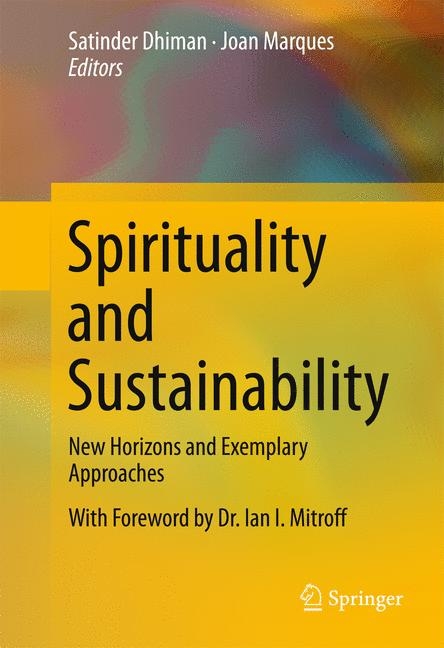
Spirituality and Sustainability (eBook)
XVI, 252 Seiten
Springer International Publishing (Verlag)
978-3-319-34235-1 (ISBN)
Contemporary approaches to economic and social development have failed to address humankind's abiding need for spiritual growth. For material development to be sustainable, spiritual advancement must be seen as an integral part of the human development algorithm. While the policy makers and governments can play their respective role, each one of us has to consciously adopt spirituality and sustainability as a way of life. This book will rely on the spiritual power of individuals to heal themselves and the environment.
Featuring interdisciplinary perspectives in areas such as science, marine biology, environmental policy, cultural studies, psychology, philosophy, ecological economics, and ethics, this book will provide extensive insights into the complimentary fields of spirituality, sustainability and ethics.
Satinder Dhiman, PhD, EdD, currently serves as a Professor of Management and as the Associate Dean, Chair, and Director of the MBA Program at Woodbury University's School of Business in Burbank, California. He has served as the Chair for a special MBA Program for Mercedes-Benz executives, China. He also consults as Accreditation Mentor and Site Visit Team Leader for the Accreditation Council for Business Schools and Programs (ACBSP) for various universities in America, Canada, Europe, and India. He has been elected as the President of International Chamber for Service Industry (ICSI), 2014-2016.
He has also completed advanced Executive Leadership Programs at Harvard, Stanford, and Wharton.
Recipient of several national and international academic and professional honors, Satinder won the Woodbury University Ambassador of the Year Award in 2015; Steve Allen Excellence in Education Award in 2006, and the prestigious ACBSP International Teacher of the Year Award in 2004. In 2013, Satinder was invited to be the opening speaker at the prestigious TEDx Conference @ College of the Canyons in Santa Clarita, Calif. He is the founder and Director of Forever Fulfilled, a Los Angeles-based Wellbeing Consultancy, which focuses on workplace wellness and self-leadership.
Satinder's work has been published in multiple national and international journals, and he has authored, co-authored, and co-edited ten books on management and leadership during the last 7 years. His current research on fulfillment, which is also the theme of his book, Seven Habits of Highly Fulfilled People (2012/2014), is focused on transformative habits of mind for attaining lasting joy and fulfillment in both personal and professional life. In his most recent book, Gandhi and Leadership (2015), Satinder offers perceptive insights into the spiritual and moral mainstay of Gandhi's exemplary leadership and its abiding influence on the world today.
Joan Marques, PhD, EdD, serves as Assistant Dean of Woodbury University's School of Business, Chair and Director of the BBA Program, and Professor of Management. Her teaching focuses on leadership, ethics, and organizational behavior, and her research interests pertain to the same areas with specific focus on workplace spirituality and leadership awareness. She has been widely published in prestigious scholarly journals such as Journal of Business Ethics, Journal of Management Development, Business and Society, Journal of Organizational Analysis, Organization Development Journal, Human Resource Development Quarterly, Journal of Global Responsibility, Journal of Communication Management, International Journal of Organizational Analysis, and many others.
Joan has authored/co-authored/co-edited more than 14 books on management and leadership topics, including Business and Buddhism (2015), in which Buddhism is approached as a leadership psychology, and Leadership and Mindful Behavior Action, Wakefulness (2014), in which she provides directives to leaders to adopt a wakeful mindset and abstain from the sleepwalking mode. She is also the author of Courage in the Twenty-First Century (2013) and The Awakened Leader (2007), and co-author of, among others, Leading Spiritually (2014), Business Administration Education (2012), Laughter is the Best Teacher (2011), Stories to Tell Your OB Students (2011), From Me to We (2011), Managing in the 21st Century (2011), The Workplace and Spirituality (2009), and Spirituality in the Workplace (2007).
Joan is a co-founder and editor-in-chief of three scholarly journals: The Business Renaissance Quarterly, Journal of Global Business Issues, and Interbeing, Journal of Personal and Professional Mastery. She presents a weekly radio program titled 'De Andere Kant' (The Other Side) on Mart Radio, and has been a long-time columnist for De Ware Tijd (The True Times), one of the largest newspapers in Paramaribo, Suriname.
Satinder Dhiman, PhD, EdD, currently serves as a Professor of Management and as the Associate Dean, Chair, and Director of the MBA Program at Woodbury University’s School of Business in Burbank, California. He has served as the Chair for a special MBA Program for Mercedes-Benz executives, China. He also consults as Accreditation Mentor and Site Visit Team Leader for the Accreditation Council for Business Schools and Programs (ACBSP) for various universities in America, Canada, Europe, and India. He has been elected as the President of International Chamber for Service Industry (ICSI), 2014-2016.He has also completed advanced Executive Leadership Programs at Harvard, Stanford, and Wharton.Recipient of several national and international academic and professional honors, Satinder won the Woodbury University Ambassador of the Year Award in 2015; Steve Allen Excellence in Education Award in 2006, and the prestigious ACBSP International Teacher of the Year Award in 2004. In 2013, Satinder was invited to be the opening speaker at the prestigious TEDx Conference @ College of the Canyons in Santa Clarita, Calif. He is the founder and Director of Forever Fulfilled, a Los Angeles-based Wellbeing Consultancy, which focuses on workplace wellness and self-leadership.Satinder’s work has been published in multiple national and international journals, and he has authored, co-authored, and co-edited ten books on management and leadership during the last 7 years. His current research on fulfillment, which is also the theme of his book, Seven Habits of Highly Fulfilled People (2012/2014), is focused on transformative habits of mind for attaining lasting joy and fulfillment in both personal and professional life. In his most recent book, Gandhi and Leadership (2015), Satinder offers perceptive insights into the spiritual and moral mainstay of Gandhi’s exemplary leadership and its abiding influence on the world today.Joan Marques, PhD, EdD, serves as Assistant Dean of Woodbury University’s School of Business, Chair and Director of the BBA Program, and Professor of Management. Her teaching focuses on leadership, ethics, and organizational behavior, and her research interests pertain to the same areas with specific focus on workplace spirituality and leadership awareness. She has been widely published in prestigious scholarly journals such as Journal of Business Ethics, Journal of Management Development, Business and Society, Journal of Organizational Analysis, Organization Development Journal, Human Resource Development Quarterly, Journal of Global Responsibility, Journal of Communication Management, International Journal of Organizational Analysis, and many others.Joan has authored/co-authored/co-edited more than 14 books on management and leadership topics, including Business and Buddhism (2015), in which Buddhism is approached as a leadership psychology, and Leadership and Mindful Behavior Action, Wakefulness (2014), in which she provides directives to leaders to adopt a wakeful mindset and abstain from the sleepwalking mode. She is also the author of Courage in the Twenty-First Century (2013) and The Awakened Leader (2007), and co-author of, among others, Leading Spiritually (2014), Business Administration Education (2012), Laughter is the Best Teacher (2011), Stories to Tell Your OB Students (2011), From Me to We (2011), Managing in the 21st Century (2011), The Workplace and Spirituality (2009), and Spirituality in the Workplace (2007).Joan is a co-founder and editor-in-chief of three scholarly journals: The Business Renaissance Quarterly, Journal of Global Business Issues, and Interbeing, Journal of Personal and Professional Mastery. She presents a weekly radio program titled “De Andere Kant” (The Other Side) on Mart Radio, and has been a long-time columnist for De Ware Tijd (The True Times), one of the largest newspapers in Paramaribo, Suriname.
Foreword 5
Contents 7
Editors and Contributors 9
1 The Case for Eco-spirituality: Everybody Can Do Something 17
Abstract 17
Conquest and Control: Disempowering Approaches 18
Sustainability and Spirituality: An Interdisciplinary Approach 18
Everybody Can Do Something 19
Defining Sustainability 20
Need for Spiritual Transformation 21
Philosophy of Universalism 22
Understanding Dharma, r?tam?, the Cosmic Order 23
The Context: The Current State of the Planet 24
Real Ecology: Rub Not and Be Not Rubbed 26
Some Good News About Climate Change Adaptability 28
Eco-spirituality 29
Albert Schweitzer: Reverence for Life 29
Conclusion 30
2 Sustaining the Cosmic Wheel of Creation: Journey from Consumer to Contributor 33
Abstract 33
Politics Without Morality and Economics Without Ethics 34
Ved?nta: The Art and Science of Harmonious Living 34
Fivefold Offerings to the Universe: Pancha Mah? Yajñ?s 36
Key Ethical and Spiritual Virtues 37
Ensuring the Wellbeing of All Beings 39
Turning the Wheel of Cosmic Co-creation: Our Life as an Offering! 40
Sustainable Diet: Animal-Based Versus Plant-Based? 42
Life Feeds on Life 43
High Cost of Raising Livestock 43
Choose Compassion: Live and Let Live 46
Conclusion 47
3 Moral Underpinnings of Sustainability 49
Abstract 49
Our Moral Stance Toward Life 49
The Golden Rule 50
Universalism 53
Utilitarianism 56
The Ethics of Sustainability 59
Profitability While Being Ethical and Sustainably Responsible 60
Summary 62
4 The Environment is a Moral and Spiritual Issue 65
Abstract 65
Our Environmental Problem 66
The Encyclical: The Document that Makes a Difference 67
So, What Do We Learn From the Papal Encyclical? 68
The Historic Encyclical in Depth: A Central Document in Spirituality and Sustainability 71
Introduction 71
Chapter One: What Is Happening to Our Common Home? 72
Chapter Two: The Gospel of Creation 75
Chapter Three: The Human Roots of the Ecological Crisis 76
Chapter Four: Integral Ecology 79
Chapter Five: Lines of Approach and Action 80
Chapter Six: Ecological Education and Spirituality 83
Conclusion 85
References 87
5 Ethics and Corporate Social Responsibity for Spirituality and Sustainability 88
Abstract 88
Introduction 89
Ethics—The 4th Bottom Line of Sustainability 90
Triple Bottom Line and Its Inadequacy 90
‘Carbon-Share’—The Most Contentious Distributive Justice Issue Globally 91
Corporate Social Responsibility (CSR) and Public Policy Development 92
Ecosystem Management—a Sociopolitical Choice 92
Evolution of CSR—A Clarion Call for Ethical Leadership in the New Economy 94
Ethical Dimension in Decision Making 95
Formation of Human Value System 95
Rational Charioteer or Centaur? 95
Ethical Decision Making—Characteristics 96
Ethics Training for Leaders and Professionals 96
Ethical Values Checklist for Leaders and Professionals 97
Environmental Ethics Dilemma—Example Case Study 98
Example Case Description 98
Chapter Summary 102
6 Spiritual Capabilities: Keys to Successful Sustainable Strategic Management 104
Abstract 104
Sustainability: The Twenty-First Century Business Context 104
Sustainable Strategic Management (SSM) 106
Organizational Resources 107
Intangible Resources 108
Organizational Capabilities 109
Core Competencies and Competitive Advantages 110
Spiritual Capabilities: A Source of Competitive Advantage 112
Howard Schultz: The Transformative Power of Spiritual Intelligence 115
Spiritual Capabilities and the Vision of Sustainability 116
Chapter Summary 117
7 The Spiritual Roots of Economic Sustainability 119
Abstract 119
Economic Sustainability: Rooted in Purpose 120
Indicators of Unsustainability 121
Inadequacy of Economic Value 122
Deep Sustainability 125
Reclaiming the Purpose of the Economy 128
Restoring Hope to the Economy 130
References 132
8 Higher Consciousness for Sustainability-as-Flourishing 134
Abstract 134
The Sustainability Challenge 135
Consciousness Development for Sustainability-as-Flourishing 136
Higher States of Consciousness 137
Engaging the Managing Intelligence of Natural Law 139
Wholeness Versus Partial Knowledge 141
The Difference Between Consciousness-Raising and Consciousness Development 142
The Role of Vedic Science and Technology 143
Directions for Further Research 148
Summary 149
9 Formless Meditation and Sustainability 151
Abstract 151
Introduction 151
Formless Meditation 152
Motivation: Fearlessly Opening to Whatever Occurs 153
Mindfulness: Vigorously Training the Attention 154
Awareness: Becoming Familiar with Primordial Presence 155
Relaxing: Resting Thoroughly 156
How Formless Meditation Fosters a Sustainable World Through Natural Social Intelligence Skills 159
Primal Empathy 160
Attunement 160
Empathic Accuracy 161
Social Cognition 162
Synchrony 162
Self-presentation 163
Influence 163
Concern 164
Conclusion 165
10 Spirituality, Sustainability and Happiness: A Quantum-Neuroscientific Perspective 166
Introduction 166
Spirit and Spirituality 167
Spirituality, Love and Sustainability 169
Happiness, Pleasure and Sustainability 172
Spirituality as the Source of Happiness and Sustainability 174
Conclusion 178
11 Case Studies: Spirituality and Sustainability 180
Abstract 180
Interface Global (Ray C. Anderson, Atlanta, GA, USA) 180
The Amish (Glen and Lamar Schmucker, Nappanee, Indiana, USA) 182
One Water (Duncan Goose, UK) 183
Lands’ End (Gary and Stephanie Comer, Chicago, Illinois, USA) 184
References 193
12 Putting Glam into Green: A Case for Sustainable Luxury Fashion 194
Abstract 194
Luxury and Sustainability: From Strange Bedfellows to Natural Allies? 195
Of Furs and Feathers—Nature and High Fashion Through the Years 196
The Rise—and Fall?—of ‘Fast Fashion’ 198
Overcoming the Birkenstock Syndrome 201
Putting Glam into Green: Luxury Fashion’s Sustainable Future 203
Chapter Summary 207
13 Global Warming Calls for an Inner Climate Change: The Transformative Power of Worldview Reflection for Sustainability 209
Abstract 209
My Personal Journey into Spirituality and Sustainability 210
Introduction 212
The Modern Worldview, Disenchantment, and Climate Change 214
Dynamics of Changing Worldviews: From Traditional to Modern to Postmodern 215
The Challenges of Postmodernity and the Emergence of the Integrative Worldview 217
The Integrative Worldview and Its Potential in Addressing Our Global Sustainability Issues 219
Conclusion 221
Summary 221
References 223
14 Un-fathoming the Spirit of Sustainability 225
Abstract 225
Introduction 226
Divested Sustainabilities and the Overdetermined Spiritual 227
Plastic Waves and Extinction Climates 228
The Differend, Slow Violence, and Alternate Histories 232
The Gulf of California/Sea of Cortez 233
Cabo Pulmo: The Northernmost Surviving Coral Reef that Almost Wasn’t 235
15 Epilogue: The Ethics and Spirituality of Sustainability 245
Abstract 245
Wholesome Thinking and Wholesome Conduct: Dharma and Karma Are Closely Aligned 245
Moral and Spiritual Basis of Sustainability: Help Ever, Hurt Never 246
Converting Karma into Karma Yoga 248
Conscientious Compassion 249
Our Habits Are Not Us 250
The Ethics of Eating: A Case for Vegetarianism 251
The Power of Individual Will 254
Vasudhaiva Kutumbakam—The Entire World as One Family 255
Creative Altruism Versus Destructive Egocentrism 256
Human Activities: Prime Driver of Climate Change 257
Conclusion 258
| Erscheint lt. Verlag | 13.6.2016 |
|---|---|
| Vorwort | Ian I. Mitroff |
| Zusatzinfo | XVI, 252 p. 4 illus., 2 illus. in color. |
| Verlagsort | Cham |
| Sprache | englisch |
| Themenwelt | Technik |
| Wirtschaft ► Betriebswirtschaft / Management ► Unternehmensführung / Management | |
| Schlagworte | Bio-diversity • Corporate Social Responsibility (CSR) • Ecological Ethics • Economic Development • Eco-Spirituality • Environmental sustainability • ethics • social development • Spirituality • sustainability • sustainable development |
| ISBN-10 | 3-319-34235-5 / 3319342355 |
| ISBN-13 | 978-3-319-34235-1 / 9783319342351 |
| Informationen gemäß Produktsicherheitsverordnung (GPSR) | |
| Haben Sie eine Frage zum Produkt? |
 PDF (Wasserzeichen)
DRM: Digitales Wasserzeichen
Dieses eBook enthält ein digitales Wasserzeichen und ist damit für Sie personalisiert. Bei einer missbräuchlichen Weitergabe des eBooks an Dritte ist eine Rückverfolgung an die Quelle möglich.
Dateiformat: PDF (Portable Document Format)
Mit einem festen Seitenlayout eignet sich die PDF besonders für Fachbücher mit Spalten, Tabellen und Abbildungen. Eine PDF kann auf fast allen Geräten angezeigt werden, ist aber für kleine Displays (Smartphone, eReader) nur eingeschränkt geeignet.
Systemvoraussetzungen:
PC/Mac: Mit einem PC oder Mac können Sie dieses eBook lesen. Sie benötigen dafür einen PDF-Viewer - z.B. den Adobe Reader oder Adobe Digital Editions.
eReader: Dieses eBook kann mit (fast) allen eBook-Readern gelesen werden. Mit dem amazon-Kindle ist es aber nicht kompatibel.
Smartphone/Tablet: Egal ob Apple oder Android, dieses eBook können Sie lesen. Sie benötigen dafür einen PDF-Viewer - z.B. die kostenlose Adobe Digital Editions-App.
Buying eBooks from abroad
For tax law reasons we can sell eBooks just within Germany and Switzerland. Regrettably we cannot fulfill eBook-orders from other countries.
aus dem Bereich