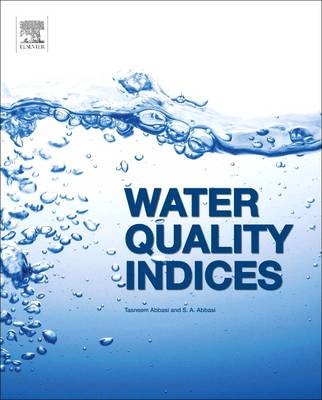
Water Quality Indices
Elsevier Science Ltd (Verlag)
978-0-444-63836-6 (ISBN)
Whereas it is easy to express the quantity of water, it is very difficult to express its quality because a large number of variables determine the water quality. WQIs seek to resolve the difficulty by translating a set of a large number of variables to a one-digit or a two-digit numeral. They are essential in communicating the status of different water resources in terms of water quality and the impact of various factors on it to policy makers, service personnel, and the lay public. Further they are exceedingly useful in the monitoring and management of water quality.
With the importance of water and water quality increasing exponentially, the importance of this topic is also set to increase enormously because only with the use of indices is it possible to assess, express, communicate, and monitor the overall quality of any water source.
Tabassum-Abbasi has received her BTech, MTech, and PhD degrees in instrumentation and control engineering, environmental engineering, and environmental technology, respectively – all from Pondicherry University. She too has been a class topper throughout, receiving gold medals. She has been working as Assistant Professor at the University of Petroleum & Energy Studies, Dehradun since January 2019, attaining senior grade (Level 2) in 2022, and selection grade (Level 3) recently. She has spent an year (2023- 24) in post-doctoral research at the University of Edinburgh as a British Council Women in Science Fellow. Besides research papers on bioprocess engineering and sustainability in highly cited journals, she has received three patents, and has registered another two. S. A. Abbasi, presently Distinguished Professor, School of Advanced Engineering, University of Petroleum and Energy Studies (UPES), Dehradun, has earlier been a full university professor and director (1987- 2015), and Emeritus Professor (2015-2024) at the Centre for Pollution Control and Environmental Engineering, Pondicherry University. Prior to it he was the founder Head of the Water Quality & Environment Division at the Centre for Water Resources, Kozhikode (1979-87), and a Visiting-cum-adjunct Professor at California State University (1984- 1987). He has also been a Visiting Professor at the universities of Minnesota, Florida, Nevada, California−Berkeley, Malaya and Al-Ahsa. Prof Abbasi is considered among the world’s foremost experts in the fields of bioprocess engineering, process safety, and environmental engineering. Among numerous coveted honours and awards received by Prof Abbasi are the National Design Award in Environmental Engineering, the IPCL award for Safety and Hazard Management in Petroleum Industries, the National Hydrology Award, the International Desalination Association’s prize, The Trever Kletz award, and fellowships of the National Academy of Sciences and the Indian Institute of Chemical Engineers.
Part 1: Water Quality Indices Based Predominantly on Physico-chemical characteristics
1. Why water quality indices2. Approaches to WQI formulation3. Conventional Indices for determining fitness of waters for different uses4. Combating uncertainities in indice-based assessment of water quality: The use of more advanced statistics, probability theory, and artificial intelligence5. Indices based on relatively advanced statistical analysis of water quality data6. Water quality indices based on fuzzy logic and other methods of artificial intelligence7. Probabilistic or stochastic water quality indices8. Planning or decision – making indices9. Indices for assessing groundwater quality10. Water quality indices of USA and Canada11. WQI generating software and a WQI-based virtual instrument
Part 2: Water Quality Indices Based on Bioassessment
12. Water quality indices based on bioassessment: an introduction13. The biotic indices14. Indices of biological integrity or the multimetric indices15. Multivariate approaches for bioassessment of water quality
Part 3: Looking Back, Looking Ahead
16. Water quality indices : Looking back, looking ahead
| Erscheinungsdatum | 23.11.2016 |
|---|---|
| Verlagsort | Oxford |
| Sprache | englisch |
| Maße | 191 x 235 mm |
| Gewicht | 500 g |
| Themenwelt | Naturwissenschaften ► Chemie ► Physikalische Chemie |
| Technik ► Umwelttechnik / Biotechnologie | |
| ISBN-10 | 0-444-63836-9 / 0444638369 |
| ISBN-13 | 978-0-444-63836-6 / 9780444638366 |
| Zustand | Neuware |
| Informationen gemäß Produktsicherheitsverordnung (GPSR) | |
| Haben Sie eine Frage zum Produkt? |
aus dem Bereich