
How to Do Systems Analysis (eBook)
John Wiley & Sons (Verlag)
978-1-119-17959-7 (ISBN)
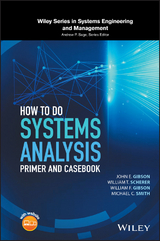
Presents the foundational systemic thinking needed to conceive systems that address complex socio-technical problems
This book emphasizes the underlying systems analysis components and associated thought processes. The authors describe an approach that is appropriate for complex systems in diverse disciplines complemented by a case-based pedagogy for teaching systems analysis that includes numerous cases that can be used to teach both the art and methods of systems analysis.
- Covers the six major phases of systems analysis, as well as goal development, the index of performance, evaluating candidate solutions, managing systems teams, project management, and more
- Presents the core concepts of a general systems analysis methodology
- Introduces, motivates, and illustrates the case pedagogy as a means of teaching and practicing systems analysis concepts
- Provides numerous cases that challenge readers to practice systems thinking and the systems methodology
How to Do Systems Analysis: Primer and Casebook is a reference for professionals in all fields that need systems analysis, such as telecommunications, transportation, business consulting, financial services, and healthcare. This book also serves as a textbook for undergraduate and graduate students in systems analysis courses in business schools, engineering schools, policy programs, and any course that promotes systems thinking.
JOHN E. GIBSON, Ph.D., was the Commonwealth Distinguished Professor of Systems Management at the School of Engineering and Applied Science, University of Virginia, Charlottesville. He served as Dean of Engineering at the University of Virginia and at Oakland University. Dr. Gibson was working on this book at the time of his death.
WILLIAM T. SCHERER, Ph.D., is a Professor in the Department of Systems and Information Engineering at the University of Virginia, where he teaches courses on systems engineering. Dr. Scherer was a student in Dr. Gibson's classes and later became a colleague. Dr. Scherer has authored and co-authored numerous publications on intelligent decision support systems, stochastic control, systems engineering education, and financial engineering. He is a former President of IEEE Intelligent Transportation Systems (ITS) Society and has won numerous teaching awards while at the University of Virginia.
WILLIAM F. GIBSON, MBA, MPA, is the Senior Managing Director and President of IVY Creek Associates, an international consulting firm for global asset managers, brokerage firms, and banks. He was Global Chief Operating Officer at ING Investment Management, and the Head of Securities and Fund Services Operations-EMEA at Citigroup. Mr. Gibson has led the infrastructure groups of global financial services firms, and is actively engaged in developing and applying new technologies in those domains. He has also been an executive lecturer at the S.C. Johnson Graduate School of Management at Cornell University.
MICHAEL C. SMITH, Ph.D., is the Executive Director of the Accelerated Masters Program in Systems Engineering at the University of Virginia. Prior to joining the University of Virginia, Dr. Smith was a Senior Scientist at Science Applications International Corporation (now Leidos) and also served on the Industrial Engineering faculties at Oregon State University and the University of Missouri. In addition to directing the University of Virginia's Accelerated Master's Program, Dr. Smith teaches an introductory course in systems thinking and the systems approach, drawing on many of the case studies in this book.
JOHN E. GIBSON, Ph.D., was the Commonwealth Distinguished Professor of Systems Management at the School of Engineering and Applied Science, University of Virginia, Charlottesville. He served as Dean of Engineering at the University of Virginia and at Oakland University. Dr. Gibson was working on this book at the time of his death. WILLIAM T. SCHERER, Ph.D., is a Professor in the Department of Systems and Information Engineering at the University of Virginia, where he teaches courses on systems engineering. Dr. Scherer was a student in Dr. Gibson's classes and later became a colleague. Dr. Scherer has authored and co-authored numerous publications on intelligent decision support systems, stochastic control, systems engineering education, and financial engineering. He is a former President of IEEE Intelligent Transportation Systems (ITS) Society and has won numerous teaching awards while at the University of Virginia. WILLIAM F. GIBSON, MBA, MPA, is the Senior Managing Director and President of IVY Creek Associates, an international consulting firm for global asset managers, brokerage firms, and banks. He was Global Chief Operating Officer at ING Investment Management, and the Head of Securities and Fund Services Operations--EMEA at Citigroup. Mr. Gibson has led the infrastructure groups of global financial services firms, and is actively engaged in developing and applying new technologies in those domains. He has also been an executive lecturer at the S.C. Johnson Graduate School of Management at Cornell University. MICHAEL C. SMITH, Ph.D., is the Executive Director of the Accelerated Masters Program in Systems Engineering at the University of Virginia. Prior to joining the University of Virginia, Dr. Smith was a Senior Scientist at Science Applications International Corporation (now Leidos) and also served on the Industrial Engineering faculties at Oregon State University and the University of Missouri. In addition to directing the University of Virginia's Accelerated Master's Program, Dr. Smith teaches an introductory course in systems thinking and the systems approach, drawing on many of the case studies in this book.
Chapter 1
Introduction
sys·tem (sĭs′ təm) n.
- A group of interacting, interrelated, or interdependent elements forming a complex whole.
- A functionally related group of elements, especially:
- The human body regarded as a functional physiological unit.
- An organism as a whole, especially with regard to its vital processes or functions.
- A group of physiologically or anatomically complementary organs or parts: the nervous system; the skeletal system.
- A group of interacting mechanical or electrical components.
- A network of structures and channels, as for communication, travel, or distribution.
- A network of related computer software, hardware, and data transmission devices.
- An organized set of interrelated ideas or principles.
- A social, economic, or political organizational form.
- A naturally occurring group of objects or phenomena: the solar system.
- A set of objects or phenomena grouped together for classification or analysis.
- A condition of harmonious, orderly interaction.
- An organized and coordinated method; a procedure.
- The prevailing social order; the establishment. Used with: You can't beat the system.
[Late Latin systēma, systēmat-, from Greek sustēma, from sunistanai, to combine: sun-, syn- + histanai, set up, establish.]
Source: Answers.com: American Heritage
In the systems approach, concentration is on the analysis and design of the whole, as distinct from…the components or parts…The systems approach relates the technology to the need, the social to the technological aspects; it starts by insisting on a clear understanding of exactly what the problem is and the goal that should dominate the solution and lead to the criteria for evaluating alternative avenues…The systems approach is the application of logic and common sense on a sophisticated technological basis…It provides for simulation and modeling so as to make possible predicting the performance before the entire system is brought into being. And it makes feasible the selection of the best approach from the many alternatives.
(Ramo, 1969, pp. 11–12)
1.1 What is a System?
A system is a set of elements so interconnected as to aid in driving toward a defined goal. There are three operative parts to this short definition. First is the existence of a set of elements—that is, a group of objects with some characteristics in common. All the passengers who have flown in a Boeing 787 or all the books written on systems engineering form a set, but mere membership in a definable set is not sufficient to form a system according to our definition. Second, the objects must be interconnected or influence one another. The members of a football team then would qualify as a system because each individual's performance influences the other members. See Ackoff (1971) for an interesting taxonomy of systems concepts (also see Whitehead et al., 2014).
Finally, the interconnected elements must have been formed to achieve some defined goal or objective. A random collection of people or things, even if they are in close proximity and thus influence each other in some sense, would not for this reason form a meaningful system. A football team meets this third condition of purposefulness, because it seeks a common goal. While these three components of our working definition fit within American Heritage's definitions, we should note that we are restricting our attention to “goal-directed” or purposeful systems, and thus our use of the term is narrower than a layman's intuition might indicate.1
It must be possible to estimate how well a system is doing in its drive toward the goal, or how closely one design option or another approaches the ideal—that is, more or less closely achieves the goal. We call this measure of progress or achievement the Index of Performance (IP) (alternatively, Measures of Effectiveness [MOE], Performance Measures [PM], etc.). Proper choice of an Index of Performance is crucial in successful system design. A measurable and meaningful measure of performance is simple enough in concept, although one sometimes has difficulty in conveying its importance to a client. It is typically complex and challenging in practice, however, to establish an index that is both measurable and meaningful. The temptation is to count what can be counted if what really matters seems indefinable. Much justifiable criticism has been directed at system analysts in this regard (Hoos, 1972; Syme et al., 2011). The Index of Performance concept is discussed in detail in Section 2.3.
Our definition of a system permits components, or the entire system in fact, to be of living form. The complexity of biological systems and social systems is such that complete mathematical descriptions are difficult, or impossible, with our present state of knowledge. We must content ourselves in such a situation with statistical or qualitative descriptions of the influence of elements one on another, rather than complete analytic and explicit functional relationships. This presents obvious objective obstacles, as well as more subtle subjective difficulties. It requires maturity by the system team members to work across disciplinary boundaries toward a common goal when their disciplinary methodologies are different not only in detail but in kind.
From these efforts at definition, we are forced to conclude that the words “system,” “subsystem,” and “parameter” do not have an objective meaning, independent of context. The electric utility of a region, for example, could be a system, or a subsystem, or could establish the value of a parameter depending on the observer's point of view of the situation. An engineer for the Detroit Edison Company (DTE Energy) could think of his electric utility as a system. Yet, he would readily admit that it is a subsystem in the Michigan Electric Coordinated System (MECS), which in turn is connected to the power pool covering the northeastern portion of the United States and eastern Canada. On the other hand, the city planner can ignore the system aspect of Detroit Edison and think of it merely supplying energy at a certain dollar cost. This is so if it is reasonable for him to assume that electricity can be provided in any reasonable amount to any point within the region. In this sense, the cost of electricity is a regional parameter. The massive Northeast U.S. power failure in 2003, along with the resulting repercussions directly affecting over 50 million people, clearly illustrates the regional nature of these systems.
That the function of an object and its relationship to neighboring objects depends on the observer's viewpoint must not be considered unusual. Koestler, for example, argues persuasively that this is true for all organisms as well as social organizations. For these units, which we have called “systems,” he coins the term “holon.”
But “wholes” and “parts” in this absolute sense just do not exist anywhere, either in the domain of living organisms or of social organizations. What we find are intermediate structures or a series of levels in an ascending order of complexity: sub-wholes which display, according to the way you look at them, some of the characteristics commonly attributed to wholes and some of the characteristics commonly attributed to parts.…The members of a hierarchy, like the Roman god Janus, all have two faces looking in opposite directions: the face turned toward the subordinate levels is that of a self-contained whole; the face turned upward toward the apex, that of a dependent part. One is the face of the master, the other the face of the servant. This “Janus effect” is a fundamental characteristic of sub-wholes in all types of hierarchies.
(Koestler, 1971)
This issue is further confused by the recent extensive use of the term “system-of-systems” or SoS, which refers to systems whose level of complexity creates emergent behavior and where the level of decision making and stakeholder values becomes difficult to determine.
Some uses of the term SoS apply to extremely complicated systems with many independently functioning but highly integrated subsystems such as might be found in a modern commercial or military aircraft or in an advanced manufacturing system with all of its associated logistics. While the system is, indeed, complicated and much care must be taken to understand, model, design, optimize, and test all of the many interfaces and scenarios under which the system must perform, the system is still very much the product of careful design around well thought-out functional requirements and operational objectives.
Other uses of the term SoS apply to systems that exhibit great complexity in which the emergent interactions and outcomes are difficult to model or anticipate and may not reflect any particular design intent, for better or worse. In this case, use of the word “system” may be applied without ever acknowledging or agreeing on the major objectives of the “system”—as in health care system, education system, economic system, and...
| Erscheint lt. Verlag | 5.7.2016 |
|---|---|
| Reihe/Serie | Wiley Series in Systems Engineering and Management |
| Wiley Series in Systems Engineering and Management | Wiley Series in Systems Engineering and Management |
| Sprache | englisch |
| Themenwelt | Technik ► Elektrotechnik / Energietechnik |
| Schlagworte | Betriebswirtschaft • Betriebswirtschaft u. Operationsforschung • Business & Management • Electrical & Electronics Engineering • Elektrotechnik u. Elektronik • Evidenced Based Learning</p> • Index of Performance • <p>Systems Engineering • Management Science/Operational Research • Program & Project Management • Programm- u. Projektmanagement • Project Management • Systemanalyse • Systems Analysis • Systems Engineering & Management • Systemtechnik • Systemtechnik u. -management • The Case Study Method • Wirtschaft u. Management • Zwicky's Morphological Box |
| ISBN-10 | 1-119-17959-9 / 1119179599 |
| ISBN-13 | 978-1-119-17959-7 / 9781119179597 |
| Informationen gemäß Produktsicherheitsverordnung (GPSR) | |
| Haben Sie eine Frage zum Produkt? |
 EPUB (Adobe DRM)
Kopierschutz: Adobe-DRM
Adobe-DRM ist ein Kopierschutz, der das eBook vor Mißbrauch schützen soll. Dabei wird das eBook bereits beim Download auf Ihre persönliche Adobe-ID autorisiert. Lesen können Sie das eBook dann nur auf den Geräten, welche ebenfalls auf Ihre Adobe-ID registriert sind.
Details zum Adobe-DRM
Dateiformat: EPUB (Electronic Publication)
EPUB ist ein offener Standard für eBooks und eignet sich besonders zur Darstellung von Belletristik und Sachbüchern. Der Fließtext wird dynamisch an die Display- und Schriftgröße angepasst. Auch für mobile Lesegeräte ist EPUB daher gut geeignet.
Systemvoraussetzungen:
PC/Mac: Mit einem PC oder Mac können Sie dieses eBook lesen. Sie benötigen eine
eReader: Dieses eBook kann mit (fast) allen eBook-Readern gelesen werden. Mit dem amazon-Kindle ist es aber nicht kompatibel.
Smartphone/Tablet: Egal ob Apple oder Android, dieses eBook können Sie lesen. Sie benötigen eine
Geräteliste und zusätzliche Hinweise
Buying eBooks from abroad
For tax law reasons we can sell eBooks just within Germany and Switzerland. Regrettably we cannot fulfill eBook-orders from other countries.
aus dem Bereich