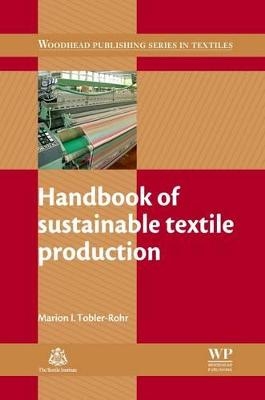
Handbook of Sustainable Textile Production
Woodhead Publishing Ltd (Verlag)
978-0-08-101694-7 (ISBN)
Dr. Marion I. Tobler-Rohr served as a senior researcher at ETH Zurich, Switzerland from 1996 to 2007 and owns her own sustainable development company, EMSC, Switzerland. Since 2008 she works as scientific research consultant for the research programs of the European Union, where she holds the position of the Swiss national contact point for nanotechnologies, material sciences and industrial processes (NMP) as well as for Environment.
Author contact details
Woodhead Publishing Series in Textiles
Foreword
Preface
Acknowledgments
Chapter 1: Sustainable development (SD) as a goal in production, marketing and trade
Abstract:
1.1 A holistic concept
1.2 Theory behind sustainable development
1.3 Sustainability in the public sector
1.4 Sustainability in industry
1.5 Environmental management systems
1.6 Environmental labeling
Chapter 2: The supply chain of textiles
Abstract:
2.1 Introduction
2.2 Natural fibers
2.3 Man-made fibers and filament and yarns
2.4 Energy
2.5 Yarn production
2.6 Fabric production
2.7 Chemical treatment
2.8 Manufacturing
2.9 Consumption, use and care
2.10 Disposal, reuse and recycling scenarios
Chapter 3: Product specification function and textile process technology
Abstract:
3.1 Introduction
3.2 Quality and textile specifications
3.3 Specification of raw material and processes
3.4 Functionality and process technology
3.5 Inherent functionality of natural fibers
3.6 Designed functionality of man-made fibers
3.7 Spinning processes: functionality in two dimensions
3.8 Functionality in three dimensions through weaving and knitting processes
3.9 Chemical treatment for customer functionality
3.10 Functionality in product development
3.11 The origin of best available technology (BAT)
3.12 Best practice in cotton growing and ginning
3.13 Optimizing energy supply in textile processing
3.14 Best mill practice
3.15 Best available technology (BAT) in finishing
3.16 Recommendations for consumption and care
Chapter 4: Life cycle assessment (LCA) and ecological key figures (EKF)
Abstract:
4.1 Introduction
4.2 Life cycle assessment (LCA) methodology
4.3 Eight case studies: scale and scope
4.4 Life cycle inventory (LCI)
4.5 Life cycle assessment (LCA) results
4.6 Life cycle assessment (LCA) sensitivity analysis
4.7 Costs
4.8 Introduction to ecological key figures (EKF)
4.9 Theory for ecological key figures (EKF)
4.10 Applied ecological key figures (EKF) in spinning and weaving
4.11 Discussion on ecological key figures (EKF) of textile products
Chapter 5: Product development and marketing: management and communication
Abstract:
5.1 Introduction
5.2 The structure of the textile and apparel sector
5.3 The marketing environment of textiles and apparel
5.4 Global trade
5.5 Consumer preferences
5.6 Positioning of companies in the market
5.7 Market segments and brands
5.8 Product development and merchandising
5.9 Distribution and distribution channels
5.10 Sourcing
Index
| Erscheinungsdatum | 07.07.2016 |
|---|---|
| Reihe/Serie | Woodhead Publishing Series in Textiles |
| Verlagsort | Cambridge |
| Sprache | englisch |
| Maße | 156 x 234 mm |
| Gewicht | 720 g |
| Themenwelt | Naturwissenschaften ► Biologie ► Ökologie / Naturschutz |
| Technik ► Maschinenbau | |
| Technik ► Umwelttechnik / Biotechnologie | |
| Wirtschaft | |
| Weitere Fachgebiete ► Land- / Forstwirtschaft / Fischerei | |
| ISBN-10 | 0-08-101694-8 / 0081016948 |
| ISBN-13 | 978-0-08-101694-7 / 9780081016947 |
| Zustand | Neuware |
| Informationen gemäß Produktsicherheitsverordnung (GPSR) | |
| Haben Sie eine Frage zum Produkt? |
aus dem Bereich