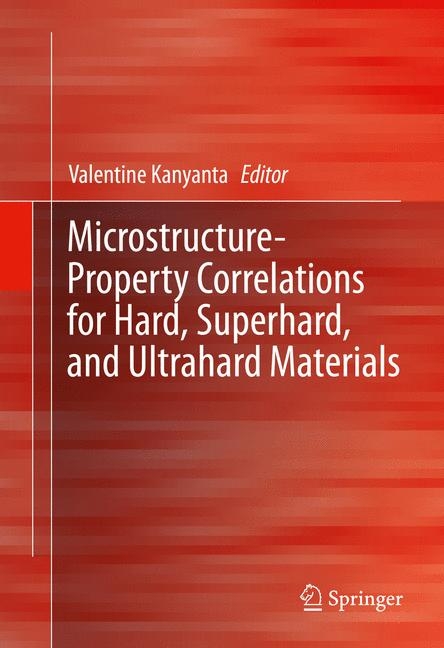
Microstructure-Property Correlations for Hard, Superhard, and Ultrahard Materials (eBook)
VII, 239 Seiten
Springer International Publishing (Verlag)
978-3-319-29291-5 (ISBN)

Dr. Valentine Kanyanta is currently a Principal Research Scientist at Element Six Ltd.
Dr. Valentine Kanyanta is currently a Principal Research Scientist at Element Six Ltd.
Contents 6
Contributors 8
Chapter 1: Hard, Superhard and Ultrahard Materials: An Overview 9
1 Introduction 9
2 Hard Materials 16
2.1 Carbides and Nitrides of Metals 17
2.2 Cermets 18
2.3 Oxides of Metals 21
3 Superhard and Ultrahard Materials 22
3.1 Diamond 22
3.2 Cubic Boron Nitride 24
3.3 Nanostructured Materials and Nanocomposites of Carbides, Nitrides and Borides 25
4 Book Overview: Why Microstructure-Property Correlation Is Important 26
References 27
Chapter 2: Applications for Superhard and Ultra-Hard Materials 32
1 Introduction 33
2 Properties of Ultra-Hard Materials 34
3 HPHT Synthetic Diamond Materials 35
4 Brief Introduction to Abrasive Machining 35
5 Applications for Diamond Synthetic Diamond Grit 37
6 Applications for Synthetic HPHT and CVD Diamond Monocrystals 40
7 Applications for HPHT Polycrystalline Diamond (PCD) 42
7.1 Introduction to PCD and HPHT Sintering 42
7.2 Abrasive Applications for PCD 44
7.3 PCD for Oil and Gas Cutters 46
8 Chemical Vapour Deposition (CVD) Diamond 48
8.1 Brief Introduction to CVD Diamond 48
8.2 Applications for Polycrystalline CVD Diamond 50
9 CVD Diamond as an Extreme Performance Optical Material 50
9.1 Diamond Windows for High Power Transmission 50
9.2 CVD Diamond Domes for Heat-Seeking Missile Applications 53
9.3 Loudspeaker Tweeters 55
9.4 Diamond Hip Joints 55
9.5 CVD Diamond for Electronics and Radiation Detectors 57
9.6 Boron-Doped Diamond for Electrochemistry 60
9.7 Electrochemical Sensors Based on b-Doped Diamond 62
9.8 Water Treatment 63
9.9 Thermal Management Applications 66
9.10 GaN-on-Diamond´s Advantages 67
9.11 Future Applications in Diamond Quantum Technology 68
9.12 The Structure of the Nitrogen Vacancy 69
9.13 Potential Markets for Diamond Quantum Devices 71
9.14 Properties of Superhard Boron Nitride 71
9.15 Physical Properties 73
10 Applications of Superhard Boron Nitrides 73
10.1 Cubic Boron Nitride 73
10.2 Abrasive Applications for cBN Crystals 74
10.3 Applications for Polycrystalline Boron Nitride (PCBN) 76
11 Summary 79
References 79
Chapter 3: Structure-Properties Relationships 82
1 Introduction 82
2 Designing Superhard Materials 84
3 Influence of Microstructural Parameters on the Mechanical Properties 86
4 Establishing Structure-Property Correlations of Superhard Materials 86
4.1 Group 1 Compounds 87
4.2 Group 2: Carbon-Based Materials 88
4.3 Group 3: Transition Metal Compounds 88
4.4 Group 4: Nanocrystalline and Superlattice Structures 89
5 The Hardness Paradigm 92
5.1 Factors Affecting Hardness 96
6 Fracture Mechanics of Superhard Materials 97
6.1 Vickers Indentation Cracks 98
6.2 Influence of Microstructural Parameters on Toughening 99
7 Strength of Brittle Materials 102
7.1 Factors Affecting Strength 103
7.2 The Conflicts Between Strength and Toughness 104
8 Wear of Superhard Materials 105
9 Thermal Shock 105
10 Concluding Remarks and Future Trends 106
References 107
Chapter 4: Measurements of Hardness and Other Mechanical Properties of Hard and Superhard Materials and Coatings 111
1 Introduction 111
2 Hardness 114
2.1 The Meaning of Hardness 114
2.2 Indentation Hardness 114
2.3 Indentation Size Effect and the Possible Errors of the Hardness Measurements 121
2.4 Measurement on Hard and Superhard Coating on Softer Substrates 125
3 Measurement of Elastic Moduli 130
4 Measurement of Stress in the Films Deposited on a Substrate 132
5 Tensile Yield Strength 134
6 Summary 134
References 135
Chapter 5: Fracture Toughness of Hard and Superhard Materials: Testing Methods and Limitations 141
1 Introduction 141
1.1 Energy Balance Approach to Fracture 142
1.2 Stress-Intensity Factor Approach 144
2 Standard Fracture Toughness Test Methods for Hard Materials 145
2.1 Single-Edge Precracked Beam (SEPB) 146
2.1.1 Bridge Precracking 146
2.1.2 Stiff Loop Precracking 147
2.1.3 Fatigue Precracking 148
2.1.4 Wedge Precracking 148
2.2 Chevron-Notched Bend (CNB) Test 148
2.3 Indentation Fracture (IF) 150
2.4 Surface Crack in Flexure 152
2.5 Double-Torsion Test 154
2.6 Diametral Compression Test 156
2.7 Single-Edge Notched Bend (SENB) and Single-Edge (V-) Notched Bend (SE(V)NB) Tests 157
2.7.1 Theory of Critical Distances 158
3 Strength of Superhard Materials 163
3.1 Gaussian Distribution 163
3.2 Lognormal Distribution 163
3.3 Weibull Distribution 164
3.3.1 Determining the Weibull Parameters 165
4 Conclusions 167
References 168
Chapter 6: Superhard and Ultrahard Nanostructured Materials and Coatings 172
1 Introduction 173
2 Concepts for the Design of New Nanostructured Superhard Materials 176
2.1 Heterostructures and Nanolaminates 176
2.2 Hardness Enhancement Due to Refinement of the Grain Size 179
2.3 Hardness Enhancement by Ion Bombardment During Thin-Film Deposition 181
2.4 Hardness Enhancement by Low-Energy Interfaces 183
2.5 Superhard Nanocomposites with Strengthened Interfacial Layer 186
2.5.1 Superhard nc-TiN/Si3N4 Nanocomposites as a Model System 187
The Role of the Interfaces 187
The Theoretically Achievable Hardness of the nc-TiN/Si3N4 Nanocomposites 192
The Mechanism of the Formation of the Nanocomposites 193
Impurities and Inappropriate Deposition Conditions Are Limiting the Achievable Hardness of the Nanocomposites 196
2.5.2 The Possibility of the Formation of Superhard Nanocomposites in Other Systems 199
Thermodynamics 200
Stability of the Interfacial Si3N4 and Alternate XY Layers 202
3 Industrial Applications 205
4 Conclusions 208
References 209
Chapter 7: Future of Superhard Material Design, Processing and Manufacturing 216
1 Introduction 216
2 Overcoming the Toughness Challenge 218
2.1 Biomimicry and Superhard Materials 219
2.2 Other Ways of Creating Exceptionally Tough Superhard Materials 228
3 Cost-Effective Manufacturing and Processing of Superhard Materials 234
3.1 Additive Manufacturing Technologies 234
Appendix 7.1: Numerical Modelling of Crack Propagation 236
Numerical Analysis 237
For Mode I 238
For Mode II 238
Fatigue Crack Growth 239
References 240
| Erscheint lt. Verlag | 31.5.2016 |
|---|---|
| Zusatzinfo | VII, 239 p. 124 illus., 85 illus. in color. |
| Verlagsort | Cham |
| Sprache | englisch |
| Themenwelt | Technik ► Maschinenbau |
| Schlagworte | 3D Printing • Additive Manufacturing • Biomimicry • Fracture toughness • Hard materials • Microstructure-Properties Correlations • nanomaterials • Nanostructured Composites • Superhard Materials • Ultrahard Materials |
| ISBN-10 | 3-319-29291-9 / 3319292919 |
| ISBN-13 | 978-3-319-29291-5 / 9783319292915 |
| Informationen gemäß Produktsicherheitsverordnung (GPSR) | |
| Haben Sie eine Frage zum Produkt? |
 PDF (Wasserzeichen)
DRM: Digitales Wasserzeichen
Dieses eBook enthält ein digitales Wasserzeichen und ist damit für Sie personalisiert. Bei einer missbräuchlichen Weitergabe des eBooks an Dritte ist eine Rückverfolgung an die Quelle möglich.
Dateiformat: PDF (Portable Document Format)
Mit einem festen Seitenlayout eignet sich die PDF besonders für Fachbücher mit Spalten, Tabellen und Abbildungen. Eine PDF kann auf fast allen Geräten angezeigt werden, ist aber für kleine Displays (Smartphone, eReader) nur eingeschränkt geeignet.
Systemvoraussetzungen:
PC/Mac: Mit einem PC oder Mac können Sie dieses eBook lesen. Sie benötigen dafür einen PDF-Viewer - z.B. den Adobe Reader oder Adobe Digital Editions.
eReader: Dieses eBook kann mit (fast) allen eBook-Readern gelesen werden. Mit dem amazon-Kindle ist es aber nicht kompatibel.
Smartphone/Tablet: Egal ob Apple oder Android, dieses eBook können Sie lesen. Sie benötigen dafür einen PDF-Viewer - z.B. die kostenlose Adobe Digital Editions-App.
Buying eBooks from abroad
For tax law reasons we can sell eBooks just within Germany and Switzerland. Regrettably we cannot fulfill eBook-orders from other countries.
aus dem Bereich