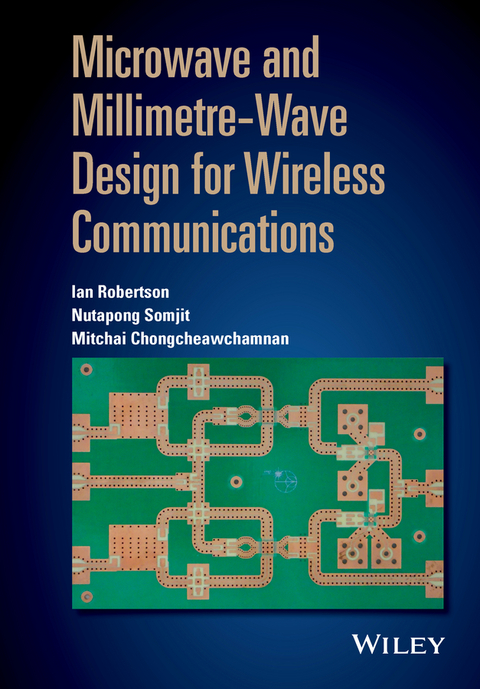
Microwave and Millimetre-Wave Design for Wireless Communications (eBook)
John Wiley & Sons (Verlag)
978-1-118-91730-5 (ISBN)
In addition, the book includes extensive line diagrams to illustrate circuit diagrams and block diagrams of systems, including diagrams and photographs showing how circuits are implemented practically. Furthermore, case studies are also included to explain the salient features of a range of important wireless communications systems. The book is accompanied with suitable design examples and exercises based on the Advanced Design System - the industry leading CAD tool for wireless design.
More importantly, the authors have been working with Agilent Technologies on a learning & teaching initiative (www.awrcorp.com/professors-in-partnership), which is designed to promote access to ongoing microwave and RF educational content that enhances and promotes AWR software solutions through ebooks and textbooks. In parallel, Agilent have recently started to offer access to this software to students without charge, providing universities have a site license. Students are able to download the software and use it on their own devices. This advanced text is therefore developed with the partnership in mind; to enable the reader to develop and their own circuits and subsystems using modern software tools and test equipment.
Professor Ian Robertson, University of Leeds, UK Ian Robertson (FIEEE 2012) received his BSc (Eng.) and PhD degrees from King's College London in 1984 and 1990, respectively. From 1984 to 1986 he worked in the MMIC Research Group at Plessey Research (Caswell). After that he returned to King's College London, initially as a Research Assistant and then as a Lecturer, leading the MMIC Research Team, and finally becoming Reader in 1994. In 1998 he was appointed Professor of Microwave Subsystems Engineering at the University of Surrey, where he established the Microwave Systems Research Group and was a founder member of the Advanced Technology Institute. In June 2004 he was appointed to the University of Leeds Centenary Chair in Microwave and Millimetre-Wave Circuits and he is now Head of the School of Electronic & Electrical Engineering. Dr Nutapong Somjit, University of Leeds, UK Nutapong Somjit?received the Dipl.-Ing. (M.Sc.) from Dresden University of Technology, Dresden, Germany, in 2005, and the PhD from KTH Royal Institute of Technology, Stockholm, Sweden, in 2012, all in electrical engineering. Since August 2012, he has been with the Chair for Circuit Design and Network Theory, Dresden University of Technology, where he leads a research team in microsensors and MEMS ICs. He is currently a lecturer (assistant professor) in the School of Electronic and Electrical Engineering, University of Leeds, United Kingdom. Dr Mitchai Chongcheawchamnan, Prince of Songkla University, Thailand Mitchai Chongcheawchamnan was born in Bangkok, Thailand. He received the B.Eng. degree in telecommunication from King Mongkut's Institute of Technology Ladkrabang, Bangkok, in 1992, the M.Sc. degree in communication and signal processing from Imperial College, London, U.K., in 1995, and the Ph.D. degree in electrical engineering from the University of Surrey, Guildford, U.K., in 2001. He joined the Mahanakorn University of Technology, Bangkok, in 1992, as a Lecturer. In 2008, he joined the Faculty of Engineering, Prince of Songkla University, Songkhla, Thailand, as an Associate Professor.
Preface
1 Introduction
2 Transmitters and Receivers
3 Scattering Parameters
4 Lumped Element Filters
5 Transmission Line Theory
6 Transmission Line Components
7 Transmission-Line Filters
8 Semiconductor Devices
9 Impedance Matching
10 Amplifiers
11 Oscillators
12 Mixers and Modulators
13 RF MEMS
14 Antennas and Propagation
15 Digital Signal Processing for Transceivers
16 Packaging and Assembly
17 Electronic Design Automation
18 Measurement Techniques
Index
1
Introduction
The rapid convergence of wireless communications systems and digital media has been one of the most exciting developments in electronics during recent years. Increasingly, consumer electronics is the driving force behind technological advance, whereas in the past it was military and space projects. Consumer electronics has become the leading edge of technology because of the potentially huge sales volumes. As the market is extremely competitive, major global companies invest large sums in research and development in order to introduce new products with more features and better performance than their rivals. One of the biggest growth areas has been in mobile internet connectivity through smartphones and tablets, leading to a paradigm shift towards cloud computing, shown by the dramatic growth in mobile subscriptions and internet traffic. 5G heralds a new era in which wireless connectivity reaches everything, with the Internet of Things (IoT) creating a revolution in almost every facet of modern life, including healthcare, smart cities, energy, robotics, manufacturing, retail and the creative industries.
In the business of consumer electronics, it is well known that customers generally get (and, indeed, expect) more features for less money as technology advances. The key to this has been the continual and rapid development of silicon technology, allied with the globalisation of the electronics manufacturing business. By putting more transistors onto a single integrated circuit (IC), clearly a given product will require less ICs and less associated components on a circuit board. Gordon Moore, a cofounder of Intel, predicted in 1965 that the complexity of a chip could be expected to increase exponentially with time for a number of years [1]. This famous prediction has developed into Moore's Law, which is an empirical law that accurately charts technological progress in the microelectronics industry, with the number of transistors on a chip doubling every year. Figure 1.1 shows a graph charting this evolution of Intel microprocessor technology, re-plotted on a linear scale to show the dramatic development of computer technology, and illustrates that we have only recently entered the information age. The impressive milestone of two billion transistors on a chip was reached in 2008 [2].
Figure 1.1 Microprocessor transistor count versus year on a linear scale.
1.1 A Brief Timeline of Consumer Electronics
“We only recently entered the information age” is a bold claim that requires substantiation. A worthy method of investigating the claim is to briefly study the history of consumer electronics and develop a timeline of how the main audio, video and communications products have developed. Figure 1.2 shows a simplified timeline of some of the most important developments in communications, radio and television. The telegraph came first, with the Cooke and Wheatstone six-wire, five-needle system and the Morse code system being independently introduced in the 1830s in the UK and US, respectively. A number of pioneers had experimented with the speaking telegraph, and it was on 10th March 1876 that Alexander Graham Bell spoke the words “Mr. Watson, come here, I want to see you” to his assistant.
Figure 1.2 A simplified timeline of developments in consumer electronics.
After various pioneering efforts to record audio, including Thomas Edison's cylinder-based Phonograph, in 1887 Emile Berliner patented the disc-based machine (the Gramophone) that that is similar to what we know today. Broadcasting has its roots in Marconi's successful demonstration of radio communications across the Atlantic in 1901. Radio broadcasting became established during the 1920s, and TV started appearing shortly after John Logie Baird's demonstration of an electromechanical television in 1926. In 1928, American inventor Philo Taylor Farnsworth gave the first public demonstration of an all-electronic scanning television system [3]. He was awarded a string of patents, which he later licensed to RCA, which became a giant in the world of TV and radio. The 1950s, 1960s and 1970s witnessed an extensive development of colour television and recording, and the first portable audio products.
The mobile telephone has its origins in Motorola's radiotelephone of 1946. The first automated cellular systems were NTT's in Tokyo in 1979 and the NMT network introduced in Sweden and Norway in 1981. The AMPS system was introduced in the USA in 1983 and the DynaTAC handheld cellular phone was introduced by Motorola, considered to be the first ever handheld phone and now recognisable instantly as the “brick phone”. GSM phones were introduced in 1991 – a digital system with greatly enhanced speech quality. Although personal computers were available about a decade before, GSM phones were one of the first consumer products that used digital electronics to perform real-time processing of signals. The 1990s can therefore be considered (debatably) the start of the digital consumer product revolution, with the DVD player (1996) and portable MP3 player (1998) appearing in the same decade. The iPhone was launched in 2007 and, in the short time since, smartphones and tablets have become an almost indispensable part of modern living, being most people's main portal to the internet, with awesome functionality that includes multi-band cellular and internet connectivity, voice-directed navigation, multimedia playback, games, augmented reality, and so on.
1.2 The Electromagnetic Spectrum
Electromagnetic waves are vital to almost all communications systems and modern consumer products. Radio waves, infrared, visible light, ultraviolet (UV) radiation and X-rays are all forms of the same phenomenon of electromagnetic wave propagation. Some of the most important frequency bands and applications of the electromagnetic spectrum are shown in Figure 1.3. This is, once again, on a logarithmic scale: X-rays have a frequency around a billion times the frequency of a mobile phone radio signal. Of course, not all these frequencies can be generated easily (if at all) by conventional transistor-based electronics. High-power microwaves, for example, are generated in a magnetron for some applications. Light, for optical storage and communications, is generated by a laser.
Figure 1.3 Frequency, wavelength and terminology for various applications of electromagnetic waves.
Some of the most common frequencies and applications are listed in Table 1.1. Wavelength (λ) is inversely proportional to frequency and, assuming free space propagation, the relationship c = f λ can be used, where c is the speed of light in vacuo (3 × 10⁸ m s−1). For radio waves, the wavelength is large and the macro effects of electromagnetism and wave propagation readily apply. At the other extreme, light has a typical wavelength of <1 μm and quantum effects start to become important: In other words, the packet nature of light – the existence of photons – must be taken into account.
Table 1.1 Example frequencies of some common systems.
| Frequency | Application |
| 0.5 to 2.6 MHz | Medium wave AM radio band |
| 220 MHz | Digital audio broadcasting |
| 500–850 MHz | UHF TV band |
| 850, 900 MHz and 1.8, 1.9 GHz | GSM mobile (cell) phones |
| 2.2 GHz | 3G mobile phones |
| 2.45 GHz | Microwave ovens, Bluetooth, 802.11b/g/n wireless LANs |
| 10 GHz | Military radar |
| 11–12 GHz | European satellite TV |
| 60 GHz | 802.11ad gigabit wireless LANs |
| 77 GHz | Cruise control in some cars |
| 198 THz | Long-distance fibre communications |
| 333 THz | TV infra-red remote control |
| 430 THz | Red light |
| 1 million THz | X-rays in hospital |
Radio transmission is used for hundreds of applications, and modern society could not exist without these radiofrequency (RF) systems. The frequency bands ranging from 100 kHz up to 100 GHz (100 000 MHz) are already extensively used for radio, TV, mobile telephones and the cellular network infrastructure, Wi-Fi, private mobile radio, satellite TV and data links, along with a whole host of other communications systems. Frequencies from...
| Erscheint lt. Verlag | 29.6.2016 |
|---|---|
| Sprache | englisch |
| Themenwelt | Technik ► Elektrotechnik / Energietechnik |
| Technik ► Nachrichtentechnik | |
| Schlagworte | components • Components & Devices • Core • devices • Drahtlose Kommunikation • Electrical & Electronics Engineering • electronics systems • Elektrotechnik u. Elektronik • Element • Example • Filters • Frequency Range • greater • Introduction • Komponenten u. Bauelemente • line theory • Mikrowellentechnik • Mikrowellen- u. Hochfrequenztechnik u. Theorie • Millimeterwelle • Mobile & Wireless Communications • parameters • Performance • RF / Microwave Theory & Techniques • semiconductor • silicon ics • Specialist • Technologies • Transmission • transmissionline • wide |
| ISBN-10 | 1-118-91730-8 / 1118917308 |
| ISBN-13 | 978-1-118-91730-5 / 9781118917305 |
| Informationen gemäß Produktsicherheitsverordnung (GPSR) | |
| Haben Sie eine Frage zum Produkt? |
 EPUB (Adobe DRM)
Kopierschutz: Adobe-DRM
Adobe-DRM ist ein Kopierschutz, der das eBook vor Mißbrauch schützen soll. Dabei wird das eBook bereits beim Download auf Ihre persönliche Adobe-ID autorisiert. Lesen können Sie das eBook dann nur auf den Geräten, welche ebenfalls auf Ihre Adobe-ID registriert sind.
Details zum Adobe-DRM
Dateiformat: EPUB (Electronic Publication)
EPUB ist ein offener Standard für eBooks und eignet sich besonders zur Darstellung von Belletristik und Sachbüchern. Der Fließtext wird dynamisch an die Display- und Schriftgröße angepasst. Auch für mobile Lesegeräte ist EPUB daher gut geeignet.
Systemvoraussetzungen:
PC/Mac: Mit einem PC oder Mac können Sie dieses eBook lesen. Sie benötigen eine
eReader: Dieses eBook kann mit (fast) allen eBook-Readern gelesen werden. Mit dem amazon-Kindle ist es aber nicht kompatibel.
Smartphone/Tablet: Egal ob Apple oder Android, dieses eBook können Sie lesen. Sie benötigen eine
Geräteliste und zusätzliche Hinweise
Buying eBooks from abroad
For tax law reasons we can sell eBooks just within Germany and Switzerland. Regrettably we cannot fulfill eBook-orders from other countries.
aus dem Bereich