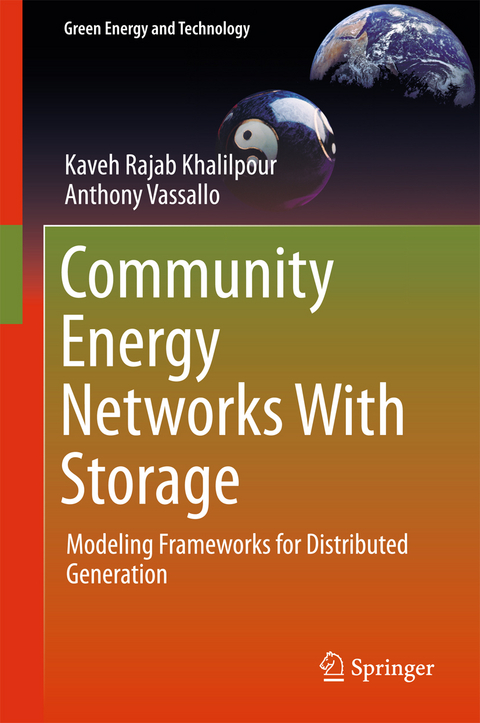
Community Energy Networks With Storage (eBook)
XXXII, 191 Seiten
Springer Singapore (Verlag)
978-981-287-652-2 (ISBN)
This book addresses the problem of building an optimal community energy network in a decentralized distributed energy context. The book introduces a few novel modeling frameworks to assist a single customer or a community of multiple end-user customers in building their optimal electricity system/network and operating their own local energy system. The content of the book is suitable for students, academics and industrial practitioners studying or working in the area of energy management and smart grid energy networks.
Preface 6
Acknowledgments 9
Contents 10
Abbreviations 13
Chapter 3 14
Chapter 7 16
Chapter 9 17
List of Figures 20
List of Tables 28
1 Introduction: Features of a Smart Energy Network 30
1.1 Climate Change Mitigation and Smart Grids 30
1.2 Smart Policy and Regulation 32
1.3 Smart Planning/Operation Management 33
1.4 Smart Network Topology (Transmission and Distribution): Decentralized Microgrids 34
1.5 Smart Generation 36
1.6 Smart Demand 37
1.7 Smart Tariffs 41
1.8 Smart Appliances 45
References 46
2 Grid Revolution with Distributed Generation and Storage 48
2.1 Distributed Energy Resources 48
2.2 PV as the Pioneer DER: History and Role in Microgrids 51
2.3 Energy Storage: History and Role in Microgrid 56
2.4 Nanogrids 61
References 66
3 A Generic Framework for DGS Nanogrids 70
3.1 Problem Statement and Formulation 70
3.1.1 DGS System Sizing 70
3.1.2 Operation Scheduling of DGS System 78
3.2 Case Study of a Grid-Connected Shopping Center 79
3.3 Summary 87
References 88
4 PV-Battery Nanogrid Systems 89
4.1 Existing Knowledge of Integrated PV-Battery Systems 89
4.2 Case Studies 92
4.2.1 Evaluation of a PV-Battery System for a House 92
4.2.2 Evaluation of Battery System for a Hospital with Installed PV System 99
4.2.3 Operation of a PV-Battery System for a House 103
4.3 Summary 108
References 109
5 Sensitivity Analysis of Grid-Connected PV-Battery Systems 111
5.1 Introduction 111
5.2 Base Case: Optimal Investment Decision for a House 111
5.3 Impact of Technology Size 114
5.4 Impact of Technology Price 116
5.5 Impact of Electricity Tariff Type 117
5.6 Impact of Electricity Price 117
5.7 Impact of Feed-in Tariff 118
5.8 Impact of Daily Consumption Pattern 119
5.9 Impact of Location and Load Seasonality 121
5.10 Summary 124
References 124
6 The “Death Spiral” for the Utility Industry: A Myth or Reality? 126
References 130
7 Economic Analysis of Leaving the Grid 131
7.1 Energy Security and Consumer Independence 131
7.2 Problem Statement and Formulation 133
7.2.1 Problem: Feasibility of Leaving the Grid with an Optimal PV-Battery System 133
7.2.2 Problem Formulation 135
7.3 Case Studies 139
7.3.1 Example 1 139
7.3.2 Example 2: Impact of Consumption Load 143
7.3.3 Example 3: Impact of Feed-in Tariff 146
7.3.4 Example 4: Impact of Technology Costs 148
7.3.5 Example 5: Impact of Geography 149
7.3.6 Example 6: PV-Battery Operation Performance 151
7.4 Summary and Policy Implications 154
References 155
8 Noncooperative Community Energy Networks 157
8.1 High DG Penetration and Grid Stability 157
8.2 Scale-up of DGS Systems to Community Level 160
8.2.1 Problem Statement and Formulation 160
8.2.2 Study 1: A Feeder with Distributed PV/Battery 163
8.3 Operation Issues of Network with High DGS Penetration 166
8.3.1 Study 2: Impact of Battery Charge Regulation on the Grid 168
8.3.2 Study 3: Impact of Electricity Tariff Structure on Grid 169
8.4 Aggregation of Multiple Feeders 171
8.5 Summary and Policy Implications 172
References 174
9 Cooperative Community Energy Networks 176
9.1 Cooperative Community Energy Networks (Microgrid of Nanogrids) 176
9.2 Problem Statement and Formulation 180
9.2.1 Problem Definition 180
9.2.2 Problem Formulation 183
9.3 Case Studies 187
9.3.1 Network of Nine Homes 187
9.3.2 Various Community Electricity Prices 193
9.3.3 Various CEPs 195
9.3.4 Impact of Grid Electricity Tariffs 197
9.3.5 A Larger CCEN with 35 Members 197
9.3.6 A Building with Centralized DGS 203
9.4 Summary 206
References 207
Appendix 208
| Erscheint lt. Verlag | 26.5.2016 |
|---|---|
| Reihe/Serie | Green Energy and Technology | Green Energy and Technology |
| Zusatzinfo | XXXII, 191 p. 118 illus. |
| Verlagsort | Singapore |
| Sprache | englisch |
| Themenwelt | Technik ► Elektrotechnik / Energietechnik |
| Technik ► Maschinenbau | |
| Schlagworte | Cooperating Energy Network • Cooperative and Non-Cooperating Energy Network • Electrical Grid • Energy Management • Multi-User Electricity Network • Photovoltaic-Battery Systems • Smart Grid and Energy Networks |
| ISBN-10 | 981-287-652-9 / 9812876529 |
| ISBN-13 | 978-981-287-652-2 / 9789812876522 |
| Informationen gemäß Produktsicherheitsverordnung (GPSR) | |
| Haben Sie eine Frage zum Produkt? |
 PDF (Wasserzeichen)
DRM: Digitales Wasserzeichen
Dieses eBook enthält ein digitales Wasserzeichen und ist damit für Sie personalisiert. Bei einer missbräuchlichen Weitergabe des eBooks an Dritte ist eine Rückverfolgung an die Quelle möglich.
Dateiformat: PDF (Portable Document Format)
Mit einem festen Seitenlayout eignet sich die PDF besonders für Fachbücher mit Spalten, Tabellen und Abbildungen. Eine PDF kann auf fast allen Geräten angezeigt werden, ist aber für kleine Displays (Smartphone, eReader) nur eingeschränkt geeignet.
Systemvoraussetzungen:
PC/Mac: Mit einem PC oder Mac können Sie dieses eBook lesen. Sie benötigen dafür einen PDF-Viewer - z.B. den Adobe Reader oder Adobe Digital Editions.
eReader: Dieses eBook kann mit (fast) allen eBook-Readern gelesen werden. Mit dem amazon-Kindle ist es aber nicht kompatibel.
Smartphone/Tablet: Egal ob Apple oder Android, dieses eBook können Sie lesen. Sie benötigen dafür einen PDF-Viewer - z.B. die kostenlose Adobe Digital Editions-App.
Buying eBooks from abroad
For tax law reasons we can sell eBooks just within Germany and Switzerland. Regrettably we cannot fulfill eBook-orders from other countries.
aus dem Bereich