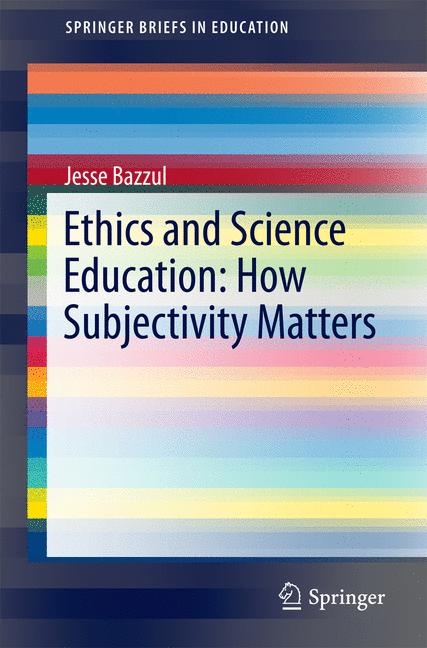
Ethics and Science Education: How Subjectivity Matters (eBook)
67 Seiten
Springer-Verlag
978-3-319-39132-8 (ISBN)

This book encapsulates a line of research that looks at how students are positioned as ethical actors/decision makers in biology education by science policy, curriculum, and classroom resources. Its basis comes from a textbook study that examined how biology texts work to constitute subjectivities related to neoliberalism and global capitalism, sex/gender and sexuality, and ethics. The study found that textbook discourses set limits on a) the types of ethical concerns represented b) the modes of ethical engagement c) the dispositions necessary to engage in ethical action or decision-making. Policy reform, regulation, and personal lifestyle choices were the primary ways students could approach ethical decision-making or action. While these approaches are useful, they are likely not sufficient for dealing with major twenty first century problems such as climate change and social inequality, along with new ethical dimensions introduced by biotechnologies and genomic research. Thisresearch brief sets a context for how discourses of science education policy and curricula work to shape a ‘subject of ethics’, that is how students come to see themselves as participants in issues of ethical concern. Drawing from a structural-poststructural philosophical approach, Science and Technology Studies, educational research, and a methodology based on discourse analysis and ethnography, this book's overall goal is to assist with research into subjectivity, ethics, politics, policy, and socioscientific issues in science education.
Jesse Bazzul is assistant professor of science and environmental education at the University of Regina. His research focuses on how science and environmental education practices/discourses work to (re)produce various subjectivities. He believes science education must become a primary site for sociopolitical engagement if societies are to meet twenty-first century problems such as growing social inequality and environmental destruction.
Chapter 1: Science Education as a Site of Struggle.- Chapter 2: The Constitution of Subjectivities: Discourse, Practices, and Repetition.- Chapter 3: The ‘Ethical Subject’ of Science Education.- Chapter 4: Science Education and Subjectivity in (Bio)political Context.- Chapter 5: Egalitarian Politics and the Dimensions of An Ethical Self.- Afterword: Different concepts and tools to bring about an ethically and politically engaged science education.
| Erscheint lt. Verlag | 24.5.2016 |
|---|---|
| Reihe/Serie | SpringerBriefs in Education | SpringerBriefs in Education |
| Zusatzinfo | VIII, 67 p. 1 illus. in color. |
| Verlagsort | Cham |
| Sprache | englisch |
| Themenwelt | Geisteswissenschaften |
| Sozialwissenschaften ► Pädagogik ► Erwachsenenbildung | |
| Technik | |
| Schlagworte | Biomedical science education • Biotechnology education • Discourse analysis • Ethics in science education • ethnography • informed citizenship • Judith Butler • Michel Foucault • poststructuralism • science education • Slavoj Žižek • Socioscientific Issues • Subjectivity • Textbook study |
| ISBN-10 | 3-319-39132-1 / 3319391321 |
| ISBN-13 | 978-3-319-39132-8 / 9783319391328 |
| Informationen gemäß Produktsicherheitsverordnung (GPSR) | |
| Haben Sie eine Frage zum Produkt? |
 PDF (Wasserzeichen)
DRM: Digitales Wasserzeichen
Dieses eBook enthält ein digitales Wasserzeichen und ist damit für Sie personalisiert. Bei einer missbräuchlichen Weitergabe des eBooks an Dritte ist eine Rückverfolgung an die Quelle möglich.
Dateiformat: PDF (Portable Document Format)
Mit einem festen Seitenlayout eignet sich die PDF besonders für Fachbücher mit Spalten, Tabellen und Abbildungen. Eine PDF kann auf fast allen Geräten angezeigt werden, ist aber für kleine Displays (Smartphone, eReader) nur eingeschränkt geeignet.
Systemvoraussetzungen:
PC/Mac: Mit einem PC oder Mac können Sie dieses eBook lesen. Sie benötigen dafür einen PDF-Viewer - z.B. den Adobe Reader oder Adobe Digital Editions.
eReader: Dieses eBook kann mit (fast) allen eBook-Readern gelesen werden. Mit dem amazon-Kindle ist es aber nicht kompatibel.
Smartphone/Tablet: Egal ob Apple oder Android, dieses eBook können Sie lesen. Sie benötigen dafür einen PDF-Viewer - z.B. die kostenlose Adobe Digital Editions-App.
Buying eBooks from abroad
For tax law reasons we can sell eBooks just within Germany and Switzerland. Regrettably we cannot fulfill eBook-orders from other countries.
aus dem Bereich