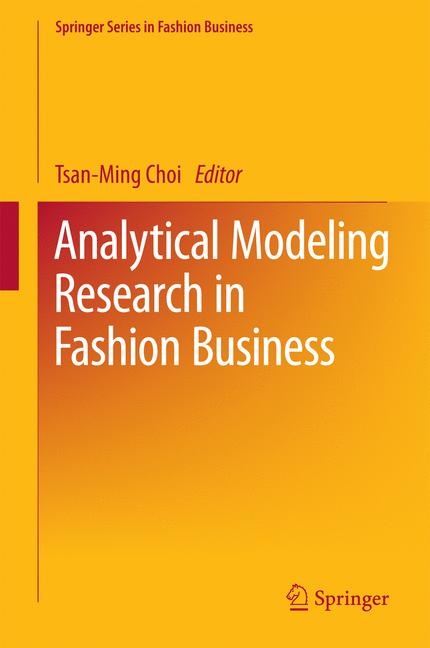
Analytical Modeling Research in Fashion Business (eBook)
272 Seiten
Springer Singapore (Verlag)
978-981-10-1014-9 (ISBN)
This book includes both theoretical results and application cases of analytical modeling based research related to the fashion and textile business. It responds to calls for deeper theoretical foundations as an expansion of research methodology in a field that has to date mostly relied on case studies and empirical analysis. Although there are a growing number of related publications which employ an analytical approach in conducting theoretical and applied research in the fashion and textile business, this book fills an essential gap by providing a comprehensive reference source that introduces the methodology and provides state-of-the-art findings on the topic. Covering an important and well-established industry, Analytical Modeling Research in Fashion Business is a pioneering text and essential reading for researchers and practitioners in the fashion and textiles industry alike.
Preface 6
Contents 8
Contributors 10
Part I Reviews and Discussions 12
1 Analytical Modeling Research in Fashion Business: An Introduction 13
Abstract 13
1.1 Introduction 13
1.2 Reviews and Discussions 15
1.3 Theoretical Economic Models 17
1.4 Engineering Models, Applications, and Cases 18
1.5 Concluding Remarks, Research Agenda and Acknowledgments 20
References 22
2 Analytical Modeling Research Methodologies for Fashion Business Operations Management 24
Abstract 24
2.1 Introduction 24
2.2 Economic Models 26
2.3 Engineering Models 31
2.4 Concluding Remarks 36
Acknowledgements 37
References 37
3 A Review: Customer Returns in Fashion Retailing 39
Abstract 39
3.1 Introduction 39
3.2 Issues of Customer Returns in Fashion Retailing 41
3.3 Managing Customer Returns 44
3.3.1 The Impact of Customer Returns Policies 44
3.3.2 Reducing Customer Returns 45
3.3.3 Decisions Related to Customer Returns 47
3.4 Future Research Directions 50
3.5 Conclusion 51
References 52
Part II Theoretical Economic Models 57
4 The Role of Quick Response in Accelerating Sales of Fashion Goods 58
Abstract 58
4.1 Introduction 59
4.2 Literature Review 61
4.2.1 Analytical Models 61
4.2.2 Empirical Models 63
4.3 The Model 64
4.3.1 A Continuous Inventory-Dependent Sales Model 64
4.3.2 Relationship Between Sales Parameters and Operational Choices 67
4.3.3 Hypotheses 68
4.4 Empirical Analysis 69
4.4.1 Industry Setting 69
4.4.2 Company Background 71
4.4.3 Data Set Description 73
4.4.4 Computation of {/varvec /alpha}_{{/varvec i}} 75
4.4.5 Testing the Hypotheses 76
4.4.5.1 Model I 77
4.4.5.2 Model II 78
4.4.6 Alternative Measures of Success 81
4.4.7 Sourcing Choices 82
4.5 Discussion 82
Acknowledgements 83
References 83
5 Mixed Channels for Apparel Sales 86
Abstract 86
5.1 Introduction and Literature Survey 87
5.2 The Model Scenario 89
5.2.1 Demand Functions 89
5.2.2 Cost Function for Value Adding 90
5.2.3 Profit Functions 91
5.3 The Contracts 91
5.3.1 Contract Under Channel Integration (I) 92
5.3.2 Contracts Under Full Information (/text {F}) 93
5.3.3 Contracts Under Asymmetric Information (/text {A}) 94
5.4 Analysis of the Contracts 96
5.4.1 Mathematical Analysis 96
5.4.2 Numerical Experiments 98
5.4.2.1 Analysis of the Manufacturer’s and Retailer’s Profits Under (A) with Various ? 99
5.4.2.2 Analysis of the Retail Channel Price with Various ? 100
5.4.2.3 Analysis of the Retail Channel Price with Various r 101
5.4.2.4 Analysis of the Value of Information 101
5.5 Conclusions 103
Appendix 104
References 106
6 Impacts of Vendor-Managed Strategic Partnership on Fashion Supply Chains with Markdown Money Policy 108
Abstract 108
6.1 Introduction 109
6.2 Literature Review 110
6.3 The Model 111
6.3.1 Decentralized Supply Chain 112
6.3.2 Centralized Supply Chain 113
6.4 Numerical Study 114
6.5 Conclusion 116
Acknowledgments 117
Appendix: Proofs 117
References 119
7 Fashion-Retailing Inventory Management with Random Supply 121
Abstract 121
7.1 Introduction 122
7.1.1 Problem Setting 122
7.1.2 Overview of Results 123
7.2 Literature Review 123
7.3 The Extended Newsvendor Model 125
7.4 Sensitivity Analysis 128
7.5 Conclusion and Further Research 130
Acknowledgments 130
References 130
Part III Engineering Models, Applications and Cases 133
8 Tales of a Fashion So(u)rcerer: Optimal Sourcing, Quotation, and In-House Production Decisions 134
Abstract 134
8.1 Introduction and Related Literature 135
8.2 Manufacturer’s Sourcing Problem: How to Do the Trick? 140
8.2.1 Effects of Demand Variability and Cost Parameters 145
8.2.2 Effects of Flexibility 145
8.2.3 Value of the Integrated Approach 146
8.3 Supplier’s Problem: How to Cast a Counterspell? 147
8.4 Manufacturer’s in-House Production Capacity Problem: Cast Your Own Spell 154
8.5 Conclusions 155
References 157
9 Distribution, Transshipment, and Sustainable Logistics for Fashion Products 159
Abstract 159
9.1 Introduction 160
9.2 Literature Review 161
9.2.1 Distribution 161
9.2.2 Transshipment 162
9.2.3 Sustainable Logistics 163
9.3 The Three Typical Operations: Models and Analysis 164
9.3.1 Distribution 164
9.3.1.1 Formulation 165
9.3.1.2 Solution Methodology 167
9.3.1.3 Expriments and Results 168
9.3.1.4 Discussions on Distribution 174
9.3.2 Transshipment 174
9.3.2.1 Formulation 175
9.3.2.2 Experiments and Results 177
9.3.2.3 Discussions on Transshipment 186
9.3.3 Sustainable Operations 187
9.3.3.1 The Sustainable Fashion Supply Chain 188
9.3.3.2 Operations Management Issues 191
9.3.3.3 Discussions on Sustainable Operations 194
9.4 Challenges and Opportunities of Using Advanced Technologies 195
9.4.1 O2O-Based Fashion Logistics Systems 195
9.4.2 IoT-Based Fashion Logistics 196
9.4.3 Experience-Based Fashion Logistics 196
9.5 Conclusions 197
References 198
10 Design of Order-Picking System and Selecting Picking Strategies in a 3PL Firm for Serving Fashion Retailing Companies 201
Abstract 201
10.1 Introduction 202
10.2 Literature Review 205
10.3 System Analysis and Problem Description 209
10.4 Solution Methodology 210
10.4.1 The Proposed Process Flow 210
10.4.2 Utilized Mathematical Models 211
10.5 Implementation 214
10.5.1 Strategical Decisions 214
10.5.2 Operational Application 221
10.5.2.1 Mathematical Model Results for Zone-Picking Strategy 224
10.5.3 Evaluation and Selection 229
10.6 Conclusion 237
References 238
11 Fashion Supply Chain Inventory Optimization Models with Service Level and Lead Time Considerations 241
Abstract 241
11.1 Introduction 241
11.2 Literature Review 243
11.3 The Analytical Model 245
11.3.1 Notations 245
11.3.2 Model Formulation 246
11.3.3 Model Analysis 247
11.4 Numerical Analysis 247
11.5 Conclusion and Future Research 251
Acknowledgments 251
References 251
12 An AHP-Based Scheme for Sales Forecasting in the Fashion Industry 254
Abstract 254
12.1 Introduction 255
12.2 AHP-Based Scheme for Data Aggregation and Disaggregation in Fashion Sales Forecasting 256
12.2.1 Introduction to the AHP 256
12.2.2 Data Aggregation and Disaggregation by the AHP 258
12.2.3 Adjustment to Exceptional Results of Pairwise Comparison 261
12.3 Numerical Experimentation 262
12.3.1 Data Set 262
12.3.2 Experiment Design and Numerical Analysis 263
12.4 Conclusion and Future Work 266
Acknowledgement 267
Appendix 267
References 268
Index 271
| Erscheint lt. Verlag | 23.5.2016 |
|---|---|
| Reihe/Serie | Springer Series in Fashion Business | Springer Series in Fashion Business |
| Zusatzinfo | X, 272 p. 44 illus. |
| Verlagsort | Singapore |
| Sprache | englisch |
| Themenwelt | Technik ► Maschinenbau |
| Wirtschaft ► Betriebswirtschaft / Management ► Logistik / Produktion | |
| Wirtschaft ► Betriebswirtschaft / Management ► Marketing / Vertrieb | |
| Wirtschaft ► Betriebswirtschaft / Management ► Planung / Organisation | |
| Wirtschaft ► Betriebswirtschaft / Management ► Unternehmensführung / Management | |
| Schlagworte | Analytical business models for fashion enterprises • Analytical modeling research for fashion operations • Analytical modeling research in fashion business • Analytical models in fashion production • Operational models in fashion business • Supply contracting models in fashion industry • textile engineering |
| ISBN-10 | 981-10-1014-5 / 9811010145 |
| ISBN-13 | 978-981-10-1014-9 / 9789811010149 |
| Informationen gemäß Produktsicherheitsverordnung (GPSR) | |
| Haben Sie eine Frage zum Produkt? |
 PDF (Wasserzeichen)
DRM: Digitales Wasserzeichen
Dieses eBook enthält ein digitales Wasserzeichen und ist damit für Sie personalisiert. Bei einer missbräuchlichen Weitergabe des eBooks an Dritte ist eine Rückverfolgung an die Quelle möglich.
Dateiformat: PDF (Portable Document Format)
Mit einem festen Seitenlayout eignet sich die PDF besonders für Fachbücher mit Spalten, Tabellen und Abbildungen. Eine PDF kann auf fast allen Geräten angezeigt werden, ist aber für kleine Displays (Smartphone, eReader) nur eingeschränkt geeignet.
Systemvoraussetzungen:
PC/Mac: Mit einem PC oder Mac können Sie dieses eBook lesen. Sie benötigen dafür einen PDF-Viewer - z.B. den Adobe Reader oder Adobe Digital Editions.
eReader: Dieses eBook kann mit (fast) allen eBook-Readern gelesen werden. Mit dem amazon-Kindle ist es aber nicht kompatibel.
Smartphone/Tablet: Egal ob Apple oder Android, dieses eBook können Sie lesen. Sie benötigen dafür einen PDF-Viewer - z.B. die kostenlose Adobe Digital Editions-App.
Buying eBooks from abroad
For tax law reasons we can sell eBooks just within Germany and Switzerland. Regrettably we cannot fulfill eBook-orders from other countries.
aus dem Bereich