


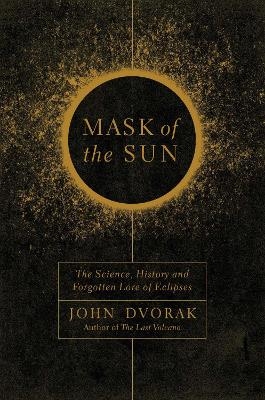
Mask of the Sun
The Science, History and Forgotten Lore of Eclipses
Seiten
2017
Pegasus Books (Verlag)
978-1-68177-330-8 (ISBN)
Pegasus Books (Verlag)
978-1-68177-330-8 (ISBN)
- Titel ist leider vergriffen;
keine Neuauflage - Artikel merken
Zu diesem Artikel existiert eine Nachauflage
They have been thought of as harbingers of evil as well as a sign of the divine. Eclipses—one of the rarest and most stunning celestial events we can witness here on Earth—have shaped the course of human history and thought since humans first turned their eyes to the sky.
What do Virginia Woolf, the rotation of hurricanes, Babylonian kings and Einstein’s General Theory Relativity all have in common? Eclipses. Always spectacular and, today, precisely predicable, eclipses have allowed us to know when the first Olympic games were played and, long before the first space probe, that the Moon was covered by dust.
Eclipses have stunned, frightened, emboldened and mesmerized people for thousands of years. They were recorded on ancient turtle shells discovered in the Wastes of Yin in China, on clay tablets from Mesopotamia and on the Mayan “Dresden Codex." They are mentioned in Homer’s Iliad and Odyssey and at least eight times in the Bible. Columbus used them to trick people, while Renaissance painter Taddeo Gaddi was blinded by one. Sorcery was banished within the Catholic Church after astrologers used an eclipse to predict a pope’s death.
In Mask of the Sun, acclaimed writer John Dvorak the importance of the number 177 and why the ancient Romans thought it was bad to have sexual intercourse during an eclipse (whereas other cultures thought it would be good luck). Even today, pregnant women in Mexico wear safety pins on their underwear during an eclipse. Eclipses are an amazing phenomena—unique to Earth—that have provided the key to much of what we now know and understand about the sun, our moon, gravity, and the workings of the universe.
Both entertaining and authoritative, Mask of the Sun reveals the humanism behind the science of both lunar and solar eclipses. With insightful detail and vividly accessible prose, Dvorak provides explanations as to how and why eclipses occur—as well as insight into the forthcoming eclipse of 2017 that will be visible across North America.
What do Virginia Woolf, the rotation of hurricanes, Babylonian kings and Einstein’s General Theory Relativity all have in common? Eclipses. Always spectacular and, today, precisely predicable, eclipses have allowed us to know when the first Olympic games were played and, long before the first space probe, that the Moon was covered by dust.
Eclipses have stunned, frightened, emboldened and mesmerized people for thousands of years. They were recorded on ancient turtle shells discovered in the Wastes of Yin in China, on clay tablets from Mesopotamia and on the Mayan “Dresden Codex." They are mentioned in Homer’s Iliad and Odyssey and at least eight times in the Bible. Columbus used them to trick people, while Renaissance painter Taddeo Gaddi was blinded by one. Sorcery was banished within the Catholic Church after astrologers used an eclipse to predict a pope’s death.
In Mask of the Sun, acclaimed writer John Dvorak the importance of the number 177 and why the ancient Romans thought it was bad to have sexual intercourse during an eclipse (whereas other cultures thought it would be good luck). Even today, pregnant women in Mexico wear safety pins on their underwear during an eclipse. Eclipses are an amazing phenomena—unique to Earth—that have provided the key to much of what we now know and understand about the sun, our moon, gravity, and the workings of the universe.
Both entertaining and authoritative, Mask of the Sun reveals the humanism behind the science of both lunar and solar eclipses. With insightful detail and vividly accessible prose, Dvorak provides explanations as to how and why eclipses occur—as well as insight into the forthcoming eclipse of 2017 that will be visible across North America.
John Dvorak, PhD, has studied volcanoes and earthquakes around the world for the United States Geological Survey, first at Mount St. Helens in 1980, then a series of assignments in Hawaii, Italy, Indonesia, Central America and Alaska. In addition to dozens of papers published in scientific journals, Dvorak has written cover stories for Scientific American, Astronomy and Physics Today.
| Erscheinungsdatum | 06.04.2017 |
|---|---|
| Zusatzinfo | 8 pages of photographs |
| Verlagsort | New York |
| Sprache | englisch |
| Maße | 152 x 229 mm |
| Themenwelt | Naturwissenschaften ► Physik / Astronomie ► Astronomie / Astrophysik |
| Technik ► Luft- / Raumfahrttechnik | |
| ISBN-10 | 1-68177-330-9 / 1681773309 |
| ISBN-13 | 978-1-68177-330-8 / 9781681773308 |
| Zustand | Neuware |
| Informationen gemäß Produktsicherheitsverordnung (GPSR) | |
| Haben Sie eine Frage zum Produkt? |
Mehr entdecken
aus dem Bereich



aus dem Bereich
was haben Kunst, Musik oder Religion mit Mathematik am Hut?
Buch | Softcover (2025)
Springer Berlin (Verlag)
CHF 34,95
Kompendium & Nachschlagewerk in 3 Bänden
Buch | Hardcover (2025)
Eigenverlag Dr. Erik Wischnewski
CHF 179,95


