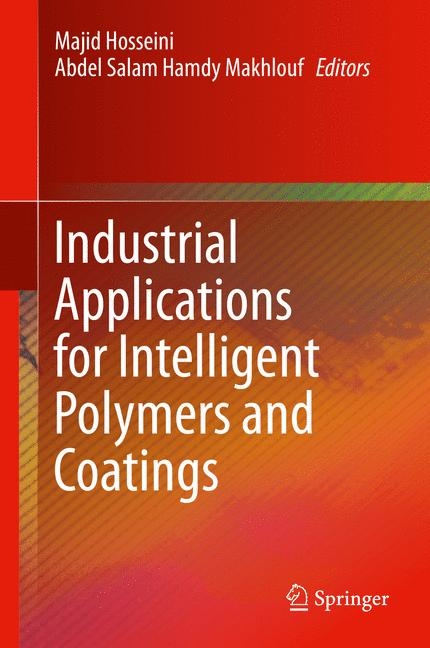
Industrial Applications for Intelligent Polymers and Coatings (eBook)
XXIII, 710 Seiten
Springer International Publishing (Verlag)
978-3-319-26893-4 (ISBN)
Dr. Majid Hosseini has earned both his Ph.D. and M.S. degrees in Chemical Engineering from The University of Akron in Ohio, United States. He has also completed his Bachelors degree in Chemical Engineering at Sharif University of Technology in Tehran, Iran. Dr. Hosseini's research interests, expertise, and experiences are very diverse, ranging from intelligent polymers and coatings to micro/encapsulation, nanoparticles for biomedical applications, industrial biotechnology, renewable energies, bioprocess engineering and developement, and biofuels. Dr. Hosseini has been actively engaged in various fields of polymers, bio/nanotechnology, sustainability, biofuels, and related technology development both in industry and academia. He is a persistent reviewer of leading international journals, has published high caliber research articles, and co-invented US and international patent application technologies. Dr. Hosseini has been a member of several professional bodies in the USA including The New York Academy of Sciences, American Institute of Chemical Engineers (AICHE), AICHE-Institute for Sustainability, AICHE-SBE (Society of Biological Engineering), New Design Institute for Emergency Relief Systems (DIERS), International Society for Pharmaceutical Engineering (ISPE), AICHE-Pharmaceutical Discovery, Development and Manufacturing Forum, and The National Society of Collegiate Scholars.
Dr. Majid Hosseini has earned both his Ph.D. and M.S. degrees in Chemical Engineering from The University of Akron in Ohio, United States. He has also completed his Bachelors degree in Chemical Engineering at Sharif University of Technology in Tehran, Iran. Dr. Hosseini’s research interests, expertise, and experiences are very diverse, ranging from intelligent polymers and coatings to micro/encapsulation, nanoparticles for biomedical applications, industrial biotechnology, renewable energies, bioprocess engineering and developement, and biofuels. Dr. Hosseini has been actively engaged in various fields of polymers, bio/nanotechnology, sustainability, biofuels, and related technology development both in industry and academia. He is a persistent reviewer of leading international journals, has published high caliber research articles, and co-invented US and international patent application technologies. Dr. Hosseini has been a member of several professional bodies in the USA including The New York Academy of Sciences, American Institute of Chemical Engineers (AICHE), AICHE-Institute for Sustainability, AICHE-SBE (Society of Biological Engineering), New Design Institute for Emergency Relief Systems (DIERS), International Society for Pharmaceutical Engineering (ISPE), AICHE-Pharmaceutical Discovery, Development and Manufacturing Forum, and The National Society of Collegiate Scholars. Dr. Abdel Salam Hamdy Makhlouf is RGV STAR Professor in the Manufacturing & Industrial Engineering Department at the University of Texas Rio Grande Valley. He is a multiple-award winner for his academic excellence: He received several prestigious awards in Germany (Humboldt Research Award for Experienced Scientists at Max Planck Institute); USA (Fulbright Visiting Scholar, NSF Fellow, and Dept. of Energy Fellow); Belgium (Belgian Federal Science Research Fellowship); Arab League (Arab Youth Excellence Award in Innovation 2013), Jordan (Abdul Hameed Shoman Award in Engineering Science 2012); Egypt (National Prize of Egypt in Advanced Science and Technology 2006; Egyptian Prize of Excellence in Surface Technology and Corrosion 2006; and Egyptian Prize of Excellence and Innovation in Materials Science and their Applications 2009); and Palestine (An-Najah Prize for Research 2014). His biography was selected to be included in Who's Who in the World® 2015, 2007 and 2006. He is Senior Editor of Insciences Journal, Nanotechnology Section, (Switzerland), Associate Editor: J. Nanostructure in Chemistry, Springer, and Associate Editor-in-Chief of the Int'l Journal of Applied Sciences. His research interests include preparation and characterization of advanced coatings, corrosion, nanomaterials, biomaterials, renewable energy and advanced materials and polymers. His publication list (+170) includes studies and review papers authored in journals from top publishers. He is the editor of 10 books and 20 book chapters. He supervised and graduated 11 PhD and Master’s students, and 5 postdoctoral fellows. He is a persistent journal reviewer, advisor, and judge of the work of his peers. He is a referee for over 30 int’l journals of a high caliber, and a continued board member of over 22 journals. He is also an experienced Editor with board titles at journals published by Springer and Elsevier, an Expert Evaluator for the EU’s FP7, with an estimated budget of over €50.521 billion, expert for the German Ministry of Education and Research, reviewer for the German Academic Exchange Service, and expert for the German Aerospace Center. He is a reviewer/panelist for the NSF programs: MME, MEP, and CREST; with an estimated budget of over $7.6 billion. He is a reviewer for the US Fulbright Commission, the Qatar National Research Fund, and the Kuwait Foundation for the Advancement of Sciences. He is a Consultant for Innosquared GmbH, and for Covestro, Germany.
Preface 6
Contents 12
Contributors 16
Chapter 1: Smart Stimuli-Responsive Nano-sized Hosts for Drug Delivery 25
1.1 Introduction 26
1.2 Stimuli-Responsive Nano-polymeric Micelles Drug Delivery System 27
1.3 Stimuli-Responsive Nanogels in Drug Delivery Systems 33
1.4 Stimuli-Responsive Magnetic Nanoparticles 36
1.5 Stimuli-Responsive Mesoporous Silica 39
1.6 Stimuli-Responsive Gold Nanoparticles 41
1.7 Conclusion 43
1.8 Future Outlook 44
References 45
Chapter 2: Stimuli-Responsive Smart Polymeric Coatings: An Overview 51
2.1 Introduction 52
2.1.1 Smart Polymeric Coatings 52
2.1.2 Stimuli-Responsive Smart Polymers 53
2.2 Applications of Smart Coatings 54
2.2.1 Smart Nonstick and Self-Cleaning Coatings 54
2.2.2 Smart Anti-stain and Scratch Resistance Coatings 57
2.2.3 Smart Antireflective Polymeric Coatings 59
2.2.4 Smart Anticorrosion Polymeric Coatings 61
2.2.5 Smart Polymeric Coatings in Actuators 61
2.2.6 Smart Coatings in Drug and Gene Delivery and Medical Devices 63
2.2.6.1 Smart Polymer-Coated Mesoporous Silica Materials for Drug Delivery 63
2.2.6.2 Smart Polymer-Coated Mesoporous Silica Materials for Gene Delivery 65
2.2.6.3 Smart Polymer-Coated Mesoporous Silica Materials for the Preparation of Medical Devices 67
2.2.7 Smart Coatings in Oil Industry 67
2.2.8 Smart Polymeric Coatings in Automobiles, Aerospace, and Textile Fabrics 70
2.3 Conclusion and Future Outlook 70
References 71
Chapter 3: Electroactive Polymers and Coatings 74
3.1 Introduction 75
3.2 Classification of Electroactive Polymers 77
3.3 The Mechanism of Operation and Conductivity Source of Electroactive Polymers 78
3.4 Creating an Electroactive Polymer: The Process and Considerations 80
3.4.1 The Electropolymerization Process 83
3.4.2 The Doping Process 85
3.5 Redox Reactions in Electroactive Polymers 86
3.5.1 Conductivity of EAPs via Redox Reactions 86
3.5.2 Evaluation of Redox Reactions in EAPs 86
3.6 Creating Composites of Smart Hydrogels and Electroactive Polymers 87
3.6.1 Responsive Hydrogels: Electrocompatible Preparation Approaches 88
3.7 Electroactive Polymer Functionalization for Specific Applications 90
3.8 The Diverse Applications of Electroactive Polymers and Coatings to the Pharmaceutical and Biomedical Industry: Controlled Delivery Applications 91
3.8.1 EAPs in Controlled Drug Release Applications 91
3.8.2 EAP-Based Polyelectrolyte Hydrogels in the Delivery of Biologics 94
3.8.3 Application of EAPs in Medical Devices 95
3.8.4 The Application of EAPs as Biomimetic Sensors: Electroactive Polymeric Sensors in Hand Prostheses 95
3.8.5 EAPs as Nanocomposites 97
3.8.6 EAPs in Shape-Memory Applications 100
3.8.7 EAPs as Artificial Muscles 101
3.8.8 Advances in Electroactive Coatings 102
3.9 Conclusion 103
References 103
Chapter 4: Characterization and Performance of Stress- and Damage-Sensing Smart Coatings 113
4.1 Introduction 113
4.2 Alumina as Particulate Sensors in a Polymer Matrix 115
4.3 Multiscale Mechanics of Smart Piezospectroscopic Composites and Coatings 116
4.4 Technology Demonstration of a Smart Piezospectroscopic Coating 119
4.5 Measurement Instrumentation for Piezospectroscopic Sensing 122
4.6 Conclusion and Future Outlook 123
References 124
Chapter 5: Smart Polymer Surfaces 126
5.1 Introduction to Smart Polymer Surfaces 126
5.2 Stimulus-Responsive Polymers 127
5.3 Modified Polymer Surfaces: Smart Interfaces 129
5.3.1 pH- and Temperature-Responsive Surfaces 129
5.3.2 Photo-responsive Surfaces 130
5.3.3 Electroactive Interfaces 130
5.3.4 Solvent- and Environment-Responsive Interfaces 131
5.3.5 Multiresponsive Interfaces 132
5.4 Patterned Responsive Surfaces: Micro- and Nanometer-Scale Topography 133
5.5 Applications of Smart Polymer Surfaces 135
5.5.1 Controlled Wettability 135
5.5.2 Bio-related Applications 136
5.5.3 Sensors 137
5.5.4 Smart Adhesives 138
5.6 Conclusion and Future Outlook 138
References 138
Chapter 6: Smart Textile Transducers: Design, Techniques, and Applications 142
6.1 Introduction: Overview of Polymer-Based Textile Transducers 143
6.2 Design Principles, Intelligent Polymer/Coating Materials, and Construction Methods 144
6.2.1 Design Principles 144
6.2.2 Intelligent Polymer Coating Materials and Construction Methods 148
6.2.2.1 Materials 148
6.2.2.2 Construction Methods 153
6.3 Applications: Industrial, Aerospace, Military, and Medical 154
6.3.1 Military and Aerospace 155
6.3.2 Medical 156
6.3.3 Civil and Industrial 157
6.4 Conclusion 161
6.5 Future Outlook 162
References 163
Chapter 7: Smart Polymers: Synthetic Strategies, Supramolecular Morphologies, and Drug Loading 168
7.1 Introduction 169
7.2 Stimuli-Responsive Polymer Architectures 171
7.2.1 Polymers Responsive to Physical Triggers 172
7.2.2 Polymers Responsive to Chemical Triggers 172
7.2.3 Polymers Responsive to Biological Triggers 173
7.3 Synthetic Strategies Using Controlled Radical Polymerization 174
7.3.1 ATRP Reaction 175
7.3.2 RAFT Polymerization 177
7.3.3 NMP Reaction 177
7.3.4 Combining CRP and Click Reactions 178
7.4 Self-Assembled Supramolecular Structures and Drug Loading 179
7.5 Conclusion 181
References 181
Chapter 8: Functions of Bioactive and Intelligent Natural Polymers in the Optimization of Drug Delivery 186
8.1 Introduction 187
8.2 Bioactive Polymers for Treatment and Management of Diseases 188
8.2.1 Natural Polymers with Antitumor Activity 188
8.2.2 Natural Polymers with Anticoagulant Activity 190
8.2.3 Natural Polymers with Antioxidant Activity 190
8.2.4 Natural Polymers with Anti-inflammatory Activity 192
8.2.5 Natural Polymers with Antidiabetic Activity 192
8.2.6 Natural Polymers with Antimicrobial Activity 192
8.2.7 Natural Polymers with Antiulcer Activity 193
8.2.8 Natural Polymers with Other Biological Activities 193
8.3 Intelligent Polymers for Treatment and Management of Diseases 194
8.3.1 Natural Polymers with Response to pH 197
8.3.2 Natural Polymers with Response to Biochemicals 198
8.3.3 Natural Polymers with Response to Temperature 198
8.3.4 Natural Polymers with Response to Electric Field 199
8.3.5 Natural Polymers with Response to Ions 200
8.3.6 Natural Polymers with Response to Other Stimuli 200
8.4 Bionanotechnological Applications of Bioactive and Intelligent Polymers 201
8.5 Commercialized Bioactive and Intelligent Drug Delivery Systems 202
8.6 Conclusion and Future Outlook 202
References 202
Chapter 9: Outlook of Aptamer-Based Smart Materials for Industrial Applications 206
9.1 Aptamer Smart Materials 206
9.2 Aptamer-Based Hydrogels 207
9.3 Gated Pores 212
9.4 Aptamer-Polyelectrolyte Films and Microcapsules 216
9.5 Future Outlook 218
9.6 Conclusion 220
References 221
Chapter 10: Superhydrophobic and Water-Repellent Polymer-Nanoparticle Composite Films 225
10.1 Introduction 226
10.2 Experimental 227
10.3 Results and Discussion 228
10.3.1 Effect of the Particle Concentration on the Wettability of the Composite Films 228
10.3.2 Effect of the Particle Size on the Wettability of the Composite Films 231
10.3.3 Effect of the Polymer on the Wettability of the Composite Films 234
10.3.4 Effect of the Underlying Substrate on the Wettability of the Composite Films 236
10.3.5 Effect of the Superhydrophobic Composite Films on the Aesthetic Appearance of Substrates 238
10.4 Industrial Applications 239
10.5 Conclusion 240
References 240
Chapter 11: Application of Conducting Polymers in Solar Water-Splitting Catalysis 242
11.1 Introduction 244
11.2 Solar Water Splitting Using Polypyrrole 246
11.3 Solar Water Splitting Using Poly(3,4-ethylenedioxythiophene) 249
11.4 Solar Water Splitting Using Polyaniline 256
11.5 Solar Water Splitting Using Polythiophene 262
11.6 Conclusion 268
References 268
Chapter 12: Smart Biopolymers in Food Industry 271
12.1 Introduction 271
12.2 Preparation of Smart Biopolymers 272
12.2.1 Preparation of Active and Smart Films for Food Packaging 272
12.2.2 Microparticle Preparation 274
12.3 General Characterization of Smart Biopolymers 276
12.3.1 Spectroscopy Characterization 276
12.3.2 Morphology Characterization 276
12.3.3 Thermal Characterization 277
12.3.4 Mechanical Properties 277
12.3.5 Characterization of Interaction with Water and Humidity 277
12.3.6 Microparticle Size 278
12.3.7 Microparticle Charge 278
12.4 Antioxidant Carbohydrate Films 278
12.4.1 Characterization of Antioxidant Films 279
12.5 Colorimetric Time-Temperature Indicator Films for Food Packaging Systems 282
12.5.1 Film Characterization 283
12.5.1.1 Dynamic Parameters of Color 283
12.6 Microencapsulation 283
12.7 Conclusion 284
References 285
Chapter 13: Designing Self-Healing Polymers by Atom Transfer Radical Polymerization and Click Chemistry 288
13.1 Introduction 289
13.2 Application of ATRP for Designing Self-Healing Polymers 289
13.2.1 Automatic One-Component Self-Healing Polymers 291
13.2.2 ATRP for Designing Reversible Non-covalent Bond-Forming Material 291
13.2.3 Self-Healing by Covalent Bond Formation 293
13.2.4 Self-Healing by Semi-encapsulation Methods 294
13.2.5 Self-Healing by Encapsulation Method 295
13.3 Click Chemistry 295
13.3.1 Diels–Alder (and Retro-Diels–Alder) Click Reaction 296
13.3.2 Cu (I)-Catalyzed Azide–Alkyne Cycloaddition (CuAAC) 299
13.3.3 Thiol–ene/yne Click Reaction 301
13.4 Combination of ATRP and Click Chemistry to Synthesize Self-Healing Material 303
13.4.1 ATRP Used for Synthesis of Azide End-Functionalized Polymers 303
13.4.2 ATRP Used for Synthesis of Alkyne End-Functionalized Polymers 304
13.4.3 ATRP Used for Synthesis of Diene-/Dienophile-Functionalized Polymers 304
13.4.4 ATRP Used for Synthesis of Thiol-Containing Polymers 306
13.4.5 ATRP Used for Synthesis of Ene-Containing Polymers 306
13.5 Conclusion 307
References 307
Chapter 14: Polyurethane-Based Smart Polymers 309
14.1 Introduction 310
14.2 Chemistry of Smart Polyurethane 310
14.2.1 Basic Component of Smart Polyurethane 311
14.2.2 Structure and Shape Memory Effect 313
14.3 Current Scenario on Shape Memory Polyurethane 316
14.3.1 Petrochemical-Based Shape Memory Polyurethane 317
14.3.2 Vegetable Oil-Based Shape Memory Polyurethane 319
14.4 Potential Application of Smart Polyurethane 323
14.5 Conclusion 326
References 326
Chapter 15: Piezoelectric PVDF Polymeric Films and Fibers: Polymorphisms, Measurements, and Applications 329
15.1 Introduction 330
15.2 Polymorphisms of PVDF 330
15.3 ?-Phase Measurements 331
15.3.1 Fourier Transformed Infrared Spectroscopy 331
15.3.2 X-Ray Diffraction 332
15.3.3 Differential Scanning Calorimetry 333
15.4 Enhanced ?-Phase Formation in PVDF Polymer 334
15.5 Piezoelectric Measurements 335
15.5.1 Piezoelectric Charge Constant (d) 335
15.5.2 Voltage Response 336
15.5.3 Polarization-Electric Field (P-E) Hysteresis Loop 337
15.5.4 Electric Displacement (Charge per Unit Mass) 337
15.5.5 Permittivity (Dielectric Constant) 338
15.5.6 Loss in Dielectric Materials (tan ?) 339
15.6 Piezoelectric PVDF Application 340
15.6.1 Sensors 340
15.6.2 Actuators 341
15.6.3 Energy Harvesters and Nanogenerators 342
15.7 Conclusion 345
References 346
Chapter 16: Multifunctional Materials for Biotechnology: Opportunities and Challenges 353
16.1 Multifunctional Materials as Targeted Drug Delivery Vesicles 354
16.1.1 Polymeric Micelles 355
16.1.2 Polymeric Microcapsules 356
16.1.3 Gold Nanostructures for Biomedical Applications 358
16.1.4 Polymer–Polyelectrolyte Complex Used in Delivery of a Therapeutic Agent 359
16.1.5 Magnetic Particles in Biotechnology 361
16.1.6 Metallopolymers as New Multifunctional Materials 364
16.1.7 Biodegradable Polymer Composite Used as Three-Dimensional Polymeric Scaffolds 365
16.2 Conclusion 366
References 366
Chapter 17: Nanocomposite Polymeric-Based Coatings: From Mathematical Modeling to Experimental Insights for Adapting Microstructure to High-Tech Requirements 370
17.1 Introduction 370
17.2 Classification of Polymer Nanocomposites 371
17.3 Mathematical Models for Prediction of Nanocomposite Properties 373
17.3.1 Models for Thermal Conductivity 373
17.3.2 Models for Dielectric Constant 374
17.3.3 Models for Electrical Conductivity 375
17.4 Methods for Microstructure Evaluation 376
17.4.1 Rheology 376
17.4.2 UV-VIS Spectroscopy 378
17.4.3 Microscopic Techniques 378
17.4.4 Electron Tomography 379
17.4.5 X-Ray-Based Methods 379
17.4.6 Mechanical Tests 380
17.4.7 Permeability Measurements 380
17.4.8 Thermal Analysis 381
17.5 Current Trends in Intelligent Polymer Composites 381
17.5.1 Thermosensitive Nanocomposites 381
17.5.2 pH-Responsive Nanocomposites 382
17.5.3 Other Stimuli-Responsive Polymer Nanocomposites 382
17.6 Conclusion 383
References 384
Chapter 18: Polymer-Based Nanocomposite Coatings for Anticorrosion Applications 387
18.1 Introduction 388
18.2 Microstructure of Polymer-Based Nanocomposites 390
18.3 Influence of Nanomodification on the Properties of Polymer Coatings 391
18.4 Fabrication Approaches 397
18.5 Polymeric Nanocoating as Carrier for Corrosion Inhibitors 398
18.6 Advanced Characterization of Nanocomposite Coatings for Corrosion Protection 402
18.7 Conclusion 407
References 408
Chapter 19: Amphiphilic Invertible Polymers and Their Applications 413
19.1 Introduction 414
19.2 Synthesis and Properties of Amphiphilic Invertible Polymers 415
19.2.1 Synthesis of Amphiphilic Invertible Polyurethanes 415
19.2.2 Synthesis of Amphiphilic Invertible Polyesters 417
19.3 Amphiphilic Invertible Polymers as Nanoreactors for the Synthesis of Metal (Ag, Au, Pd) and Semiconductor (CdSe, Si) Nanoparticles 418
19.3.1 Synthesis of Metal Nanoparticles 419
19.3.2 Synthesis of Semiconductor Nanoparticles 425
19.3.3 Synthesis of Fibrillar Carbon Nanostructures 428
19.4 Conclusion 428
References 429
Chapter 20: Smart Coatings for Corrosion Protection 430
20.1 Introduction 430
20.2 Mechanical Damage as a Releasing Stimulus 432
20.3 Inhibitor Nanocontainers: Release Controlled by an Ion-Exchange Reaction 433
20.3.1 Anionic Materials 434
20.3.2 Cationic Materials 437
20.4 Response Based on pH Changes Due to Corrosion Processes 439
20.5 Other Trigger Mechanisms 442
20.6 Conclusion 445
References 445
Chapter 21: Smart Textile Supercapacitors Coated with Conducting Polymers for Energy Storage Applications 449
21.1 Introduction 450
21.1.1 Smart Textiles 450
21.1.2 Smart Conductive Textiles 450
21.1.3 Smart Conductive Textiles for Energy Applications 452
21.2 Preparation of Conductive Textiles 453
21.2.1 Coated Conductive Fibers and Textiles 453
21.2.1.1 Sputtering 453
21.2.1.2 Evaporative Deposition Techniques 453
21.2.1.3 Electroless Plating Technique 453
21.2.1.4 Electrically Conducting Polymer Coatings 454
21.2.2 Conductive Ink Coatings 455
21.2.2.1 Dip-Dry Coating 455
21.2.2.2 Inkjet Printing 455
21.2.2.3 Reactive Inkjet Printing 456
21.2.2.4 Screen Printing 456
21.2.3 Conductive Textiles from Conductive Fibers 457
21.2.3.1 Carbon-Based Conductive Fibers 457
21.2.3.2 ECP-Based Conductive Fibers 457
21.2.3.3 Twisted Conductive Fibers 457
21.2.3.4 Biscrolled Conductive Fibers 458
21.2.3.5 Welded Conductive Fibers 458
21.3 Capacitors for Energy Storage Devices 458
21.3.1 Conventional Capacitors 458
21.3.2 Supercapacitors 461
21.3.3 Electrochemical Capacitors 462
21.3.3.1 Electrochemical Double-Layer Capacitors 462
21.3.3.2 Pseudocapacitors 463
21.3.3.3 Hybrid Capacitors 463
Composite ECs 463
Asymmetric ECs 464
Battery-Type ECs 464
21.4 Materials for Textile Supercapacitors 464
21.4.1 ECP-Based Textile Supercapacitors 465
21.4.1.1 Polyaniline-Based Textile Supercapacitors 466
21.4.1.2 Polypyrrole-Based Textile Supercapacitors 467
21.4.1.3 Polythiophene-Based Textile Supercapacitors 470
21.4.2 Hybrid Textile Supercapacitors 471
21.4.2.1 Textile Supercapacitors Based on ECPs/CC Composites 471
21.4.2.2 Textile Supercapacitors Based on ECPs/Graphene Composites 472
21.4.2.3 Textile Supercapacitors Based on ECP/CNT Composites 473
21.4.3 Supercapacitor Textiles from Supercapacitor Fibers 475
21.5 Conclusion 479
21.6 Future Outlook 481
References 481
Chapter 22: Self-Healing Coatings for Corrosion Protection of Steel 490
22.1 Introduction 490
22.2 Background of Self-Healing Coatings 491
22.2.1 Self-Healing Concept 491
22.2.2 Matrices Used for Self-Healing Coatings 492
22.2.2.1 Inorganic Coatings 492
22.2.2.2 Organic Coatings 493
Polymers 493
Epoxy-Based Coatings 493
Hybrid Coatings 494
Paints 494
22.2.3 Healing Agents 495
22.2.3.1 Pigments 495
22.2.3.2 Nanoparticles 495
22.2.3.3 Nanocontainers with Inhibitors 496
22.2.3.4 Microvascular Systems 497
22.3 Techniques for Obtaining Self-Healing Coatings 497
22.3.1 Layer-by-Layer Deposition 497
22.3.2 Incorporation in Sol–Gel Coatings 500
22.3.3 Other Methods for Self-Healing Coatings Preparation 501
22.4 Conclusion 501
References 502
Chapter 23: Overview of Silane-Based Polymer Coatings and Their Applications 504
23.1 Introduction 505
23.2 History of Development 506
23.3 Challenges with Silane-Based Polymer Coatings 506
23.4 Properties of the Newly Developed Coating Material and Its Applications 508
23.4.1 Spray Coating and Its Sealing 510
23.4.1.1 Metal Spray Coating 510
23.4.1.2 Other Spray Coating Processes 510
23.4.1.3 Sealing Agents for Spray Coating 511
23.4.2 Application for Hot-Dip Galvanized Steel 513
23.4.3 Sealing Agents for Anodic Oxidation Film 514
23.4.4 Protection of Concrete and Rocks 515
23.4.4.1 Deterioration of Concrete and Its Protection 515
23.4.4.2 Deterioration of Rock and Conservation 517
23.4.5 Antibiofouling 517
23.4.5.1 Biofouling 517
23.5 Conclusion 518
References 519
Chapter 24: Smart Self-Healing Polymer Coatings: Mechanical Damage Repair and Corrosion Prevention 521
24.1 Introduction 522
24.1.1 Definition of Self-Healing 522
24.1.2 Design of Self-Healing Materials 522
24.1.2.1 Release of Healing Agents 522
Microcapsule Embedment 523
Hollow Fiber Embedment 523
24.1.2.2 Reversible Cross-Links 523
Covalent Reversible Cross-Links 523
Non-covalent Reversible Cross-Links 524
24.1.2.3 Miscellaneous Technologies 525
Electrohydrodynamics 525
Conductivity 525
Shape Memory Effect 525
24.2 Healing of Mechanical Damage 526
24.3 Nano-/Microcontainers Loaded with Corrosion Inhibitors 530
24.3.1 Synthesis Procedure Micro-/Nanocapsules 530
24.3.1.1 Mechanism of Smart Self-Healing 531
24.3.1.2 Healing Agents Used in the Microcapsules 531
Capsules Filled with Water-Repelling Agents 531
Capsules Filled with Oil 531
Corrosion Inhibitors 532
24.3.2 Layer-by-Layer (LbL) Assembled Nanocontainers 533
24.3.3 Layered or Porous Inorganic Materials 534
24.3.3.1 Bentonite and Montmorillonite 535
24.3.3.2 Zeolites 536
24.3.3.3 LDHs 537
24.3.3.4 Halloysite 537
24.3.3.5 Porous Nanoparticles and Hollow Spheres 538
24.3.3.6 Other Containers 539
24.4 Conclusion 540
References 540
Chapter 25: Optical Sensor Coating Development for Industrial Applications 546
25.1 Introduction 546
25.1.1 Basic Concepts for Sensors 547
25.1.2 Optical Chemical Sensors 548
25.1.3 Sol-Gel Process 549
25.2 Optical Sensors Prepared Using the Sol-Gel Method 549
25.2.1 Strategies for Compound Incorporation 550
25.2.2 Sol-Gel Process Parameters 551
25.2.3 Recent Advances 554
25.3 Conclusion 559
References 560
Chapter 26: Sensory Polymers for Detecting Explosives and Chemical Warfare Agents 562
26.1 Introduction 563
26.2 Chemical Warfare Agents 564
26.2.1 Conjugated or Conductive Polymers 565
26.2.2 Molecularly Imprinted Polymers 567
26.2.3 Sensor Array Based on a Set of Polymers 568
26.2.4 Miscellaneous 569
26.3 Explosives 569
26.3.1 Conjugated or Conductive Polymers 570
26.3.2 Molecularly Imprinted Polymers 574
26.3.3 Sensor Array Based on a Set of Polymers 575
26.3.4 Miscellaneous 575
26.4 Conclusion and Future Outlook 577
References 578
Chapter 27: Smart Polymeric-Based Microencapsulation: A Promising Synergic Combination 586
27.1 Introduction 587
27.2 Microencapsulation Techniques: A General Overview 589
27.3 Preparation of Smart Polymers 593
27.4 Applications 596
27.4.1 Microencapsulated Self-Healing Agents 596
27.4.2 Microencapsulation of Phase-Change Materials 599
27.4.3 Microencapsulation of Biologically Responsive Materials 602
27.5 Conclusion 606
References 607
Chapter 28: Adhesion of Polymer Coatings: Principles and Evaluation 614
28.1 Introduction 614
28.2 Mechanisms of Adhesion of Polymer Coatings 615
28.3 Factors Influencing Adhesion of Coatings 617
28.4 Strategies for Enhancement of Adhesion of Polymer Coatings 618
28.5 Techniques for Characterization of the Coating Adhesion 619
28.5.1 Destructive Methods for the Evaluation of the Coating Adhesion 620
28.5.2 Nondestructive Methods of the Characterization of Adhesion 621
28.6 Conclusion 623
References 624
Chapter 29: Smart Polymer Nanoparticles for High-Performance Water-Based Coatings 627
29.1 Introduction 628
29.1.1 Theory of Polymer Diffusion and Cross-Linking 629
29.1.2 Measuring Polymer Diffusion During Film Formation 631
29.2 Reactive Cross-Linking Strategies 633
29.2.1 Acetoacetoxy Cross-Linking 634
29.2.2 Melamine-Formaldehyde Cross-Linking 634
29.2.3 Acetal Cross-Linking 637
29.2.4 Epoxy Cross-Linking 638
29.2.5 Isocyanate Cross-Linking 638
29.2.6 Ionic Cross-Linking 638
29.2.7 Carbodiimide Cross-Linking 640
29.3 Smart Polymer Nanoparticles 641
29.4 Future Outlook: Potential Smart Cross-Linking Reactions 648
29.5 Conclusion 650
References 650
Chapter 30: Radiation-Curable Smart Coatings 654
30.1 Introduction 654
30.1.1 UV-Curable Self-Cleaning Coatings 655
30.1.2 UV-Curable Antifog Coatings 658
30.1.3 UV-Curable Self-Healing Coatings 660
30.1.4 UV-Curable Antibacterial Coatings 661
30.2 Conclusion 663
References 663
Chapter 31: New Functional Composite Silane-Zeolite Coatings for Adsorption Heat Pump Applications 665
31.1 Introduction 666
31.2 New Challenges on Adsorption Heat Pumps 666
31.2.1 Thermally Driven Adsorption Machines: An Introduction 666
31.2.2 Thermally Driven Adsorption Machines: Current R& D Advancement and Future Challenges
31.3 Functional Composite Silane-Zeolite Coatings 673
31.4 Application, Measurements, and Results 674
31.4.1 Materials and Testing 674
31.5 Results 675
31.5.1 Morphology 675
31.5.1.1 Adsorption Tests 677
31.5.2 Wettability Tests 678
31.5.3 Adhesion Tests 679
31.5.4 Impact Test 680
31.5.5 Electrochemical Performances 680
31.6 Zeolite-Coated Heat Exchanger 682
31.7 Conclusion 683
31.8 Future Outlook 684
References 684
Chapter 32: Intercalation of Poly[oligo(ethylene glycol)-oxalate] into Lithium Hectorite 686
32.1 Introduction 686
32.2 Experimental 689
32.2.1 Purification and Lithiation of Hectorite 689
32.2.2 Synthesis of Polymers and Polymer–Salt Complexes 689
32.2.3 Preparation of Nanocomposites 689
32.3 Instrumentation 690
32.3.1 Powder X-ray Diffraction 690
32.3.2 Thermogravimetric Analysis 690
32.3.3 Differential Scanning Calorimetry 690
32.3.4 Attenuated Total Reflectance Spectroscopy 690
32.3.5 AC Impedance Spectroscopy 690
32.4 Results and Discussion 691
32.4.1 POEGO/Lithium Hectorite 691
32.4.1.1 Powder X-ray Diffraction 691
32.4.1.2 Thermogravimetric Analysis 693
32.4.1.3 Differential Scanning Calorimetry 695
32.4.1.4 Attenuated Total Reflectance 696
32.4.1.5 AC Impedance Spectroscopy 698
32.5 Conclusion 701
References 702
Index 704
| Erscheint lt. Verlag | 14.5.2016 |
|---|---|
| Zusatzinfo | XXIII, 710 p. 265 illus., 163 illus. in color. |
| Verlagsort | Cham |
| Sprache | englisch |
| Themenwelt | Technik ► Maschinenbau |
| Wirtschaft | |
| Schlagworte | Coating Technology • Functional Materials • High Temperature Application • Intelligent Materials • Intelligent Polymers • Shape memory alloys • Shape Memory Composites • Shape memory polymers • Shape Memory Technology • Smart Coatings • Smart Polymers • Smart Textile Design • Surface Engineering • thermal spray |
| ISBN-10 | 3-319-26893-7 / 3319268937 |
| ISBN-13 | 978-3-319-26893-4 / 9783319268934 |
| Informationen gemäß Produktsicherheitsverordnung (GPSR) | |
| Haben Sie eine Frage zum Produkt? |
 PDF (Wasserzeichen)
DRM: Digitales Wasserzeichen
Dieses eBook enthält ein digitales Wasserzeichen und ist damit für Sie personalisiert. Bei einer missbräuchlichen Weitergabe des eBooks an Dritte ist eine Rückverfolgung an die Quelle möglich.
Dateiformat: PDF (Portable Document Format)
Mit einem festen Seitenlayout eignet sich die PDF besonders für Fachbücher mit Spalten, Tabellen und Abbildungen. Eine PDF kann auf fast allen Geräten angezeigt werden, ist aber für kleine Displays (Smartphone, eReader) nur eingeschränkt geeignet.
Systemvoraussetzungen:
PC/Mac: Mit einem PC oder Mac können Sie dieses eBook lesen. Sie benötigen dafür einen PDF-Viewer - z.B. den Adobe Reader oder Adobe Digital Editions.
eReader: Dieses eBook kann mit (fast) allen eBook-Readern gelesen werden. Mit dem amazon-Kindle ist es aber nicht kompatibel.
Smartphone/Tablet: Egal ob Apple oder Android, dieses eBook können Sie lesen. Sie benötigen dafür einen PDF-Viewer - z.B. die kostenlose Adobe Digital Editions-App.
Buying eBooks from abroad
For tax law reasons we can sell eBooks just within Germany and Switzerland. Regrettably we cannot fulfill eBook-orders from other countries.
aus dem Bereich