Cyber-Risk Informatics (eBook)
John Wiley & Sons (Verlag)
978-1-119-08752-6 (ISBN)
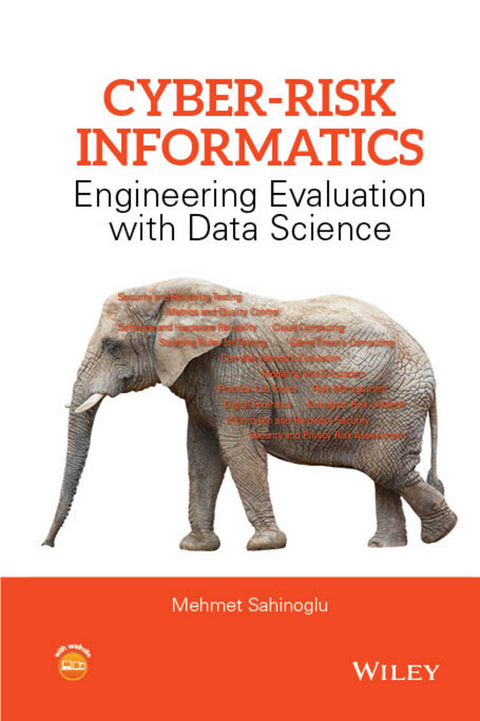
This book provides a scientific modeling approach for conducting metrics-based quantitative risk assessments of cybersecurity vulnerabilities and threats.
This book provides a scientific modeling approach for conducting metrics-based quantitative risk assessments of cybersecurity threats. The author builds from a common understanding based on previous class-tested works to introduce the reader to the current and newly innovative approaches to address the maliciously-by-human-created (rather than by-chance-occurring) vulnerability and threat, and related cost-effective management to mitigate such risk. This book is purely statistical data-oriented (not deterministic) and employs computationally intensive techniques, such as Monte Carlo and Discrete Event Simulation. The enriched JAVA ready-to-go applications and solutions to exercises provided by the author at the book's specifically preserved website will enable readers to utilize the course related problems.
• Enables the reader to use the book's website's applications to implement and see results, and use them making 'budgetary' sense
• Utilizes a data analytical approach and provides clear entry points for readers of varying skill sets and backgrounds
• Developed out of necessity from real in-class experience while teaching advanced undergraduate and graduate courses by the author
Cyber-Risk Informatics is a resource for undergraduate students, graduate students, and practitioners in the field of Risk Assessment and Management regarding Security and Reliability Modeling.
Mehmet Sahinoglu, a Professor (1990) Emeritus (2000), is the founder of the Informatics Institute (2009) and its SACS-accredited (2010) and NSA-certified (2013) flagship Cybersystems and Information Security (CSIS) graduate program (the first such full degree in-class program in Southeastern USA) at AUM, Auburn University's metropolitan campus in Montgomery, Alabama. He is a fellow member of the SDPS Society, a senior member of the IEEE, and an elected member of ISI. Sahinoglu is the recipient of Microsoft's Trustworthy Computing Curriculum (TCC) award and the author of Trustworthy Computing (Wiley, 2007).
Mehmet Sahinoglu, a Professor (1990) Emeritus (2000), is the founder of the Informatics Institute (2009) and its SACS-accredited (2010) and NSA-certified (2013) flagship Cybersystems and Information Security (CSIS) graduate program (the first such full degree in-class program in Southeastern USA) at AUM, Auburn University's metropolitan campus in Montgomery, Alabama. He is a fellow member of the SDPS Society, a senior member of the IEEE, and an elected member of ISI. Sahinoglu is the recipient of Microsoft's Trustworthy Computing Curriculum (TCC) award and the author of Trustworthy Computing (Wiley, 2007).
This book provides a scientific modeling approach for conducting metrics-based quantitative risk assessments of cybersecurity vulnerabilities and threats. This book provides a scientific modeling approach for conducting metrics-based quantitative risk assessments of cybersecurity threats. The author builds from a common understanding based on previous class-tested works to introduce the reader to the current and newly innovative approaches to address the maliciously-by-human-created (rather than by-chance-occurring) vulnerability and threat, and related cost-effective management to mitigate such risk. This book is purely statistical data-oriented (not deterministic) and employs computationally intensive techniques, such as Monte Carlo and Discrete Event Simulation. The enriched JAVA ready-to-go applications and solutions to exercises provided by the author at the book s specifically preserved website will enable readers to utilize the course related problems. Enables the reader to use the book's website's applications to implement and see results, and use them making budgetary sense Utilizes a data analytical approach and provides clear entry points for readers of varying skill sets and backgrounds Developed out of necessity from real in-class experience while teaching advanced undergraduate and graduate courses by the author Cyber-Risk Informatics is a resource for undergraduate students, graduate students, and practitioners in the field of Risk Assessment and Management regarding Security and Reliability Modeling. Mehmet Sahinoglu, a Professor (1990) Emeritus (2000), is the founder of the Informatics Institute (2009) and its SACS-accredited (2010) and NSA-certified (2013) flagship Cybersystems and Information Security (CSIS) graduate program (the first such full degree in-class program in Southeastern USA) at AUM, Auburn University s metropolitan campus in Montgomery, Alabama. He is a fellow member of the SDPS Society, a senior member of the IEEE, and an elected member of ISI. Sahinoglu is the recipient of Microsoft's Trustworthy Computing Curriculum (TCC) award and the author of Trustworthy Computing (Wiley, 2007).
Mehmet Sahinoglu, a Professor (1990) Emeritus (2000), is the founder of the Informatics Institute (2009) and its SACS-accredited (2010) and NSA-certified (2013) flagship Cybersystems and Information Security (CSIS) graduate program (the first such full degree in-class program in Southeastern USA) at AUM, Auburn University's metropolitan campus in Montgomery, Alabama. He is a fellow member of the SDPS Society, a senior member of the IEEE, and an elected member of ISI. Sahinoglu is the recipient of Microsoft's Trustworthy Computing Curriculum (TCC) award and the author of Trustworthy Computing (Wiley, 2007).
| Erscheint lt. Verlag | 29.4.2016 |
|---|---|
| Sprache | englisch |
| Themenwelt | Informatik ► Netzwerke ► Sicherheit / Firewall |
| Mathematik / Informatik ► Informatik ► Theorie / Studium | |
| Technik ► Elektrotechnik / Energietechnik | |
| Schlagworte | Cloud Computing • Cloud Risk-O-Meter • Computer Engineering • Computer Science • Computertechnik • CPM • Cyber-Risk • cybersecurity • Discrete-Event Simulation • Electrical & Electronics Engineering • Elektrotechnik u. Elektronik • email security • Firewall • Game-Theoretic Computing • Human Factors & Risk Assessment • Informatik • Informationstechnologie • Information Technologies • LGM • Logging • Menschliche Faktoren u. Risikobewertung • Monte Carlo simulation • MS-DOS Commands • Security Meter (SM) Model Design • Software Reliability Failure-Count Models • Software Reliability Modeling • Statistical Quality Control • System Hardening • wireless networks |
| ISBN-10 | 1-119-08752-X / 111908752X |
| ISBN-13 | 978-1-119-08752-6 / 9781119087526 |
| Informationen gemäß Produktsicherheitsverordnung (GPSR) | |
| Haben Sie eine Frage zum Produkt? |
 PDF (Adobe DRM)
Kopierschutz: Adobe-DRM
Adobe-DRM ist ein Kopierschutz, der das eBook vor Mißbrauch schützen soll. Dabei wird das eBook bereits beim Download auf Ihre persönliche Adobe-ID autorisiert. Lesen können Sie das eBook dann nur auf den Geräten, welche ebenfalls auf Ihre Adobe-ID registriert sind.
Details zum Adobe-DRM
Dateiformat: PDF (Portable Document Format)
Mit einem festen Seitenlayout eignet sich die PDF besonders für Fachbücher mit Spalten, Tabellen und Abbildungen. Eine PDF kann auf fast allen Geräten angezeigt werden, ist aber für kleine Displays (Smartphone, eReader) nur eingeschränkt geeignet.
Systemvoraussetzungen:
PC/Mac: Mit einem PC oder Mac können Sie dieses eBook lesen. Sie benötigen eine
eReader: Dieses eBook kann mit (fast) allen eBook-Readern gelesen werden. Mit dem amazon-Kindle ist es aber nicht kompatibel.
Smartphone/Tablet: Egal ob Apple oder Android, dieses eBook können Sie lesen. Sie benötigen eine
Geräteliste und zusätzliche Hinweise
Buying eBooks from abroad
For tax law reasons we can sell eBooks just within Germany and Switzerland. Regrettably we cannot fulfill eBook-orders from other countries.
aus dem Bereich