Modern Devices (eBook)
John Wiley & Sons (Verlag)
978-1-119-01182-8 (ISBN)
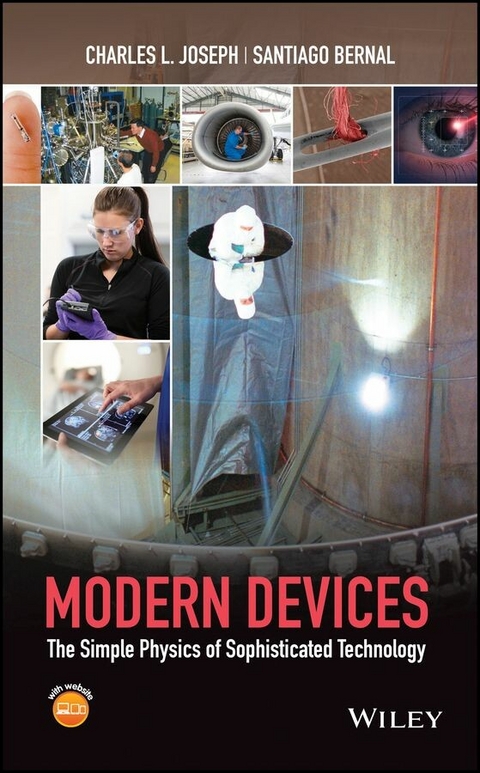
Focuses on the common recurring physical principles behind sophisticated modern devices
This book discusses the principles of physics through applications of state-of-the-art technologies and advanced instruments. The authors use diagrams, sketches, and graphs coupled with equations and mathematical analysis to enhance the reader's understanding of modern devices. Readers will learn to identify common underlying physical principles that govern several types of devices, while gaining an understanding of the performance trade-off imposed by the physical limitations of various processing methods. The topics discussed in the book assume readers have taken an introductory physics course, college algebra, and have a basic understanding of calculus.
- Describes the basic physics behind a large number of devices encountered in everyday life, from the air conditioner to Blu-ray discs
- Covers state-of-the-art devices such as spectrographs, photoelectric image sensors, spacecraft systems, astronomical and planetary observatories, biomedical imaging instruments, particle accelerators, and jet engines
- Includes access to a book companion site that houses Power Point slides
Charles L. Joseph, PhD, is a retired research professor from the Department of Physics and Astronomy at the Rutgers University, who specialized in technology development for NASA flight missions. Prof. Joseph has more than 30 years' experience working closely with aerospace and electro-optical companies as well as government laboratories, taking technologies from experimental breadboard devices to ruggedized instruments suitable for NASA missions. He was a co-investigator and the detector scientist on STIS, a second-generation instrument for the Hubble Space Telescope.
Santiago Bernal, PhD, is an associated research scientist at the Institute for Research in Electronics and Applied Physics (IREAP) at the University of Maryland. Dr. Bernal received his B.S. in physics from the National University of Colombia in 1981. He joined the IREAP in 2000 and has since been the leading experimentalist on the University of Maryland Electron Ring.Focuses on the common recurring physical principles behind sophisticated modern devices This book discusses the principles of physics through applications of state-of-the-art technologies and advanced instruments. The authors use diagrams, sketches, and graphs coupled with equations and mathematical analysis to enhance the reader s understanding of modern devices. Readers will learn to identify common underlying physical principles that govern several types of devices, while gaining an understanding of the performance trade-off imposed by the physical limitations of various processing methods. The topics discussed in the book assume readers have taken an introductory physics course, college algebra, and have a basic understanding of calculus. Describes the basic physics behind a large number of devices encountered in everyday life, from the air conditioner to Blu-ray discs Covers state-of-the-art devices such as spectrographs, photoelectric image sensors, spacecraft systems, astronomical and planetary observatories, biomedical imaging instruments, particle accelerators, and jet engines Includes access to a book companion site that houses Power Point slides Modern Devices: The Simple Physics of Sophisticated Technology is designed as a reference for professionals that would like to gain a basic understanding of the operation of complex technologies. The book is also suitable as a textbook for upper-level undergraduate non-major students interested in physics.
Charles L. Joseph, PhD, is a retired research professor from the Department of Physics and Astronomy at the Rutgers University, who specialized in technology development for NASA flight missions. Prof. Joseph has more than 30 years' experience working closely with aerospace and electro-optical companies as well as government laboratories, taking technologies from experimental breadboard devices to ruggedized instruments suitable for NASA missions. He was a co-investigator and the detector scientist on STIS, a second-generation instrument for the Hubble Space Telescope. Santiago Bernal, PhD, is an associated research scientist at the Institute for Research in Electronics and Applied Physics (IREAP) at the University of Maryland. Dr. Bernal received his B.S. in physics from the National University of Colombia in 1981. He joined the IREAP in 2000 and has since been the leading experimentalist on the University of Maryland Electron Ring.
1
PRINCIPLES OF PHYSICS AND THE RELEVANCE TO MODERN TECHNOLOGIES
The basic motivation that science, the scientific method, and scientific reasoning should be mastered by an increasingly large fraction of our population can be seen in Figure 1.1, which shows the volume of an individual’s knowledge and understanding compared to the collective, comprehensive volume of all human experience. The gray areas represent the fragments grasped by an individual with some areas being connected (i.e., related) through various mental paths. Gray blobs that are clustered represent the formation of expertise in some field. Most of the volume (white area) is empty, indicating those topics where the individual is uninformed. As the figure depicts, the overall volume of knowledge and understanding is increasing rapidly with time. While the individual continues to grow and learn, adding more fragments as well as enhancing his/her expertise in some fields (larger, more concentrated gray area clusters), it is difficult to keep pace with all that one ought to understand. This task becomes virtually impossible if one relies solely on the incorporation of more factual knowledge, especially in a world that is increasingly becoming more reliant on technologies. A human being has a limited amount of memory that can be accessed with any reliability. The person who develops and incorporates scientific cognitive skills has a significant advantage since there are relatively few concepts underlying the physics behind all science and technology. Each fundamental theory can be applied to numerous applications, providing shortcuts to acquiring an understanding of new, unfamiliar equipment. The laws of physics are unchanging, and after basic concepts have been established, these evolve slowly on timescales of centuries. Basic scientific cognitive skills provide the individual with more mental tools, and he/she can exploit the observed commonalities between recognized and unfamiliar technologies.
Figure 1.1 In the ever-expanding body of human knowledge, it is difficult for an individual to keep pace by only absorbing factual information. Gray areas represent small fragments of an individual’s knowledge compared to all of the available data. Some of these fragments are connected (shown as lines) via various means (e.g., factual, cognitive, and reasoning).
All modern technologies are the exploitation of one or at most a few basic laws of physics. Insights into these governing principles illuminate simultaneously the intrinsic operation as well as the inherent strengths and limitations of any apparatus or piece of equipment. Once optimized, there are only two ways to enhance the performance further. First, one performance parameter can often be enhance within limits at the expense of another. For example, power and speed in many electronics devices can be sacrificed against each other. Computing speed can be increased, but only at the expense of needing more power. Increased power consumption normally carries the penalties of greater cooling requirements, greater mass, and greater volume. Second, the only other way to enhance the performance of a device that has already been optimized is to switch to a totally different technology, one obeying a different set of physical laws.
The mastery of the underlying physics of modern equipment is satisfying, giving the student added insights into the equipment used throughout their careers. However, acquiring these cognitive skills does require some serious effort. It is important to bear in mind that in the early stages of learning physics, the individual has to absorb each rudimentary concept through the process of solving a number of similar problems. This learning process is similar in nature to a student learning a musical instrument, who must repetitively practice his or her scales and perform other repetitive exercises prior to the thrill and enjoyment of performing. The same is true of an individual taking up a new sport activity. He/she cannot expect to become a star without first receiving instruction on various techniques and plenty of practice. While rudimentary training cannot be avoided if the individual is to gain a solid understanding, the approach of the current text seeks to provide the motivational framework necessary to entice the student. The acquisition of new knowledge and new reasoning skills has to be a life-long endeavor, if one wants to rise above the crowd.
The current text contains a series of boxes titled Intro Physics Flashback to assist the individual identify the appropriate concepts from his/her freshman physics course. Individuals with strong backgrounds in high school or freshman-level college can ignore these Flashbacks. Throughout the textbook, the student is advised to search for recurring principles and to organize his or her thoughts according to a hierarchy of importance. Merely identifying the appropriate equations to solve a problem is simply substituting one factual database for another, a list of equations instead of a list of facts. Such an approach leaves the student unable to recognize the underlying physics for an unfamiliar device.
Moreover, the student is encouraged to step back on a regular basis and contemplate the reasonableness of his or her assumptions, measurements, or conclusions. Always ask: Is this statement consistent with other facts and knowledge? How does my answer compare with other information? It is of great assistance in answering these types of questions if the individual has at his or her finger tips a few benchmark numbers. For example, it is not uncommon for students to calculate the mass of a subatomic particle to be more massive than that of the Earth. The individual who knows one or more crude benchmark values, say the mass of a proton (10−27 kg) or of the Earth (6 × 1024 kg), easily recognizes if his calculation is amiss or the significance of someone else’s presentation of facts. It is important to memorize or if necessary look up benchmark values for everything. For instance, what value constitutes a large amount of electrical charge? At what maximum voltage will there likely be a breakdown, leading to a discharge? Is this value the same for different environments (e.g., using an insulator or operating in a vacuum)? What is the smallest amount of electrical current that can be reliably measured? Incorporating benchmark numbers dramatically assists a researcher to identify spurious or suspicious measurements and to perform consistency checks on his calculations. Many investigators refer to this mental process as performing sanity checks.
1.1 CM, EM, AND QM: THE BACKBONE OF PHYSICS
Classical mechanics (CM), quantum mechanics (QM), and electromagnetism (EM) are topical areas that form the backbone of most physics knowledge and reasoning. CM deals with objects, how the objects respond to forces and changes in gravitational potential energy, while electromagnetism involves electric charge and the response of these charges to electric and magnetic fields, all of which may vary over time. QM came into its own in the early part of the twentieth century. QM is the physics of atoms and subatomic particles as well as the discrete quantization of energy. There are, of course, important other physics disciplines such as optics and more exotic topics such as relativity. The latter deals with the strange properties that objects or particles exhibit when moving close to the speed of light. While a global positioning system (GPS), for example, has to take into account the effects of general relativity to function properly, the basic concepts of a GPS can be understood in a simple Newtonian environment with relativity being a small correction factor.
Most technologies are essentially a component of one or more of these three backbone areas of physics. For example, optics is an application of EM, dealing with the transportation, absorption, or reflection of EM waves (most notably visible light) interacting with various materials. Electronics, magnetism, and electricity also fall under the EM umbrella. Most everyday experiences and the operation of devices can be shown to be specific applications of CM, QM, or EM. In turn, each of these topic areas can be reduced essentially to a small number of equations, embodying virtually a complete description of all natural phenomena. The physicist, who generally has a fondness for elegance, tends to prefer thinking in abstract, broad-brushed generalizations that describe a wide range of observed attributes. Unfortunately, physics classes have been taught historically in these abstract terms, leaving many students with the impression that physics has little relevance to their everyday life experiences.
For instance, a simple pulley taught seemingly laboriously in an introductory physics class might seem blasé to the student. He or she might think it is some archaic tool used only by their grandfathers’ and earlier generations, a relic of the past that is only used in very old antiquated equipment that should have been replaced decades ago. In fact, pulleys continue to be the best choice for many new applications. A set of pulleys is still the most effective method used by hospitals to apply traction for certain types of skeletal injuries. Pulleys are crucial for supplying very precise amounts of pull in accurate directions. As a result, pulleys are used in the most advanced prosthetics (i.e., artificial limbs). Figure 1.2 shows several examples where pulleys continue to be employed as the most effective tool.
Figure 1.2 A...
| Erscheint lt. Verlag | 2.5.2016 |
|---|---|
| Sprache | englisch |
| Themenwelt | Naturwissenschaften ► Physik / Astronomie ► Allgemeines / Lexika |
| Technik ► Elektrotechnik / Energietechnik | |
| Schlagworte | Adaptive optics • Components & Devices • Components and Devices • Electrical & Electronics Engineering • electron microscopy • Elektrotechnik u. Elektronik • Gerät • Gerät • Image? Display Systems • Imaging Instruments • Komponenten u. Bauelemente • Material Science • nanotechnology • Optical Couples • Optical Fibers • Optical microscopy • Optical Systems • Photoelectric Image Sensors • Photonics • Physics • Physik • Power generation • Semiconductor Fabrication • Solid-state Electronics • Spectrographs • Technik |
| ISBN-10 | 1-119-01182-5 / 1119011825 |
| ISBN-13 | 978-1-119-01182-8 / 9781119011828 |
| Informationen gemäß Produktsicherheitsverordnung (GPSR) | |
| Haben Sie eine Frage zum Produkt? |
 EPUB (Adobe DRM)
Kopierschutz: Adobe-DRM
Adobe-DRM ist ein Kopierschutz, der das eBook vor Mißbrauch schützen soll. Dabei wird das eBook bereits beim Download auf Ihre persönliche Adobe-ID autorisiert. Lesen können Sie das eBook dann nur auf den Geräten, welche ebenfalls auf Ihre Adobe-ID registriert sind.
Details zum Adobe-DRM
Dateiformat: EPUB (Electronic Publication)
EPUB ist ein offener Standard für eBooks und eignet sich besonders zur Darstellung von Belletristik und Sachbüchern. Der Fließtext wird dynamisch an die Display- und Schriftgröße angepasst. Auch für mobile Lesegeräte ist EPUB daher gut geeignet.
Systemvoraussetzungen:
PC/Mac: Mit einem PC oder Mac können Sie dieses eBook lesen. Sie benötigen eine
eReader: Dieses eBook kann mit (fast) allen eBook-Readern gelesen werden. Mit dem amazon-Kindle ist es aber nicht kompatibel.
Smartphone/Tablet: Egal ob Apple oder Android, dieses eBook können Sie lesen. Sie benötigen eine
Geräteliste und zusätzliche Hinweise
Buying eBooks from abroad
For tax law reasons we can sell eBooks just within Germany and Switzerland. Regrettably we cannot fulfill eBook-orders from other countries.
aus dem Bereich