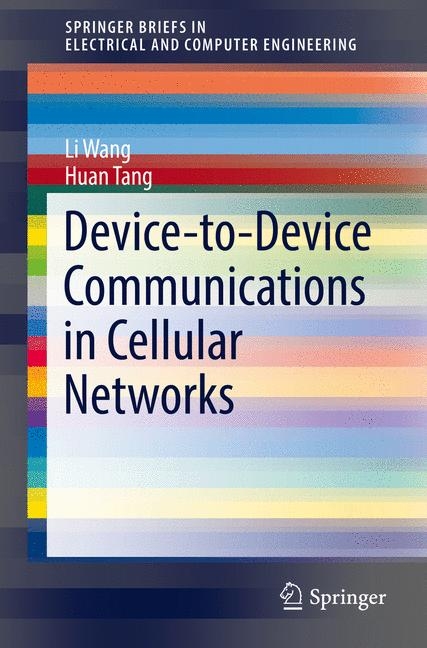
Device-to-Device Communications in Cellular Networks (eBook)
90 Seiten
Springer International Publishing (Verlag)
978-3-319-30681-0 (ISBN)
Acknowledgments 8
Contents 10
Acronyms 14
Symbols and Notations 16
1 Introduction 18
1.1 D2D Communications Towards 5G 19
1.1.1 History of D2D Standardization Activities 19
1.1.2 Classifications of D2D Communications 20
1.1.3 D2D-Assisted Cellular Communication 22
1.2 Research Challenges in D2D-Assisted Networks 23
1.2.1 Synchronization 23
1.2.2 Device Discovery 24
1.2.3 Mode Selection 25
1.2.4 Interference Management 25
1.2.5 Power Control 26
1.2.6 Channel Measurements 26
1.3 Outline of the Book 27
References 27
2 Critical Technologies for D2D Communications 29
2.1 Proximity Discovery 29
2.1.1 Taxonomy of D2D Proximity Discovery 29
2.1.2 Procedure of Proximity Discovery 30
2.1.3 Related Works and Motivations 31
2.2 Mode Selection 33
2.2.1 Taxonomy of Typical Communication Modes 33
2.2.2 Related Works and Motivations 34
2.3 Resource Management 35
2.3.1 Related Technologies in Resource Management 35
2.3.2 Related Works and Motivations 36
2.4 Chapter Summary 38
References 38
3 Proximity Discovery for Cellular D2D Underlay 41
3.1 LTE System Architecture 41
3.1.1 Basic Structure for LTE Uplink 42
3.1.2 Physical Channels for LTE Uplink 43
3.2 Framework for Neighbor Discovery in LTE 44
3.2.1 Resource Allocation and Multiplexing 44
3.2.2 SC-FDMA Transmitter and Receiver 45
3.2.3 System Model 47
3.2.4 Sparse Vector Recovery 48
3.3 Block Sparse Bayesian Learning 48
3.3.1 Problem Formulation 48
3.3.2 Maximum Likelihood Estimation 49
3.3.3 Simulation Results and Performance Analysis 51
3.3.3.1 Simulation Parameters 52
3.3.3.2 Performance of Sparse Channel Recovery 53
3.3.3.3 Error Probability of Parameter Estimation 53
3.3.3.4 Detection Probability 53
3.4 Chapter Summary 54
References 55
4 Mode Selection for Cellular D2D Underlay 56
4.1 System Model 56
4.1.1 Channel Model 57
4.1.2 Resource Multiplexing 59
4.2 Problem Formulation 60
4.2.1 Two-Step Approach 61
4.3 Mixed-Mode Allocation 62
4.3.1 Uplink Sharing 62
4.3.2 Downlink Sharing 64
4.3.3 Successive Convex Approximation 65
4.4 Resource Allocation 66
4.4.1 Lagrangian Dual Decomposition 67
4.4.2 Reduced Complexity Algorithm 68
4.4.3 Distributed Implementation 70
4.4.4 Simulation Results and Performance Analysis 71
4.4.4.1 Mode Allocation Results 71
4.4.4.2 Joint Resource Allocation and Power Control 72
4.5 Chapter Summary 72
References 74
5 Resource Management for Cellular D2D Underlay 75
5.1 Critical Problems of Resource Management 75
5.1.1 General Problems 76
5.2 Bipartite Graph-Based Resource Management 77
5.2.1 Graph Matching Problems 77
5.2.2 Typical Matching Objectives and Solutions 78
5.2.2.1 Maximum Cardinality Pairing Problem 78
5.2.2.2 Stable Marriage for Maximum Pairing Satisfaction 79
5.2.2.3 The Optimal Assignment Problem 79
5.3 Resource Allocation in Ideal Case 80
5.3.1 Model Assumption 80
5.3.2 Bipartite Graph Construction 81
5.3.3 Pairing for System Capacity Maximization 83
5.3.3.1 Determination of D2D Candidate Sets 84
5.3.3.2 Objective of System Capacity Maximization 85
5.3.4 Proposed Low-Complexity Pairing Algorithm 85
5.3.5 Simulation Results and Performance Analysis 86
5.4 Resource Allocation in Practical Case 88
5.4.1 Social Interaction in Practical Case 89
5.4.2 Socially Enabled D2D Link Admission 89
5.4.2.1 Analysis of One-Time Delivery of Time-Sensitive Data Block 90
5.4.2.2 Analysis of Multiple Encounter Delivery with Delay Constraint 92
5.4.3 Socially Enabled Capacity Maximization Problem 93
5.4.4 Simulation Results and Performance Analysis 94
5.4.4.1 One-Time Delivery 95
5.4.4.2 Multiple Encounter Delivery 98
5.5 Chapter Summary 99
References 101
6 Summary and Future Work 102
| Erscheint lt. Verlag | 29.4.2016 |
|---|---|
| Reihe/Serie | SpringerBriefs in Electrical and Computer Engineering | SpringerBriefs in Electrical and Computer Engineering |
| Zusatzinfo | XVI, 90 p. 32 illus., 28 illus. in color. |
| Verlagsort | Cham |
| Sprache | englisch |
| Themenwelt | Mathematik / Informatik ► Informatik ► Netzwerke |
| Mathematik / Informatik ► Informatik ► Web / Internet | |
| Technik ► Nachrichtentechnik | |
| Schlagworte | cellular networks • Device-to-device communications (D2D) • Mobile Social Networks • Mode selection • Power Control • Proximity discovery • Resource Management • Spectrum Allocation • wireless communications |
| ISBN-10 | 3-319-30681-2 / 3319306812 |
| ISBN-13 | 978-3-319-30681-0 / 9783319306810 |
| Informationen gemäß Produktsicherheitsverordnung (GPSR) | |
| Haben Sie eine Frage zum Produkt? |
 PDF (Wasserzeichen)
DRM: Digitales Wasserzeichen
Dieses eBook enthält ein digitales Wasserzeichen und ist damit für Sie personalisiert. Bei einer missbräuchlichen Weitergabe des eBooks an Dritte ist eine Rückverfolgung an die Quelle möglich.
Dateiformat: PDF (Portable Document Format)
Mit einem festen Seitenlayout eignet sich die PDF besonders für Fachbücher mit Spalten, Tabellen und Abbildungen. Eine PDF kann auf fast allen Geräten angezeigt werden, ist aber für kleine Displays (Smartphone, eReader) nur eingeschränkt geeignet.
Systemvoraussetzungen:
PC/Mac: Mit einem PC oder Mac können Sie dieses eBook lesen. Sie benötigen dafür einen PDF-Viewer - z.B. den Adobe Reader oder Adobe Digital Editions.
eReader: Dieses eBook kann mit (fast) allen eBook-Readern gelesen werden. Mit dem amazon-Kindle ist es aber nicht kompatibel.
Smartphone/Tablet: Egal ob Apple oder Android, dieses eBook können Sie lesen. Sie benötigen dafür einen PDF-Viewer - z.B. die kostenlose Adobe Digital Editions-App.
Buying eBooks from abroad
For tax law reasons we can sell eBooks just within Germany and Switzerland. Regrettably we cannot fulfill eBook-orders from other countries.
aus dem Bereich