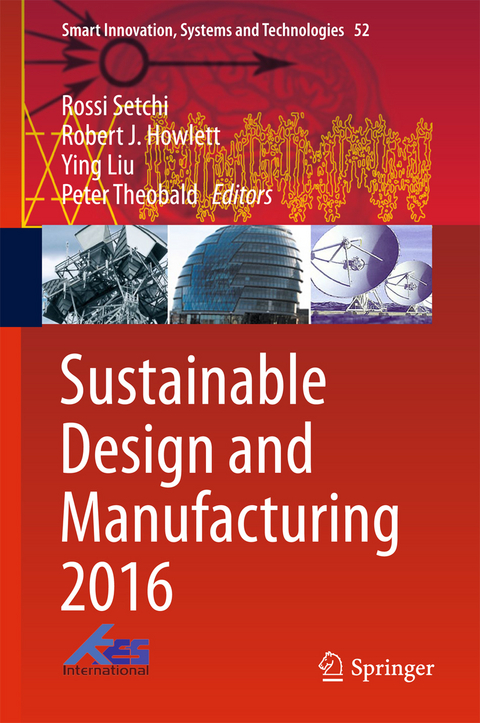
Sustainable Design and Manufacturing 2016 (eBook)
XII, 689 Seiten
Springer International Publishing (Verlag)
978-3-319-32098-4 (ISBN)
This volumes consists of 59 peer-reviewed papers, presented at the International Conference on Sustainable Design and Manufacturing (SDM-16) held in Chania, Crete Greece in April 2016. Leading-edge research into sustainable design and manufacturing aims to enable the manufacturing industry to grow by adopting more advanced technologies, and at the same time improve its sustainability by reducing its environmental impact. SDM-16 covers a wide range of topics from sustainable product design and service innovation, sustainable process and technology for the manufacturing of sustainable products, sustainable manufacturing systems and enterprises, decision support for sustainability, and the study of societal impact of sustainability including research for circular economy. Application areas are wide and varied. The book will provide an excellent overview of the latest research and development in the area of Sustainable Design and Manufacturing.
Preface 6
Contents 7
Part I General Track 1: Sustainable Design, Innovation and Services 13
1 A New CAD Integrated Application to Support Designers and Increase Design Sustainability 14
Abstract 14
1 Introduction 15
2 Description and Operation of the Software SFIDA 16
2.1 Design Constraints 17
2.2 Design Variables 18
2.3 Check Instruments 20
2.4 Output 22
3 Conclusions 23
References 24
2 A Conflict Analysis and Resolution Method Based on Integrating the Extension and TRIZ Methods 25
Abstract 25
1 Introduction 25
2 Transforming the Modeling of Extension and TRIZ Methods 26
2.1 Transforming Engineering Parameters of TRIZ to Extension Method 26
2.2 Transforming TRIZ Inventive Principle to Extension Method 27
2.3 Transforming Factors of Conflict of the Extension Method to TRIZ 27
3 Analyzing and Resolving Conflicts Based on Integrating the Extension and TRIZ Methods 28
3.1 Analyzing and Resolving Single-Factor Conflict Problems 28
3.2 Analyzing and Resolving Multiple-Factor Conflict Problems 29
4 Example Verification 30
4.1 Analyzing Conflict Problem 31
4.2 Resolving the Conflict in the Large Screw Air Compressor Based on Integrating the Extension and TRIZ Methods 31
5 Conclusion 34
Acknowledgement 35
References 35
3 Investigating the Regulatory-Push of Eco-innovations in Brazilian Companies 36
Abstract 36
1 Introduction 36
2 Eco-innovation and Industrial Development 37
3 Eco-innovation and Public Governance 39
4 Methodology 40
5 Results and Discussion 41
6 Final Remarks 44
References 45
4 Evolutive Scenarios for a New Concept of Sustainable Mobility 47
Abstract 47
1 Introduction 48
2 Sustainable Mobility and Models and Social Innovation 48
3 The Demand of Mobility and the Instruments for Sharing 49
4 The Evolution of Productive Processes Through New Technologies 51
5 Innovative Digital Productions for Automotive Design 52
6 Conclusions 54
References 55
5 Implications of Open Source Design for Sustainability 56
Abstract 56
1 Beyond Sustainable Product Design 56
2 Open Source Design, Definition, Challenges, Potentials 57
2.1 Characterizing Open Source Design 58
2.2 Challenges for Further Development 59
2.3 Potential of Open Source Design for Environmental Sustainability 59
3 Empirical Research—Case Studies 60
3.1 Methodology 61
3.2 Analysis of the Four Selected Projects 61
3.3 Interpretation of Results 64
4 Conclusion 65
References 65
6 Sustainable Supply Chain Management in a Circular Economy—Towards Supply Circles 67
Abstract 67
1 Introduction 67
2 Method 68
3 Literature Review 69
3.1 Literature of Circular Economy 69
3.2 Literature on the SCM Aspects of a CE 70
3.3 Literature on SSCM 71
3.4 Literature on Product-Service Systems 72
4 Results 73
4.1 Findings from Empirical Data 73
4.2 Synthesis and What Is Missing in Current Literature 75
5 Conclusions 77
References 77
7 How Does Sustainability Help or Hinder Innovation? 79
Abstract 79
1 Background 79
2 Methodology 80
3 Results 81
3.1 How Sustainability Helps Innovation 81
3.2 How Sustainability Hinders Innovation 84
4 Discussion: Practical Implications of the Findings 86
4.1 Taking the Initiative 86
4.2 Long-Term Orientation 87
4.3 Sustainability as an Opportunity 87
4.4 Limitations of This Research 88
5 Conclusion 88
References 88
8 A New Sustainable Product Development Model in Apparel Based on 3D Technologies for Virtual Proper Fit 90
Abstract 90
1 Introduction 90
1.1 CSR (Corporate Social Responsibility) 91
1.2 Collective Action on Sustainability 92
2 Understanding the Evolution of the Sector—More Focus on Design and Digital Solutions 94
2.1 Development of New Digital Tools and Solutions 94
2.2 The Problem of Fit-Challenges 96
3 Development of Programs and Solutions to Support Fit and Sustainability 97
4 Conclusion 99
Acknowledgements 99
References 99
Part II General Track 2: Sustainable Manufacturing Processes and Technologies 101
9 Generic Approach to Sustainability Improvements in Manufacturing Ovens 102
Abstract 102
1 Introduction 103
2 Methodology 104
2.1 Product Understanding 104
2.2 Process Improvement 104
2.3 Process Parameter Optimisation 105
3 Case Study: Industrial Oven Improvement 105
3.1 Process Specific Flowchart 105
3.2 Product Understanding 106
3.3 Process Improvement 107
3.4 Process Parameter Optimisation 109
4 Recommendations 110
5 Conclusion 111
Acknowledgements 111
References 111
10 Increasing Energy Potentials of Air-Jet Weaving Machines by Using Energy Efficiency as a Central Requirement in the Design Phase of the Weft Insertion Process 113
Abstract 113
1 Introduction 114
2 Method 116
2.1 Application of the Method 118
3 Results 120
4 Discussion 122
5 Conclusion 123
Acknowledgements 123
References 124
11 Modelling and Verification of Energy Consumption in CNC Milling 125
Abstract 125
1 Introduction 125
2 Methodology 127
3 Results 128
4 Analysis and Discussion 130
5 Conclusions 134
References 135
12 Optimal Cutting Parameters to Reduce Power Consumption in Face Milling of a Cast Iron Alloy for Environmental Sustainability 136
Abstract 136
1 Introduction 137
2 Relationship Between Power Consumption and Cutting Force 138
2.1 Characteristics of Machine Tool Power Consumption 138
2.2 Power Modeling Method of the Three Types Consumption 138
3 Experimental Details 140
3.1 Workpiece Material, Cutting Tool and Machine Tool 140
3.2 Design of Face Milling Experiments 141
3.3 Power Analyzing System 142
4 Results and Discussions 143
4.1 Results and Second Order RSM Model Prediction Model Optimization 143
4.2 Parameters Optimization Based on RSM 145
5 Conclusions 148
Acknowledgements 148
References 149
13 Innovative Active Cross-Linking Agents for Sustainable Leather Manufacturing 150
Abstract 150
1 Introduction 150
2 ACL Leather Manufacturing 152
3 Conclusions 155
References 156
14 An Approach to Electricity Monitoring and Targeting (M& T) in Irish Precision Engineering SMEs
Abstract 157
1 Energy 157
1.1 Sustainable Manufacturing 158
1.2 Energy Usage in Production Machines 158
2 Methodology 159
2.1 Overall Electricity Consumption 159
2.2 Power Profile 160
2.3 Production Process Analysis 162
3 Case Study 163
3.1 Overall Energy Patterns 164
3.2 Production Process Analysis 164
4 Conclusions 166
Acknowledgement 167
Bibliography 167
15 Exploring the Scope of Industrial Symbiosis: Implications for Practitioners 169
Abstract 169
1 Introduction 169
2 Origins and Definitions 170
3 Operationalizing Industrial Symbiosis 171
3.1 The Geographical Dispersion 172
4 The Network Perspective 172
4.1 The Role of Intermediaries 173
5 The Social Aspects of Industrial Symbiosis 173
6 Gaps and Research Opportunities for Industrial Symbiosis Implementation 175
7 Concluding Remarks 176
Acknowledgements 176
References 177
16 Towards Reverse Logistics Archetypes to Stimulate Manufacturers’ Usage of End of Life and End of Use Products 179
Abstract 179
1 Introduction 179
2 Reverse Logistics Context 180
3 Research Methodology and Design for RL Archetype Development 181
4 Reverse Logistics Archetypes 182
4.1 Archetype 1: Advanced Industry Goods Recovery 183
4.2 Archetype 2: Products with Low Residual Value and EPR 183
4.3 Archetype 3: Service Parts Logistics 184
5 Conclusion 185
Acknowledgments 186
References 186
Part III General Track 3: Sustainable Manufacturing Systems and Enterprises 188
17 Sustainable Manufacturing Systems Based on Demand Forecasting—Supply Chain Sustainable Growth 189
Abstract 189
1 Introduction 190
2 Supply Chain Definition 190
3 Demand Forecasting 192
4 Manufacturing 193
5 System Approach and Manufacturing Systems 194
6 General Case Study 196
7 Conclusion 198
References 198
18 An Analysis of Indirect Water Withdrawal and Consumption in Automotive Manufacturing Facilities 201
Abstract 201
1 Introduction 201
2 Hypothetical Automotive Company (HAC) with Global Production 202
2.1 Automotive Manufacturing Facility Location and Water Data 202
2.2 Electricity Consumption for Vehicle Production 203
3 Water Impact of Electricity Generation 204
3.1 Water Impact of Different Generation Technologies 204
3.2 Electricity Generation Grid Mix by Source for Different Countries 205
3.3 Calculation of Indirect Water Withdrawal and Consumption by Energy 205
4 Indirect Water Withdrawal and Consumption 206
4.1 Results 206
4.2 Discussion 206
5 Comparison with Direct Withdrawal and Consumption 208
6 Discussion 209
7 Conclusion 210
Acknowledgements 210
References 211
19 How are Micro Enterprises Adopting Emergent Technologies? 212
Abstract 212
1 Introduction 212
2 Methodology 213
3 Results and Findings 214
3.1 Survey Respondents 214
3.2 Observations Between Entrepreneurs, Micro-Enterprises and Small Companies 216
4 Discussion 220
5 Conclusion 222
References 223
20 Improving Performance of Eco-Industrial Parks 224
Abstract 224
1 Introduction 224
2 Structural Ecosystem Metrics 226
3 Combining Eco-Industrial Parks 228
3.1 EIP Combo 1: Lubei Industrial Park, Mongstad EIP, Wallingford EIP, and Kymi EIP 229
3.2 EIP Combo 2: GERIPA, Gladstone, and Montfort 229
3.3 EIP Combo 3: Brownsville EIP, Burnside EIP, Clark Special Economic Zone, and Kawasaki 229
4 Discussion 232
5 Conclusion 235
Acknowledgements 235
References 235
21 Product Change Management and Future Information Architectures 238
Abstract 238
1 Introduction 238
1.1 Through Life Product Management 238
1.2 Information Technology Challenges 239
2 Motivation for Research 240
2.1 Industry Life Cycles 240
2.2 Management Models 240
2.3 Product Management 241
2.4 Information Technology 242
3 Investigative Approach 242
4 Future State 243
4.1 Vision 243
4.2 Future Product Management 244
4.3 Future Information Architectures 245
5 Conclusion 246
References 246
22 Road-Mapping Towards a Sustainable Lower Energy Foundry 248
Abstract 248
1 Introduction 248
2 Low Energy Foundry 249
3 Energy Consumptions Pattern in Cast Iron Sand Casting Foundries 250
3.1 Energy Audit in Foundry F 251
3.2 Energy Audit in Foundry D 252
4 Energy Savings in Foundries 252
4.1 Direct Energy Savings in Foundries 253
4.2 Indirect Energy Savings in Foundries 254
5 Conclusions 256
References 256
23 Increasing Production Efficiency Through Electronic Batch Record Systems: A Case Study 258
Abstract 258
1 Introduction 258
2 Research Methods 259
3 Hardcopy and Electronic Manufacturing Batch Records 260
4 Results 262
4.1 Case Study of EBRS Implementation at a Life Science Manufacturing Company 262
4.1.1 Advantages of Implementing EBRS 262
4.1.2 Disadvantages of Implementing EBRS 263
5 Conclusion and Directions for Future Work 264
Acknowledgements 265
References 265
24 A Method for Understanding Sustainable Design Trade-Offs During the Early Design Phase 267
Abstract 267
1 Introduction 267
2 Methodology 269
3 Results 273
4 Discussion 274
5 Conclusion 275
Acknowledgements 275
References 276
25 Achieving Sustainability in SME Manufacturing Operations via the Use of Flexible Integrated Technology and Product Symbiosis 277
Abstract 277
1 Introduction 278
2 Background/Literature Review 278
3 Sustainable Product Design, Material—Process Choice and Utilisation 280
4 Sustainable Product Design, Material—Process Utilisation to Achieve Cost Reduction 282
5 Application Case Study 284
6 Conclusions 287
Acknowledgements 288
References 288
Part IV General Track 4: Decision Support and Sustainability 290
26 Business Model Experimentation for Sustainability 291
Abstract 291
1 Introduction 292
2 Literature 292
2.1 Sustainable Business Model Innovation 292
2.2 Business Experimentation 293
2.3 Research Gap: Sustainable Business Model Experimentation 294
3 Method 294
4 Results: Cases 296
4.1 Case Overview 296
4.2 Cross Case Analysis 297
5 Discussion and Conclusion 297
References 298
27 Design of Indicators for Measuring Product Performance in the Circular Economy 301
Abstract 301
1 Introduction 301
1.1 Theoretical Roots 302
1.2 The EMF Notion of a Circular Economy 302
1.3 Circular Economy Indicators 303
1.4 Existing Circular Economy Indicators 303
2 Methodology 304
3 Results 304
3.1 User Feedback 310
4 Discussion 311
4.1 Comparison with KCC 311
4.2 Use of Single Metric 311
4.3 Does the Metric Reliably Indicate Improved Environmental Outcomes? 311
4.4 Does the Metric Lead to Improved Decision Making? 312
4.5 Future Work 313
5 Conclusion 313
References 314
28 An Integrated Product Development Approach to Improving Sustainability Using Simulated Experiments: Manufacturing Case Study 316
Abstract 316
1 Introduction 317
1.1 Sustainable Manufacturing 317
1.2 Integrated Product Development 317
1.3 Manufacturing Simulation 318
1.4 Research Gap 318
2 Methodology 318
3 Results 321
3.1 Scenario 1—Improving Machine Quality 321
3.2 Scenario 2—Changing the Shift Pattern of the Loading/Packaging Personnel 322
3.3 Scenario 3—Changing Stack Size of Bins 322
3.4 Scenario 4—Changing Product Characteristics 323
3.5 Scenario 5—Reducing the Workforce 324
4 Conclusions 325
References 326
29 Life Cycle Assessment and Life Cycle Costing as Supporting Tools for EVs Lightweight Design 328
Abstract 328
1 Introduction 328
2 The ENLIGHT Project 330
3 Methodological Approach 330
3.1 Life Cycle Assessment 331
3.2 Life Cycle Costing Model 333
4 Results 334
4.1 Components, Materials and Technologies Description 334
4.2 LCA Results 336
4.3 LCC Results 336
5 Discussion and Conclusions 339
Acknowledgements 339
References 340
30 The Characteristic Objects Method: A New Intelligent Decision Support Tool for Sustainable Manufacturing 342
Abstract 342
1 Introduction 342
2 Literature Review 343
3 Fuzzy Set Theory: Preliminaries 344
4 The Characteristic Objects Method 346
5 Experimental Study 348
6 Conclusion 350
References 350
31 Green Supplier Selection Framework Based on Multi-Criteria Decision-Analysis Approach 353
Abstract 353
1 Introduction 353
2 Literature Review 354
3 Proposed Framework 356
4 Empirical Study 358
5 Conclusions 362
References 362
Part V Invited Session 1: Design for Additive Manufacture 364
32 Application of Sustainable Design in Additive Manufacturing of an Unmanned Aerial Vehicle 365
Abstract 365
1 Introduction 366
2 The State of Technology 367
3 Specifications for Sustainable Design for Additive Manufacturing 368
4 Case Study of Implementation of Sustainable Design in Additive Manufacturing 369
4.1 Example of Short Development Cycle 370
4.2 Example for a Long Development Cycle 371
5 Results and Discussion 372
6 Conclusion and Outlook 373
References 374
33 Evaluating Innovative CAD Techniques in the Creation of Conformal Cellular Structures 376
Abstract 376
1 Introduction 377
1.1 Additive Manufacturing 377
1.2 Design for Additive Manufacture: Energy Absorption Materials 377
2 Technical Evaluation of Existing Conformal Software 378
2.1 Cellular Design in Creo Parametric 378
2.2 Cellular Design in Materialise 3-Matic 380
3 Overcoming Existing Technical Limitations by Developing New Software Code 382
3.1 Cellular Design in 3D Studio Max 382
4 Discussion 384
References 385
34 An Investigation into the Quasi-Static Response of Ti6Al4V Lattice Structures Manufactured Using Selective Laser Melting 387
Abstract 387
1 Introduction 387
2 Related Works 388
3 Experiments 389
3.1 Material Characterization 389
3.2 Design of the Lattice Structures and Compression Tests 390
4 Numerical Modelling 391
5 Results and Discussion 393
5.1 Characterization of Ti6Al4V Tensile Specimens 393
5.2 Mechanical Response of the Lattice Structures 393
6 Concluding Remarks 395
Acknowledgements 396
References 396
35 A Bottom-up Design Framework for CAD Tools to Support Design for Additive Manufacturing 398
Abstract 398
1 Introduction 398
2 Review of Design for Additive Manufacturing 399
2.1 A Review of Existing Design Rules 399
2.2 A Review of Additive Manufacturing Computer Design Tools 400
3 Framework for a New Additive Manufacturing CAD Tool 400
3.1 Additive Manufacturing Design Considerations 401
3.2 The Role of Computation in Design for Additive Manufacturing 402
3.3 CAD Support for Bottom up Design for Additive Manufacturing 403
3.4 A Collaborative Generative CAD Tool for Additive Manufacturing 404
3.5 Disadvantages to Bottom-up Design Methods for Additive Manufacturing 406
4 Conclusions and Future Perspectives 406
Acknowledgements 407
References 407
36 A Surface Modification Decision Tree to Influence Design in Additive Manufacturing 409
Abstract 409
1 Introduction 410
1.1 Benefits and Uses of Additive Manufacturing 410
2 Challenges in Additive Manufacturing 411
2.1 Part Quality 411
2.2 Designing for Additive Manufacturing 412
3 Post Processing in Additive Manufacturing 412
3.1 Removal of Loose Powder 413
3.2 Heat Treatment 413
3.3 Removal of Build Plate and Supports 413
3.4 Surface Modification 413
4 Vision for the Future of Design for Additive Manufacturing 416
5 Discussion 418
6 Conclusions and Future Work 419
Acknowledgements 419
References 419
37 Additive Manufacturing Simulation Using Signed Distance Fields 421
Abstract 421
1 Introduction and Motivation 421
1.1 Geometric Design Challenges for Manufacturing Simulation 422
1.2 Geometric Representations 423
2 Continuous Distance Fields 424
2.1 Modelling with Signed Distance Functions 424
2.2 Rendering of Distance Fields 425
2.3 Related Work and Optimisations 425
3 Additive Manufacturing Simulation Using Distance Fields 426
3.1 Case 1: A Simple Geometry 426
3.2 Case 2: A More Complex Geometry 427
3.3 Case 3: Additive and Subtractive Combination 427
3.4 Discussion and Limitations 427
4 Conclusions 428
Acknowledgements 429
References 429
Part VI Invited Session 2: Sustainability and Resilience in Agri-food Supply Chains 431
38 Agri-food Supply Chain for Mitigation of Volatilities in the Role of Intermediary: A Case Study of a Mushroom Trading Company in Taiwan 432
Abstract 432
1 Introduction 432
2 Literature Review 433
3 Methodology 434
4 Findings and Analysis of Results 435
4.1 Demand-Side Factors 436
4.2 Supply-Side Factors 436
4.3 Macroeconomic Factors 436
4.4 Structural Factors 437
5 Discussion of Results 438
6 Conclusions 438
References 439
39 Exploring Dynamic Natural-Resource-Based Capabilities for Sustainable Agri-food Chains 440
Abstract 440
1 Introduction 440
2 Literature Review 441
2.1 The Natural-Resource-Based View 441
2.2 NRBV Extensions and Developments 442
2.3 The NRBV and SSCM 443
2.4 The NRBV and Dynamic Capabilities 444
3 Research Design 445
4 Preliminary Findings 447
5 Conclusions 448
References 449
40 Supplier Selection Processes: A Case Study in a Chinese Dairy Company 451
Abstract 451
1 Introduction 451
2 Literature Review 452
3 Research Methodology 453
4 Analysis of Research Results 454
5 Discussion 457
6 Conclusions 457
References 458
41 Supply Chain Risk Management Identification and Mitigation: A Case Study in a Chinese Dairy Company 459
Abstract 459
1 Introduction 459
2 Literature Review 460
2.1 Risk Identification 460
2.2 Risk Assessment and Evaluation 461
2.3 Risk Mitigation 461
2.4 Implementation and Risk Monitoring 461
3 Methodology 462
4 Analysis of Results 462
4.1 Supply Risk 462
4.2 Demand Risk 463
4.3 Operational and Control Risk 465
4.4 Environmental Risk 465
4.5 Risk Assessment 466
5 Discussion 466
6 Conclusions 468
References 469
42 Future Prospects of Sustainable Aquaculture Supply Chain Practices 471
Abstract 471
1 Introduction 472
2 The Aquaculture Sector Development 472
3 Sustainability in the Aquaculture Sector: Main Concerns 473
4 Fishery Supply Chains and Consumers Awareness 474
5 Popular Tools for Assessing Sustainability 475
6 Supply Chain Re-engineering Towards Sustainability: The Nireus Aquaculture S.A Case Study 476
6.1 The Company and Its Supply Chain 476
6.2 Supply Chain Restructuring 477
7 Discussion and Conclusions 479
References 480
Part VII Invited Session 3: Eco-design Through Systematic Innovation 482
43 QFD for a SME Network of the Wood Sector to Improve Competitiveness and Sustainability 483
Abstract 483
1 Introduction 483
2 The QFD Methodology: Scope, Limits and Applications 484
3 The Need for Innovation in SME Networks of the Wood Sector 485
4 QFD for SME Networks 486
5 Applying the QFD Methodology on the Wood Sector 487
6 From the QFD Analysis to the Strategic Plan 490
7 Conclusions 491
References 492
44 Using TRIZ to Combine Advantages of Different Concepts in an Eco-Design Process 494
Abstract 494
1 Introduction 494
2 State of the Art 495
2.1 Basic Concepts of TRIZ 495
2.1.1 Ideality Through the TRIZ Perspective 495
2.1.2 Contradictions 496
2.1.3 Hybridization 496
2.2 Transitional Representations in Design 496
2.2.1 Transitional Representations as Synthesis Tools 497
2.2.2 Transitional Representations as a Mediation Tool 497
3 Case Study 497
4 Application and Results 498
4.1 Method 498
4.2 Protocol 499
4.3 Results 499
4.3.1 Phase 1: Ideality Definition 499
4.3.2 Phase 2: From Idealities to Transitional Representations 500
4.3.3 Phase 3: Hybridization of Partial Idealities 501
5 Conclusion 503
References 504
45 Is TRIZ an Ecodesign Method? 505
Abstract 505
1 Introduction 505
2 State of the Art 507
3 A Comprehensive TRIZ Based Ecodesign Approach 508
4 Laws of Evolution of a Technical System 510
4.1 Laws of Evolution in i-Tree 510
5 TRIZ Resources 511
5.1 Resources in i-Tree 511
6 Contradictions 512
6.1 Contradictions in i-Tree 512
7 TRIZ 40 Inventive Principles 513
7.1 40 Inventive Principles in i-Tree 513
8 Conclusions 514
References 514
46 An Integrated Eco-Design Decision Making Tool 516
Abstract 516
1 Introduction 517
2 The Integrated Eco-Design Decision Making Tool 518
2.1 Stage 1: The Life Cycle Analysis 518
2.2 Stage 2: The Eco-Process Model 518
2.3 Stage 3: The Eco-House of Quality 521
2.4 Stage 4: The Eco-CBR Tool 523
2.5 New Case Development 523
3 Discussion 525
4 Conclusions 526
Acknowledgement 526
References 526
47 A Bridge Between CAD and LCA to Optimise the Life Cycle Inventory Phase 528
Abstract 528
1 Introduction 529
2 Proposed Approach 530
2.1 Data Classification and Matching 532
2.2 Product Lifecycle Model Structure 533
3 Preliminary Case Study 535
4 Conclusions and Future Steps 537
References 538
Part VIII Invited Session 4: Redistributed Manufacturing for Resilience and Sustainability 540
48 Can Re-distributed Manufacturing and Digital Intelligence Enable a Regenerative Economy? An Integrative Literature Review 541
Abstract 541
1 Introduction 541
2 Fundamental Drivers of Circular Economy and RdM 543
3 Criteria Definition and Case Study Analysis 545
3.1 RdM Criteria 545
3.2 Circular Innovation Criteria 547
4 Findings 548
4.1 Types of RdM 549
4.1.1 Distributed Production and Services 549
4.2 Connected Production and Services 550
4.2.1 Localised Production and Services 550
5 Conclusions and Research Directions 550
Acknowledgements 551
References 551
49 Makespaces: From Redistributed Manufacturing to a Circular Economy 554
Abstract 554
1 Introduction 555
2 Literature Review 555
2.1 The Emergence of Makespaces 555
2.2 Re-distributed Manufacturing (RDM) 556
2.3 Circularity: Circular Product Design and Circular Business Models 557
2.4 Literature Summary: Research and Practice Gap 557
3 Methodology 558
4 Results and Analysis 559
4.1 Redistributed Manufacturing: Terminology and Examples 559
4.2 The Role of Makespaces in a Sustainable Redistributed Future 560
4.3 Challenges and Opportunities 561
4.4 Overlaps Between Makespaces, CE and RDM 562
5 Conclusion 564
Acknowledgements 564
References 564
50 An Exploratory Study of the Resilience of Manufacturing in the Cardiff Capital Region 566
Abstract 566
1 Introduction 567
2 QuiScore 567
2.1 QuiScore Description 567
2.2 QuiScore in Research 568
3 Analysis of Economic Resilience of CCR 570
3.1 Overall Manufacturing Resilience 570
3.2 Sectorial Resilience 572
3.2.1 Chemicals Sector 572
3.2.2 Wearing Apparel 574
4 Conclusions 574
5 Limitations and Further Work 575
Acknowledgments 575
References 575
51 Design of an Integrated Assessment of Re-distributed Manufacturing for the Sustainable, Resilient City 577
Abstract 577
1 Introduction 577
1.1 Definition of Terms 578
2 Research Objectives and Methodology 579
3 Integrated Assessment Steps 580
4 Discussion 585
5 Conclusions 587
Acknowledgments 587
References 587
52 The Local Nexus Network: Exploring the Future of Localised Food Systems and Associated Energy and Water Supply 589
Abstract 589
1 Introduction 590
2 Conceptual Framing of the Local Nexus 591
3 A Case Study on Bread 592
3.1 Bread for Oxford: The Current Configuration and Its Shaping Factors 592
3.2 Possible Re-Distributed Futures 594
3.3 Energy Consumption 595
3.4 Water Footprint 596
4 Opportunities and Challenges of Local Nexus: Initial Reflections 597
5 Concluding Remarks 598
Acknowledgments 599
References 599
Part IX Invited Session 5: UK-China Forum on Innovation for Green Manufacturing 601
53 Application of Multilevel Maturity in Collaborative Development Mode of Aircraft 602
Abstract 602
1 Introduction 602
2 Multilevel Maturity 604
2.1 Modular Aircraft Product Development 604
2.2 Multilevel Maturity 605
3 Maturity Evaluation 606
3.1 Multilevel Maturity Evaluation 606
3.1.1 Single-Level Fuzzy Evaluation 606
3.1.2 Multilevel Fuzzy Comprehensive Evaluation 607
3.2 Multi-Level Maturity Evaluation Process 608
4 Application of the Multilevel Maturity Model 609
4.1 Maturity Evaluation of Level-1 611
4.2 Maturity Evaluation of Level-2 611
4.3 Maturity Evaluation of Level-3 612
5 Conclusion 612
Acknowledgment 613
References 613
54 A Social Sustainability Assessment Model for Manufacturing Systems Based on Ergonomics and Fuzzy Inference System 614
Abstract 614
1 Introduction 614
2 Ergonomics-Based Social Sustainability Assessment Framework 615
2.1 Work Task (T) 615
2.2 Work Environment (E) 616
2.3 Human-Machine Interaction (I) 618
3 FIS-Based Social Sustainability Assessment Model 618
3.1 The Weighted Mamdani FIS 618
3.2 The First Stage Assessment 619
3.3 The Second Stage Assessment 620
4 Conclusions 622
Acknowledgements 622
References 622
55 Cloud Manufacturing Service-Oriented Platform for Group Enterprises 624
Abstract 624
1 Introduction 624
2 The CMfg Service-Oriented Platform for GEs 625
2.1 The Framework of CMfg Service-Oriented Platform 625
2.2 The Composition Module of the Platform 626
3 The CMfg Service-Oriented Platform for GEs in Machining Process 627
3.1 The Core Running Process of the Platform 627
3.2 Simulation of the Running Process of the Platform 631
4 Conclusions 632
Acknowledgements 632
References 633
56 Mathematical Model of Multi-source Energy Flows for CNC Worm Wheel Grinding Machine Tools 634
Abstract 634
1 Introduction 634
2 Processing Technology and Structural Features 636
2.1 Processing Technology 636
2.2 Structural Features 637
3 Characteristics of Energy Consumption 637
4 The Model of Energy Flows 639
4.1 Energy Flows Modelling of Main Driving System 640
4.2 Energy Flows of Feeding Systems 641
4.3 Energy Flows of Grinding Wheel Dressing System 642
4.4 Energy Flows of Auxiliary Systems 643
5 Application Analysis of the Model of Energy Flows 644
5.1 Establish the Assessment Model of Energy Efficiency 644
5.2 The Prediction of Energy Consumption 645
6 Conclusion 646
Acknowledgments 646
References 646
57 Fault Status Assessment for Fault Diagnosis of a Multistage Planetary Gear Set Based on Dynamic Simulation and Experimental Analysis 648
Abstract 648
1 Introduction 649
2 Nonlinear Dynamic Model of a Two-Stage Planetary Gear Set 649
3 Fault Features Analysis and Crack Level Assessment Based on Dynamic Simulation 652
4 Experimental Results 656
5 Conclusions 660
Acknowledgments 660
References 660
Author Index 662
| Erscheint lt. Verlag | 2.4.2016 |
|---|---|
| Reihe/Serie | Smart Innovation, Systems and Technologies | Smart Innovation, Systems and Technologies |
| Zusatzinfo | XII, 689 p. 221 illus., 72 illus. in color. |
| Verlagsort | Cham |
| Sprache | englisch |
| Themenwelt | Informatik ► Theorie / Studium ► Künstliche Intelligenz / Robotik |
| Technik | |
| Wirtschaft ► Betriebswirtschaft / Management ► Logistik / Produktion | |
| Schlagworte | Closed-loop Design • Design for Environment • Design for Lifecycle • Design for Social Sustainability • Ecodesign • SDM-16 • Sustainable design • Sustainable Design and Manufacturing • Sustainable Product and Service Modeling |
| ISBN-10 | 3-319-32098-X / 331932098X |
| ISBN-13 | 978-3-319-32098-4 / 9783319320984 |
| Informationen gemäß Produktsicherheitsverordnung (GPSR) | |
| Haben Sie eine Frage zum Produkt? |
 PDF (Wasserzeichen)
DRM: Digitales Wasserzeichen
Dieses eBook enthält ein digitales Wasserzeichen und ist damit für Sie personalisiert. Bei einer missbräuchlichen Weitergabe des eBooks an Dritte ist eine Rückverfolgung an die Quelle möglich.
Dateiformat: PDF (Portable Document Format)
Mit einem festen Seitenlayout eignet sich die PDF besonders für Fachbücher mit Spalten, Tabellen und Abbildungen. Eine PDF kann auf fast allen Geräten angezeigt werden, ist aber für kleine Displays (Smartphone, eReader) nur eingeschränkt geeignet.
Systemvoraussetzungen:
PC/Mac: Mit einem PC oder Mac können Sie dieses eBook lesen. Sie benötigen dafür einen PDF-Viewer - z.B. den Adobe Reader oder Adobe Digital Editions.
eReader: Dieses eBook kann mit (fast) allen eBook-Readern gelesen werden. Mit dem amazon-Kindle ist es aber nicht kompatibel.
Smartphone/Tablet: Egal ob Apple oder Android, dieses eBook können Sie lesen. Sie benötigen dafür einen PDF-Viewer - z.B. die kostenlose Adobe Digital Editions-App.
Buying eBooks from abroad
For tax law reasons we can sell eBooks just within Germany and Switzerland. Regrettably we cannot fulfill eBook-orders from other countries.
aus dem Bereich