


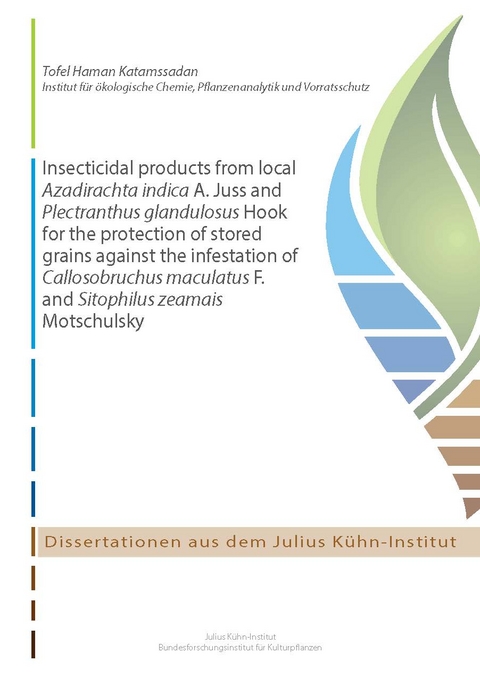
Insecticidal products from local Azadirachta indica A. Juss and Plectranthus glandulosus Hook for the protection of stored grains against the infestation of Callosobruchus maculatus F. and Sitophilus zeamais Motschulsky
Seiten
2016
Bundesforschungsinstitut für Kulturpflanzen (JKI) (Verlag)
978-3-95547-033-3 (ISBN)
Bundesforschungsinstitut für Kulturpflanzen (JKI) (Verlag)
978-3-95547-033-3 (ISBN)
Callosobruchus maculatus F. (Coleoptera: Chrysomelidae) and Sitophilus zeamais
Motschulsky (Coleoptera: Curculionidae) are very serious storage pests of cowpea and maize, respectively which cause serious losses to during storage. Chemical synthetic residual insecticides, which degrade the environment, are widely used for the control of these pests. Alternative control methods are required to minimize the hazardous effects of such insecticides. Botanical insecticides are more biodegradable and could be a source of more environmental-friendly insecticides. Accordingly, the effectiveness of oils from Azadirachta indica A. Juss seeds and pulverized leaves and seeds of this plant and that of Plectranthus glandulosus Hook as well as the binary mixtures of the botanical powders were tested against C. maculatus on cowpea seeds and S. zeamais on maize grains. The azadirachtin A contents of A. indica seed oils and powders from sun-dried kernels, shade-dried kernels, sun-dried seeds and shade-dried seeds, and the chemical composition of P. glandulosus powders from sun-dried and shade-dried leaves, were determined, before admixing each product with cowpea seeds or maize grains for the different insect bioassay studies. Adult toxicity bioassays involved the introduction of 20 C. maculatus to 50 g of treated cowpea and 20 S. zeamais to 50 g of treated maize in glass jars at 25ºC and 60% r.h. and also at varying temperatures and relative humidities, and then mortality counts were determined for up to 6 d (C. maculatus) or 14 d (S. zeamais). After the mortality counts, the grains were kept until all
the emerging F1 progeny were recorded. In separate experiments, cowpea seeds and maize grains were treated with the different botanicals and kept for storage intervals ranging from 1 to 180 d before infesting respectively with adult C. maculatus and S. zeamais, for mortality determination, similar to that of the toxicity bioassay. From the results, the average content of Azadirachtin A in the seed powder was 1.20 g/kg, and this was not influenced by sun-drying. On the contrary, the oil from the sun-dried seeds (2.89 g/kg) had a lower azadirachtin A content than that from the shade-dried seeds (3.69 g/kg). Sun-drying did not affect the diversity of volatile compounds in the leaves of P. glandulosus, as the same 50 compounds were found in the sun-dried and shade-dried leaves, although in different proportions. Generally, P. glandulosus powder caused greater mortality to C. maculatus and S. zeamais than A. indica seed powder, but the seed oil was more active towards both insects than the powders. Drying regime had no influence on the toxicity of the botanical powders and oil to both insects, with the recording of 100% mortality for the highest tested dose of each botanical 6 d (C. maculatus) or 14 d (S. zeamais) post-infestation. The A. indica products were more effective in suppressing progeny emergence in both insects than P. glandulosus leaf powders. No progeny emerged when the dose was ≥ 2 ml/kg for the seed oil and ≥ 10
g/kg for the seed powder. In line with progeny emergence, A. indica products completely
prevented grain damage by the two insect species when the dose was ≥ 2 ml/kg for the seed oil and ≥ 10 g/kg for the seed powder. Binary mixtures of the botanicals were antagonistic regarding toxicity to C. maculatus and S. zeamais. Azadirachtin A content of the seed oil did vary on treated cowpea up to 90 d and on treated maize up to 30 d, but the toxicity of the oil declined greatly after 15 days for C. maculatus and 60 days for S. zeamais. Whereas variations in temperature and humidity had no effect on the toxicity of A. indica seed oil to both insects, the efficacy of the powders from P. glandulosus leaves and A. indica seeds reduced with increasing relative humidity. Insecticidal products from sun- or shade-dried parts of A. indica and P. glandulosus could form a major component of the integrated storage protection package for cowpea and maize against beetle infestations.
Motschulsky (Coleoptera: Curculionidae) are very serious storage pests of cowpea and maize, respectively which cause serious losses to during storage. Chemical synthetic residual insecticides, which degrade the environment, are widely used for the control of these pests. Alternative control methods are required to minimize the hazardous effects of such insecticides. Botanical insecticides are more biodegradable and could be a source of more environmental-friendly insecticides. Accordingly, the effectiveness of oils from Azadirachta indica A. Juss seeds and pulverized leaves and seeds of this plant and that of Plectranthus glandulosus Hook as well as the binary mixtures of the botanical powders were tested against C. maculatus on cowpea seeds and S. zeamais on maize grains. The azadirachtin A contents of A. indica seed oils and powders from sun-dried kernels, shade-dried kernels, sun-dried seeds and shade-dried seeds, and the chemical composition of P. glandulosus powders from sun-dried and shade-dried leaves, were determined, before admixing each product with cowpea seeds or maize grains for the different insect bioassay studies. Adult toxicity bioassays involved the introduction of 20 C. maculatus to 50 g of treated cowpea and 20 S. zeamais to 50 g of treated maize in glass jars at 25ºC and 60% r.h. and also at varying temperatures and relative humidities, and then mortality counts were determined for up to 6 d (C. maculatus) or 14 d (S. zeamais). After the mortality counts, the grains were kept until all
the emerging F1 progeny were recorded. In separate experiments, cowpea seeds and maize grains were treated with the different botanicals and kept for storage intervals ranging from 1 to 180 d before infesting respectively with adult C. maculatus and S. zeamais, for mortality determination, similar to that of the toxicity bioassay. From the results, the average content of Azadirachtin A in the seed powder was 1.20 g/kg, and this was not influenced by sun-drying. On the contrary, the oil from the sun-dried seeds (2.89 g/kg) had a lower azadirachtin A content than that from the shade-dried seeds (3.69 g/kg). Sun-drying did not affect the diversity of volatile compounds in the leaves of P. glandulosus, as the same 50 compounds were found in the sun-dried and shade-dried leaves, although in different proportions. Generally, P. glandulosus powder caused greater mortality to C. maculatus and S. zeamais than A. indica seed powder, but the seed oil was more active towards both insects than the powders. Drying regime had no influence on the toxicity of the botanical powders and oil to both insects, with the recording of 100% mortality for the highest tested dose of each botanical 6 d (C. maculatus) or 14 d (S. zeamais) post-infestation. The A. indica products were more effective in suppressing progeny emergence in both insects than P. glandulosus leaf powders. No progeny emerged when the dose was ≥ 2 ml/kg for the seed oil and ≥ 10
g/kg for the seed powder. In line with progeny emergence, A. indica products completely
prevented grain damage by the two insect species when the dose was ≥ 2 ml/kg for the seed oil and ≥ 10 g/kg for the seed powder. Binary mixtures of the botanicals were antagonistic regarding toxicity to C. maculatus and S. zeamais. Azadirachtin A content of the seed oil did vary on treated cowpea up to 90 d and on treated maize up to 30 d, but the toxicity of the oil declined greatly after 15 days for C. maculatus and 60 days for S. zeamais. Whereas variations in temperature and humidity had no effect on the toxicity of A. indica seed oil to both insects, the efficacy of the powders from P. glandulosus leaves and A. indica seeds reduced with increasing relative humidity. Insecticidal products from sun- or shade-dried parts of A. indica and P. glandulosus could form a major component of the integrated storage protection package for cowpea and maize against beetle infestations.
| Erscheinungsdatum | 27.04.2016 |
|---|---|
| Reihe/Serie | Dissertationen aus dem Julius Kühn-Institut |
| Zusatzinfo | Tab., graph. Darst. |
| Sprache | englisch |
| Maße | 140 x 210 mm |
| Gewicht | 200 g |
| Einbandart | geklebt |
| Themenwelt | Naturwissenschaften |
| Technik | |
| Weitere Fachgebiete ► Land- / Forstwirtschaft / Fischerei | |
| Schlagworte | Azadirachta indica, Plectranthus glandulosus • Grain • Storage |
| ISBN-10 | 3-95547-033-4 / 3955470334 |
| ISBN-13 | 978-3-95547-033-3 / 9783955470333 |
| Zustand | Neuware |
| Informationen gemäß Produktsicherheitsverordnung (GPSR) | |
| Haben Sie eine Frage zum Produkt? |
Mehr entdecken
aus dem Bereich

aus dem Bereich
Buch | Hardcover (2023)
Haymarket Media (Verlag)
CHF 44,50
erfolgreich produzieren & selbst vermarkten
Buch | Hardcover (2023)
Stocker Verlag
CHF 34,95


