


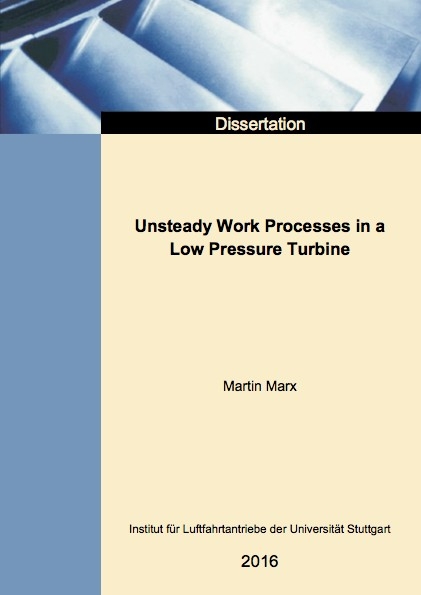
Unsteady Work Processes in a Low Pressure Turbine
Seiten
2016
Dr. Hut (Verlag)
978-3-8439-2573-0 (ISBN)
Dr. Hut (Verlag)
978-3-8439-2573-0 (ISBN)
- Keine Verlagsinformationen verfügbar
- Artikel merken
In this thesis, the unsteady turbine work and the underlying physical processes are analyzed. Methods are developed to validate and quantify the so-called wake differential work effect, an inviscid stator wake momentum recovery in subsequent turbine rotors due to unsteady work. If low-momentum wake fluid receives work through an unsteady, inviscid work mechanism, the momentum difference compared to the undisturbed free stream fluid is reduced, which offers a potential reduction in the overall mixing loss.
In a combined experimental and numerical approach, the static pressure field of a two-stage low-pressure turbine is analyzed in order to isolate and investigate local unsteady work regions, which are responsible for the differential work in upstream originated wakes.
Through a Lagrangian analysis, in which a large number of stator wake- and free stream particles are tracked through the subsequent turbine rotor, the existence of the wake differential work effect is verified on a statistically representative basis. With the Lagrangian method, on average a 14% elevated stagnation enthalpy of the stator wake fluid behind the first rotor is shown, which serves as a confirmation for the existence of the differential work effect.
A simplified, inviscid, one-dimensional model is created, which expresses unsteady work as an interaction of fluid particles with propagating static pressure waves. Through this model, the thermodynamic response of the fluid particles on a static pressure increase or decrease is described, in terms of estimating the kinetic energy and static enthalpy change due to the pressure wave.
In a final step, the developed pressure wave model is incorporated into a steady mixing sum, through which the influence of a differential work transfer between the two streams on the downstream mixing loss is approximated. It is concluded that a mixing loss reduction due to unsteady work effects is possible, but requires a work transfer region which is well-aligned in order to only transfer energy from the high-momentum free stream into the low-momentum wake. If this is not given, the unsteady work mechanism may act as significant loss source, instead.
The research presented here is based on the ATRD turbine, a full-scale engine- representative turbine rig preserving both Mach and Reynolds number similarity. The turbine is installed and tested at the Altitude Test Facility at Stuttgart University.
In a combined experimental and numerical approach, the static pressure field of a two-stage low-pressure turbine is analyzed in order to isolate and investigate local unsteady work regions, which are responsible for the differential work in upstream originated wakes.
Through a Lagrangian analysis, in which a large number of stator wake- and free stream particles are tracked through the subsequent turbine rotor, the existence of the wake differential work effect is verified on a statistically representative basis. With the Lagrangian method, on average a 14% elevated stagnation enthalpy of the stator wake fluid behind the first rotor is shown, which serves as a confirmation for the existence of the differential work effect.
A simplified, inviscid, one-dimensional model is created, which expresses unsteady work as an interaction of fluid particles with propagating static pressure waves. Through this model, the thermodynamic response of the fluid particles on a static pressure increase or decrease is described, in terms of estimating the kinetic energy and static enthalpy change due to the pressure wave.
In a final step, the developed pressure wave model is incorporated into a steady mixing sum, through which the influence of a differential work transfer between the two streams on the downstream mixing loss is approximated. It is concluded that a mixing loss reduction due to unsteady work effects is possible, but requires a work transfer region which is well-aligned in order to only transfer energy from the high-momentum free stream into the low-momentum wake. If this is not given, the unsteady work mechanism may act as significant loss source, instead.
The research presented here is based on the ATRD turbine, a full-scale engine- representative turbine rig preserving both Mach and Reynolds number similarity. The turbine is installed and tested at the Altitude Test Facility at Stuttgart University.
| Erscheinungsdatum | 15.04.2016 |
|---|---|
| Reihe/Serie | Luftfahrt |
| Verlagsort | München |
| Sprache | englisch |
| Maße | 148 x 210 mm |
| Gewicht | 231 g |
| Einbandart | Paperback |
| Themenwelt | Technik ► Luft- / Raumfahrttechnik |
| Schlagworte | Low Pressure Turbines • Unsteady Work Processes • wake differential work effect |
| ISBN-10 | 3-8439-2573-9 / 3843925739 |
| ISBN-13 | 978-3-8439-2573-0 / 9783843925730 |
| Zustand | Neuware |
| Informationen gemäß Produktsicherheitsverordnung (GPSR) | |
| Haben Sie eine Frage zum Produkt? |
Mehr entdecken
aus dem Bereich


aus dem Bereich
Prozessautomatisierung, Bioverfahrenstechnik, Advanced Process …
Buch | Softcover (2025)
De Gruyter Oldenbourg (Verlag)
CHF 76,90
Grundlagen, Mathematik, Kartenkunde, leistungsbasierte Navigation
Buch | Softcover (2022)
De Gruyter Oldenbourg (Verlag)
CHF 102,10
Learning-Based BI-Level Models and Algorithms
Buch | Softcover (2025)
De Gruyter (Verlag)
CHF 125,90


