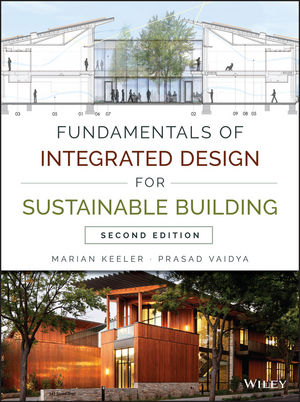
Fundamentals of Integrated Design for Sustainable Building (eBook)
John Wiley & Sons (Verlag)
978-1-118-88227-6 (ISBN)
Fundamentals of Integrated Design for Sustainable Building is the first textbook to merge principles, theory, and practice into an integrated workflow. This book introduces the technologies and processes of sustainable design and shows how to incorporate sustainable concepts at every design stage. This comprehensive primer takes an active learning approach that keeps students engaged.
This book dispenses essential information from practicing industry specialists to provide a comprehensive introduction to the future of design. This new second edition includes:
- Expansive knowledge-from history and philosophy to technology and practice
- Fully updated international codes, like the CAL code, and current legislations
- Up-to-date global practices, such as the tools used for Life-Cycle Assessment
- Thorough coverage of critical issues such as climate change, resiliency, health, and net zero energy building
- Extensive design problems, research exercise, study questions, team projects, and discussion questions that get students truly involved with the material
Sustainable design is a responsible, forward-thinking method for building the best structure possible in the most efficient way. Conventional resources are depleting and building professionals are thinking farther ahead. This means that sustainable design will eventually be the new standard and everyone in the field must be familiar with the concepts to stay relevant. Fundamentals of Integrated Design for Sustainable Building is the ideal primer, with complete coverage of the most up to date information.
MARIAN KEELER, ASSOCIATE AIA, LEED AP, is a San Francisco-based green building consultant, formerly with Simon & Associates, and a specialist on healthful building materials.
PRASAD VAIDYA, LEED AP, is a Professor and Area Chair for Building Energy Performance at CEPT University in India, and Director at zenerG, a San Francisco-based consultancy that specializes in projects, programs, and policies toward sustainable net-zero-energy solutions.
MARIAN KEELER, ASSOCIATE AIA, LEED AP, is a San Francisco-based green building consultant, formerly with Simon & Associates, and a specialist on healthful building materials. PRASAD VAIDYA, LEED AP, is a Professor and Area Chair for Building Energy Performance at CEPT University in India, and Director at zenerG, a San Francisco-based consultancy that specializes in projects, programs, and policies toward sustainable net-zero-energy solutions.
Contributors
Killer Banshee Studios (KBS) is an art, design, and research partnership founded by Kriss De Jong and Eliot Daughtry in 1996. The team focuses on the fields of media, technology and education, and often partners with non-profit organizations with a social conscience. Using their expertise in arcane and difficult research, they apply practical design to concepts, information, and visualization to create solutions to real problems for real projects. For more than 15 years, they have produced numerous projects, with related websites, books, and recordings, driven to make complex ideas easier to understand. Their projects range from groundbreaking online collaboration systems like Rocket Network for musicians, to iEngineer, a markup system for engineering document review. De Jong and Daughtry have created projects with support from the Andy Warhol Foundation, the National Endowment for the Arts, the NY State Council on the Arts, the NYC Dept of Cultural Affairs, the Clorox Foundation, and the Alameda County Arts Commission. Of the 469 images in this book, KBS researched, interpreted and created 139 illustrations and investigated the ownership, copyright terms and protections associated with the remaining 330 images.
Leon Alevantis, MS, PE, LEED AP, has recently retired from the California Department of Public Health (CDPH) where he held the position of senior mechanical engineer and sustainability manager for over ten years. During this time Leon led numerous cutting-edge sustainable projects for the facilities owned by CDPH making it one of the leading state agencies in implementing the Governor’s Executive Order for sustainable state buildings. Prior to this, Leon was the deputy chief of the Indoor Air Quality Section at the California Department of Health Services (later re-named CDPH) where he coordinated the state’s numerous pioneering efforts to conceive, specify, design, and implement indoor air quality and other sustainable measures in California state buildings. Leon was a key individual in the development and implementation of California Section 01350, an internationally recognized health-based specification for testing and selecting building materials. Among his research projects was the largest study of emissions from building materials with recycled content. Leon is an active committee member of the American Society of Heating, Refrigerating, and Air-Conditioning Engineers’s ASHRAE Standard 189.1 (“Standard for the Design of High-Performance Green Buildings”), a former member of numerous other ASHRAE committees and contributing author of ASHRAE’s IAQ Design Guide.
Kevin Conger, FASLA, is one of three founding partners of CMG Landscape Architecture, a San Francisco-based studio. Mr. Conger serves as President and CEO of CMG, directing many of the firm’s projects and developing a role in the Bay Area design community. His recent projects have included Better Market Street, the Yerba Buena Street Life Plan and redevelopment plans for Treasure Island, Hunters Point, and Concord Naval Weapons Station as well as universities and schools, parks, and urban infill residential development. Kevin was recently awarded a Seed Fund Fellowship for his design work and commitment to more vibrant, democratic space in San Francisco, and is a Fellow of the American Society of Landscape Architects.
Eva B. Craig studied sustainable design at Harvard University (Master of Architecture in Urban Design), and Rice University (Bachelor of Architecture). Her practice of architecture has evolved into healthful building consulting services. Her body of work consists of private residences and offices, including those of the Environmental Working Group, in the San Francisco Bay area. She specializes in issues facing families with children.
Abena Darden, LEED AP ND, is a building sustainability project director with Thornton Tomasetti. She has more than six years of experience in the green building industry providing LEED Online technical support, LEED documentation and project management. She provides sustainability consulting for large- and small-scale developments including master planning projects, and projects pursuing LEED for Neighborhood Development certification. Abena’s roles on these projects include developing sustainable master planning guidelines and technical LEED documentation and managing client relationships. She also consults on LEED for New Construction and Existing Buildings Operations & Maintenance projects, for a wide range of clients including non-profit and hospitality. Abena holds a bachelors in English from the University of Copenhagen and served as a Subject Matter Expert for the new LEED v4 Green Associate exam. Saneta deVuono-Powell, MCP, JD, is a planner and community health specialist at Raimi + Associates. She has over a decade of experience in qualitative research, community engagement and policy implementation; including participatory action research and health impact assessments. Saneta’s interest in urban planning grew out of her policy implementation work during her tenure as an attorney at the ACLU of Northern California and then later at Human Impact Partners. She received her Master’s in City and Regional Planning from UC Berkeley, with a focus on equity, health, and the environment. She recently moved back to the United States after completing a yearlong Fulbright program in Spain, where she researched the use public space and waterways in Granada and Barcelona.
Graham Grilli is a native Rhode Islander and an active environmentalist from an early age. After achieving a bachelor’s degree in environmental science and spending several years gaining on-site building experience, he is now pursuing a master’s of architecture degree at the Illinois Institute of Technology. Graham hopes that smart design and innovative thinking will soon revolutionize the way we live on this planet.
Jamie Phillips, ASLA, is a landscape architect and Senior Associate at Conger Moss Guillard Landscape Architecture with specific expertise in stormwater systems and the design of large-scale stormwater treatment projects that interconnect public open space, habitat, and natural systems. Her projects include Marin Country Day School and many other sustainable education environments, and redevelopment planning including the Treasure Island Master Plan and Stormwater Management Plan, and the Yerba Buena Island Habitat Management Plan.
Matt Raimi, AICP, LEED-AP, founded Raimi + Associates in 2006 and has almost 20 years of experience in planning across the country. He focuses on creating more livable and sustainable cities, and has spoken extensively on applying the principles of new urbanism to comprehensive plans, incorporating public health concerns into the planning process, and promoting sustainable development at the local level. He has directed the preparation of many General Plans, specific plans, and corridor plans in the Bay Area and throughout the State, with an emphasis on creating healthy and sustainable communities. Matt Raimi is the co-author of a seminal book on smart growth and the impact of sprawl titled Once There Were Greenfields: How Urban Sprawl Is Undermining America’s Environment, Economy and Social Fabric. He is also the author of several other publications, including Understanding the Relationship Between Public Health and the Built Environment (USGBC, 2006) and Five Years of Progress: 110 Communities Where ISTEA Is Making a Difference (STPP, 1996). Matt holds a master’s degree in regional planning from the University of North Carolina at Chapel Hill a BA from the University of Rochester, and is a an AICP-certified planner.
James Reinertsen, AIA, LEED AP BD+C and BO+M, GGP is a Project Manager with Sustainable Design Consulting LLC. He provides sustainable design process management for a range of building projects, including schools, university buildings, municipal facilities, and multi-unit residential buildings. He is experienced in many LEED Rating Systems (New Construction, Schools, Commercial Interiors, Existing Buildings Operations and Maintenance), in the Green Garage Certification Program, and in municipal and county sustainable design programs.
Rupal Sanghvi, MPH is the Founder and Director of HealthxDesign (pronounced Health by Design), which identifies the role of design—including the built environment— to improve health outcomes. Through an rigorous, cross-sector approach, HealthxDesign collaborates with leading design, planning, engineering, and architecture firms to leverage existing health and social science knowledge and assessment methodologies for optimizing the performance of design at the population-level. She is a Principal Investigator at the Public Health Institute, a Fellow at the Design Trust for Public Space, and part-time Faculty at Parsons, the New School for Design. Rupal is a consistent reviewer for the American Public Health Conference and has received the United States Secretary of Health’s Award for Innovations in Health Promotion and Disease Prevention. She earned her Master of Public Health in Environmental Health at the University of Michigan.
Jan D. Stensland, LEED AP BD+C and ID+C, is the founding principal of Inside Matters, which provides indoor environmental quality and sustainable design consulting, education, and research to corporations, government agencies, manufacturers, healthcare institutions, and universities. Her specialty area is healthy building and furnishing materials. As one of the original LEED Faculty she taught LEED...
| Erscheint lt. Verlag | 8.4.2016 |
|---|---|
| Sprache | englisch |
| Themenwelt | Technik ► Architektur |
| Schlagworte | Architecture • Architektur • Bauentwurf • Bill Burke • Building Design • CAL Green code • Eco-building • Environmental Design • Fundamentals of Integrated Design for Sustainable Building Second Edition • Green Building • green building practices • Green Design • green design codes • green design handbook • integrated building sustainable design • LEED design • LEED resources • Life-Cycle Assessment • Marian Keeler • net-zero energy building • sustainability legislation • Sustainable Architecture • sustainable building materials • sustainable building textbook • sustainable building theory • Sustainable design • sustainable design philosophy • sustainable design standards |
| ISBN-10 | 1-118-88227-X / 111888227X |
| ISBN-13 | 978-1-118-88227-6 / 9781118882276 |
| Informationen gemäß Produktsicherheitsverordnung (GPSR) | |
| Haben Sie eine Frage zum Produkt? |
 EPUB (Adobe DRM)
Kopierschutz: Adobe-DRM
Adobe-DRM ist ein Kopierschutz, der das eBook vor Mißbrauch schützen soll. Dabei wird das eBook bereits beim Download auf Ihre persönliche Adobe-ID autorisiert. Lesen können Sie das eBook dann nur auf den Geräten, welche ebenfalls auf Ihre Adobe-ID registriert sind.
Details zum Adobe-DRM
Dateiformat: EPUB (Electronic Publication)
EPUB ist ein offener Standard für eBooks und eignet sich besonders zur Darstellung von Belletristik und Sachbüchern. Der Fließtext wird dynamisch an die Display- und Schriftgröße angepasst. Auch für mobile Lesegeräte ist EPUB daher gut geeignet.
Systemvoraussetzungen:
PC/Mac: Mit einem PC oder Mac können Sie dieses eBook lesen. Sie benötigen eine
eReader: Dieses eBook kann mit (fast) allen eBook-Readern gelesen werden. Mit dem amazon-Kindle ist es aber nicht kompatibel.
Smartphone/Tablet: Egal ob Apple oder Android, dieses eBook können Sie lesen. Sie benötigen eine
Geräteliste und zusätzliche Hinweise
Buying eBooks from abroad
For tax law reasons we can sell eBooks just within Germany and Switzerland. Regrettably we cannot fulfill eBook-orders from other countries.
aus dem Bereich