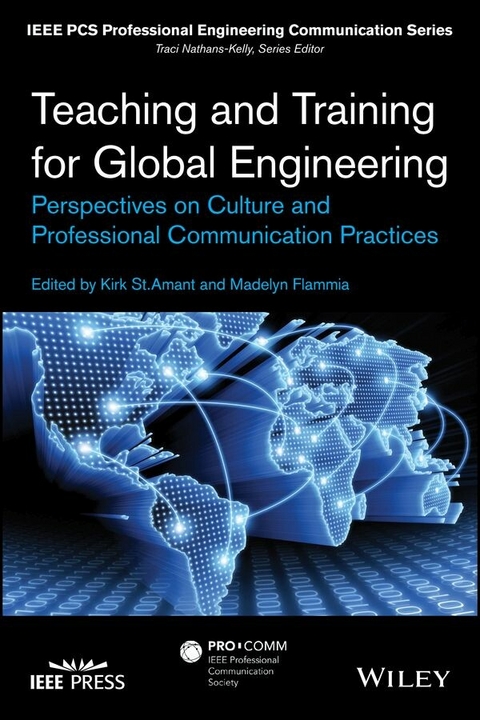
Teaching and Training for Global Engineering (eBook)
John Wiley & Sons (Verlag)
978-1-119-08428-0 (ISBN)

- An in-depth analysis of how cultural factors influence translation, document design, and visual communication
- A review of approaches for addressing the issue of international communication in a range of classes and training sessions
- A summary of strategies for engaging in effective e-learning in international contexts
- A synopsis of how to incorporate emerging media into international teaching and training practices
Kirk St.Amant is the Eunice C. Williamson Endowed Chair in Technical Communication at Louisiana Tech University, USA. Dr. St.Amant has previously worked on international projects for companies such as Metronic, VERITAS Software, The Braun Corporation, Unisys, Humanitarian Demining Information Center (HDIC), and the Consortium for the Enhancement of Ukrainian Management Education (CEUME). Madelyn Flammia is an Associate Professor at the University of Central Florida, USA, teaching graduate and undergraduate courses in Technical Communication. Dr. Flammia is the co-author of Intercultural Communication: A New Approach to International Relations and Global Challenges. She has published articles in IEEE Transactions on Professional Communication and the Journal of Technical Writing and Communication, and was the recipient of a 2014 NCTE Technical and Scientific Communication Award.
Foreword
One Person’s Perspective on Culture and Communication Practices
Why Are You Reading This Book?
You're reading this book, very likely, because you are an academic or a trainer, a student, or a practitioner who understands the importance of the global reach and interconnectedness of business. It's a cliché of sorts to say that the world is a global village. However, it would be hard to imagine a job today or in the foreseeable future in which our ability to communicate well with coworkers, managers, and our customers all over the world is not critical to our success and to the success of the companies for whom we work.
Why Is It Important to Consider Culture?
Experience is the best teacher. My experience in being exposed to and confused by the complexities of communication across cultures taught me that I needed to get educated so that I could become a better interpreter of the communication contexts in which I found myself. In sharing some of my stories, I hope to demonstrate the importance of considering, and learning about, cultures different from our own.
My first story comes from my early days as a professor of business and technical writing at an engineering-focused college. Seeking the opportunity to gain real-world experience with engineers, I accepted a short-term consulting job to work with Japanese engineers at a manufacturing facility in Georgia. These engineers were in training for management positions in Japan, and the first step in their training was to serve on a 2-year assignment in the United States. The plant manager was from the United States, as were most of the workers at the plant.
The focus of the work was to help the Japanese engineers converse more comfortably and fluently with their coworkers and managers from the United States on both technical/engineering topics as well as any other topics that might be useful. The opportunity to work with Japanese engineers was exciting; the location of the plant, however, was challenging in that it required a two-hour drive each way. Nonetheless, I enjoyed getting to know the Japanese engineers and seeing them progress rapidly in their English proficiency. However, when the plant manager asked me whether I would be interested in extending my contract for a longer period of time, I declined because I had underestimated the time commitment and the need to focus on my responsibilities as a new professor.
At the celebratory dinner held at a local Japanese restaurant at the completion of this phase of their training, I told the Japanese engineers that I would not be continuing because of the long commute and my busy schedule. The next day I got a call from the US plant manager, sharing with me the deep disgrace the Japanese engineers felt and their desire to know what they might have done to offend me.
I was flabbergasted. I thought I had been very gentle in explaining the reason I was not renewing my arrangement with the client, and I thought I had been very encouraging about how well they were doing with their conversational English at this point. Clearly, I had missed some important sub-text, some aspect of communication that was hidden below the surface but nonetheless noted by the Japanese engineers. They had lost face with me, as well as the plant manager who had hired me, and I had been the cause of it.
Fast forward a decade to my next major exposure to a culture that was “foreign” to me, this time in China. Here are a few typical examples of puzzling exchanges I encountered, from among many that I could name.
- Context: Waiting in an airport in Western China for the late arrival of the one flight to Beijing for that day. Clear blue sky above. No plane in sight.
- Me: To the ticket agent: “Why is the plane delayed?”
- Ticket agent to me: Looking up at the sky… pause… then responding to me: “Maybe bad weather?”
- Context: On a tour bus in rural China.
- Me: To the tour guide: “What kind of vegetables are those in the field?”
- Tour guide to me: Looking out at the field and then back at me… pause… “Chinese vegetables.”
In each of these exchanges, I knew something was happening that prompted these kinds of responses. I just didn't know what to call it or how to avoid such awkward situations in the future.
Later, after taking some seminars in Asian culture, I came to understood that it was, once again, face. When asked a question, the Chinese person with whom I was speaking wanted to answer with something rather than nothing. Not answering would disappoint the person who asked the question and embarrass the person who cannot answer, resulting in a loss of face on both sides of the communication.
Through experiences such as these, I began to appreciate how the many and nuanced aspects of cultural communication expectations can affect most—if not all—of the exchanges that take place between individuals.
How Can Teaching Provide Learning Opportunities?
I found myself in China as a result of being selected by my university as the first professor in a teaching exchange with a Beijing-based Chinese engineering university of similar size and scope. In preparation for my semester-long stay in China, I studied Mandarin for six months, the result being that I was minimally conversant in Pinyin, the language system of modern China, which translates Chinese characters into Latin script. However, I could not read Chinese characters.
Although I had begun my cultural education by reading several travel guides and Chinese histories, for an understanding of the deeper, more complex meaning of communication exchanges, I was often in the dark. As it turned out, I was as much a student of culture as a teacher of English. Here are two stories from my teaching encounters that provided excellent learning opportunities for me and can be used as examples of the need to learn about other cultures as much as possible before immersion in them.
The first story occurred at the beginning of the semester, and it involved middle school English teachers who had been handpicked from all over China to attend a specialized year-long course in English. Selection for this class was considered to be prestigious because it was taught by a Western, English-speaking teacher (i.e., me for the first semester and a colleague from my university for the second semester).
I started the first class meeting by describing the classroom style generally associated with Western teaching and learning, and I suggested that, to help conceptualize this idea, we (the students and I) should try to interact in the Western style I had just described. So, for instance, I instructed the students to remain seated when they addressed me (rather than stand when speaking, which was the expected practice of students in the Chinese school system). I noted, as well, that they should not all speak at once when I asked a question (another cultural norm in the Chinese classroom). Rather, I explained, I would use the Western teaching style/approach of calling on each student, one at a time, and I expected them to respond individually.
All went well until I called on someone who did not know the answer to the question I asked. When that student rose to respond, there was a brief moment of silence and then everyone in the room chimed in to answer the question for her. After I repeatedly witnessed this group response to a question posed to an individual, I came to understand that the students' support of a single member was motivated by the desire to save the face of the individual and maintain harmony in the group. Their cultural mores were too deeply engrained to change at a mere suggestion from me.
The second story occurred at the end of the semester, at the point at which I had graded the students' final exams and it became clear that one student would not pass the course. After I distributed the results of the final exam to the students, I was approached by several of her classmates, the best students in the class, who pleaded her case in asking that the failing student be given a passing grade. It was at that point I learned that, in Chinese culture, everyone has face. If one member of a group loses face, all members of the group to which that person belongs also lose face. Because the students who came to me had status (face) from their high grades in the course, they took on the responsibility to intervene on behalf of their fellow student who did not have enough face/status to make such a request. As I was engrained in my own culture's focus on individual achievement earned through individual effort, I did not allow myself to be persuaded to change the student's grade so that she could pass the course. The result was a loss of face for all involved—the students and the teacher. I often wonder whether I made the wrong decision. In hindsight, I feel that I did. And, not surprisingly, the failing student returned with her classmates in the second semester of the program.
Another story comes from teaching the Chinese graduate students, who were taking a different English class of mine in preparation for the national exam they would have to pass at the end of the year. For this course, the school's administrators provided me with a prescribed textbook, and I was expected to use it systematically.
One day, I decided to diverge from the dry set of exercises at the end of the chapter and instead offered the students an...
| Erscheint lt. Verlag | 25.3.2016 |
|---|---|
| Reihe/Serie | IEEE PCS Professional Engineering Communication Series |
| IEEE PCS Professional Engineering Communication Series | IEEE PCS Professional Engineering Communication Series |
| Sprache | englisch |
| Themenwelt | Naturwissenschaften |
| Sozialwissenschaften ► Kommunikation / Medien ► Kommunikationswissenschaft | |
| Sozialwissenschaften ► Politik / Verwaltung | |
| Sozialwissenschaften ► Soziologie | |
| Technik | |
| Schlagworte | becoming interculturally competent • Business & Management • Communication & Media Studies • Cultural Communication • engineering communication • Engineering Education • engineering linguistics • global engineering • global engineering teams • globalized engineering • global linux • glocal • IEEE books • ieee series • intercultural communication for engineers • intercultural communication for scientists • international engineering • Kommunikationswissenschaften • Kommunikation u. Medienforschung • Kulturelle Kommunikation • multilingual matters • Post-Globalization • professional communication in engineering • Training • Training & Human Resource Development / Communication Skills • Training u. Personalentwicklung / Kommunikationsfähigkeit • Training u. Personalentwicklung / Kommunikationsfähigkeit • Wirtschaft u. Management • working with global engineers • working with international engineers |
| ISBN-10 | 1-119-08428-8 / 1119084288 |
| ISBN-13 | 978-1-119-08428-0 / 9781119084280 |
| Informationen gemäß Produktsicherheitsverordnung (GPSR) | |
| Haben Sie eine Frage zum Produkt? |
 EPUB (Ohne DRM)
Digital Rights Management: ohne DRM
Dieses eBook enthält kein DRM oder Kopierschutz. Eine Weitergabe an Dritte ist jedoch rechtlich nicht zulässig, weil Sie beim Kauf nur die Rechte an der persönlichen Nutzung erwerben.
Dateiformat: EPUB (Electronic Publication)
EPUB ist ein offener Standard für eBooks und eignet sich besonders zur Darstellung von Belletristik und Sachbüchern. Der Fließtext wird dynamisch an die Display- und Schriftgröße angepasst. Auch für mobile Lesegeräte ist EPUB daher gut geeignet.
Systemvoraussetzungen:
PC/Mac: Mit einem PC oder Mac können Sie dieses eBook lesen. Sie benötigen dafür die kostenlose Software Adobe Digital Editions.
eReader: Dieses eBook kann mit (fast) allen eBook-Readern gelesen werden. Mit dem amazon-Kindle ist es aber nicht kompatibel.
Smartphone/Tablet: Egal ob Apple oder Android, dieses eBook können Sie lesen. Sie benötigen dafür eine kostenlose App.
Geräteliste und zusätzliche Hinweise
Buying eBooks from abroad
For tax law reasons we can sell eBooks just within Germany and Switzerland. Regrettably we cannot fulfill eBook-orders from other countries.
aus dem Bereich