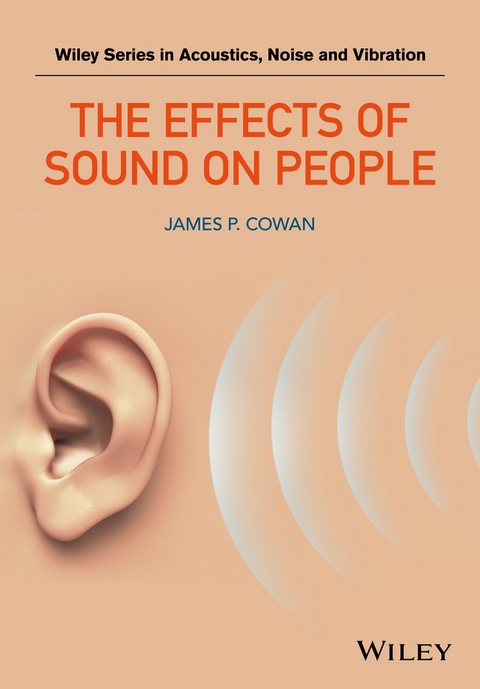
The Effects of Sound on People (eBook)
John Wiley & Sons (Verlag)
978-1-118-89567-2 (ISBN)
Provides a summary of current research results on the physiological and psychological effects of sound on people
- Covers how the operation of the hearing mechanism affects our reactions to sounds
- Includes research results from studies on noise sources of public concern such as transportation, public utility, and recreational sources, with emphasis on low frequency sound and infrasound
- Covers sounds that affect some but not others, how sounds can be controlled on a practical level, and how and what sounds are regulated
- Includes coverage of both positive and negative effects of sound
James P. Cowan is a board-certified noise control engineer with more than 30 years of experience in noise control, architectural acoustics, and environmental noise issues. He has consulted to public agencies, architects, engineers, industrial personnel, and attorneys in all areas of noise control; hearing damage and protection criteria; and acoustic design of all types of spaces. Mr. Cowan has lectured on acoustical topics to thousands of professionals, delivering live seminars and webinars, and teaching courses for universities, professional societies, and private organizations across the US for more than 25 years. In addition to several book chapters and many published articles, Mr. Cowan is the author of Architectural Acoustics Design Guide, published by McGraw-Hill in 2000, Architectural Acoustics, an interactive educational CD set published by McGraw-Hill in 1999, and Handbook of Environmental Acoustics, a reference book in community noise issues published by Van Nostrand Reinhold (subsequently Wiley) in 1994.
Provides a summary of current research results on the physiological and psychological effects of sound on people Covers how the operation of the hearing mechanism affects our reactions to sounds Includes research results from studies on noise sources of public concern such as transportation, public utility, and recreational sources, with emphasis on low frequency sound and infrasound Covers sounds that affect some but not others, how sounds can be controlled on a practical level, and how and what sounds are regulated Includes coverage of both positive and negative effects of sound
James P. Cowan is a board-certified noise control engineer with more than 30 years of experience in noise control, architectural acoustics, and environmental noise issues. He has consulted to public agencies, architects, engineers, industrial personnel, and attorneys in all areas of noise control; hearing damage and protection criteria; and acoustic design of all types of spaces. Mr. Cowan has lectured on acoustical topics to thousands of professionals, delivering live seminars and webinars, and teaching courses for universities, professional societies, and private organizations across the US for more than 25 years. In addition to several book chapters and many published articles, Mr. Cowan is the author of Architectural Acoustics Design Guide, published by McGraw-Hill in 2000, Architectural Acoustics, an interactive educational CD set published by McGraw-Hill in 1999, and Handbook of Environmental Acoustics, a reference book in community noise issues published by Van Nostrand Reinhold (subsequently Wiley) in 1994.
List of Figures
List of Tables
About the Author
Series Preface
Preface
Chapter 1 Acoustic parameters
1.1 Introduction
1.2 Sound generation
1.2.1 Frequency
1.2.2 Wavelength
1.3 Sound propagation
1.3.1 Unimpeded divergence
1.3.2 Impeded propagation
Reflection
Refraction
Diffraction
Diffusion
1.3.3 Sound behavior indoors
Echo
Room modes
Reverberation
1.3.4 Sound behavior outdoors
Atmospheric absorption
Atmospheric refraction
Ground effects
Vegetation effects
Chapter 2 Sound description
2.1 Introduction
2.2 The decibel scale
2.3 Frequency weighting networks
2.3.1 Loudness
2.3.2 Weighting scales
2.4 Frequency band analysis
2.4.1 Noise by color
2.5 Common sound descriptors
2.5.1 Environmental descriptors
2.5.2 Sound propagation in terms of sound levels
Divergence
Refraction and diffraction
Reverberation
Chapter 3 Sound perception
3.1 Introduction
3.2 Human hearing apparatus and mechanism
3.2.1 Outer ear
3.2.2 Middle ear
3.2.3 Inner ear
3.2.4 Signal processing in the brain
Localization
Masking and audibility
3.2.5 Vestibular system
3.3 Alternate sound perception mechanisms
3.3.1 Bone conduction
3.3.2 Cartilage hearing
3.3.3 Tinnitus
3.34 Electromagnetic hearing
3.4 Hypersensitivities
3.4.1 Hyperacusis/misophonia
3.4.2 Electrohypersensitivity
3.5 Low frequency and infrasound perception
Chapter 4 Physiological effects of sound exposure
4.1 Introduction
4.2 Body resonance and damage potential
4.3 Hearing loss
4.3.1 Presbycusis
4.3.2 Noise-induced hearing loss
4.3.3 Hearing loss from illness or agents
4.4 Cardiovascular disease
4.4.1 Hypertension
4.4.2 Ischaemic diseases
4.5 Vibroacoustic disease
4.6 Low frequency noise concerns
4.7 Infrasound concerns
Chapter 5 Psychological effects of sound exposure
5.1 Introduction
5.2 Annoyance
5.3 Stress
5.4 Sleep disturbance
5.5 Learning disabilities
5.5.1 Cognitive development/school performance
5.5.2 Office/occupational
5.6 Emotional effects
Chapter 6 Sound sources associated with negative effects
6.1 Introduction
6.2 Transportation sources
6.2.1 Roadway
6.2.2 Aircraft
Fixed wing
Rotary wing
6.2.3 Rail
6.3 Industry and utilities
6.3.1 Power plants
6.3.2 Wind farms
6.3.3 Electrical power systems
6.4 Personal/recreational sources
6.4.1 Firearms
6.4.2 Public performances
6.4.3 Toys/ personal listening devices
6.4.4 Appliances/tools
6.5 Hums
6.6 Acoustic weapons
Chapter 7 Positive effects of sound
7.1 Introduction
7.2 Music psychology
7.3 Sound therapies
7.4 Natural sources/soundscapes
7.5 Using sound to influence people
Chapter 8 Sound control and regulation
8.1 Introduction
8.2 Sound control fundamentals
8.2.1 Absorption
8.2.2 Transmission control
8.2.3 Partial barriers
8.2.4 Cancellation
8.2.5 Control at the source
8.2.6 Control in the path between the source and listener
8.2.7 Control at the listener
Acoustic privacy
8.3 Regulations and guidelines
8.3.1 Occupational
8.3.2 Environmental
National
Local
8.4 Current and future research
Glossary
Index
| Erscheint lt. Verlag | 22.3.2016 |
|---|---|
| Reihe/Serie | Wiley Series in Acoustics Noise and Vibration | Wiley Series in Acoustics Noise and Vibration |
| Sprache | englisch |
| Themenwelt | Technik ► Maschinenbau |
| Schlagworte | acoustic • Acoustic effects • Acoustic Physics • Control Process & Measurements • effect of sound • Energie • Energie u. Umweltaspekte • Energy • Energy & Environmental Impact • Hearing research • Human Hearing • infrasound effects • low frequency sound effects • Maschinenbau • mechanical engineering • Mess- u. Regeltechnik • negative effects of sound • noise control principles • noise effects • Noise sources • Physics • Physics of Acoustics • Physik • Physik des Schalls • positive effects of sound • Sound Control • sound effects • sound generation • Sound Perception |
| ISBN-10 | 1-118-89567-3 / 1118895673 |
| ISBN-13 | 978-1-118-89567-2 / 9781118895672 |
| Informationen gemäß Produktsicherheitsverordnung (GPSR) | |
| Haben Sie eine Frage zum Produkt? |
 PDF (Adobe DRM)
Kopierschutz: Adobe-DRM
Adobe-DRM ist ein Kopierschutz, der das eBook vor Mißbrauch schützen soll. Dabei wird das eBook bereits beim Download auf Ihre persönliche Adobe-ID autorisiert. Lesen können Sie das eBook dann nur auf den Geräten, welche ebenfalls auf Ihre Adobe-ID registriert sind.
Details zum Adobe-DRM
Dateiformat: PDF (Portable Document Format)
Mit einem festen Seitenlayout eignet sich die PDF besonders für Fachbücher mit Spalten, Tabellen und Abbildungen. Eine PDF kann auf fast allen Geräten angezeigt werden, ist aber für kleine Displays (Smartphone, eReader) nur eingeschränkt geeignet.
Systemvoraussetzungen:
PC/Mac: Mit einem PC oder Mac können Sie dieses eBook lesen. Sie benötigen eine
eReader: Dieses eBook kann mit (fast) allen eBook-Readern gelesen werden. Mit dem amazon-Kindle ist es aber nicht kompatibel.
Smartphone/Tablet: Egal ob Apple oder Android, dieses eBook können Sie lesen. Sie benötigen eine
Geräteliste und zusätzliche Hinweise
Buying eBooks from abroad
For tax law reasons we can sell eBooks just within Germany and Switzerland. Regrettably we cannot fulfill eBook-orders from other countries.
aus dem Bereich